
Opinion
Africa’s $90 Billion Debt Reckoning: A Stress Test, Not a Crisis
The looming debt repayment cycle is not a catastrophe. It is a long-overdue market correction – and for the discerning investor, it is precisely where the opportunity lies.

By Ajay Wasserman
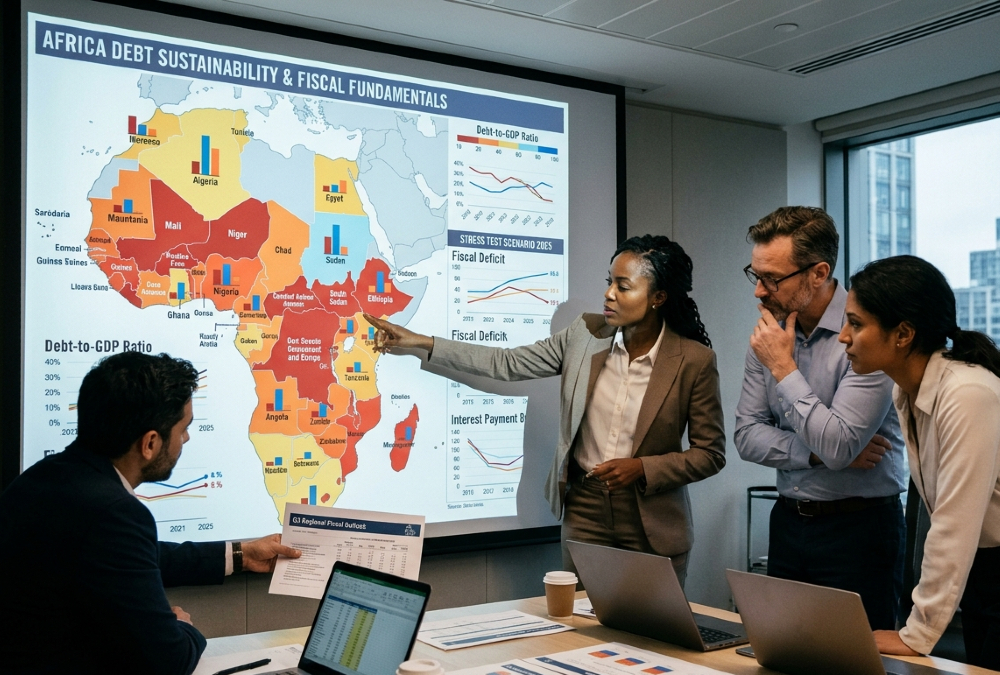
A single number is commanding attention across emerging-market trading desks and finance ministries alike: US$90 billion. That is the scale of sovereign debt repayments bearing down on African economies through 2026, and predictably, the financial press has reached for its most well-worn vocabulary – “debt wall,” “stress,” “default risk.”
That framing, while dramatic, fundamentally misreads the moment.
This is not a crisis. It is a correction – and there is an important difference.
The End of Cheap Capital’s Free Ride
For the better part of a decade, capital was cheap, abundant, and, frankly, undiscriminating. Sovereigns across the continent tapped international markets with relative ease, and in too many cases, without the fiscal architecture to justify the access.
That era is over. The zero-rate environment that permitted a certain casualness about debt sustainability has expired, and what remains is something considerably more clarifying: accountability.
The countries that used that window well – those that built credible fiscal frameworks, diversified their revenue bases, and maintained policy discipline through the cycle – will refinance. The terms will not be generous, but the access will be there. Capital has an instinct for institutional integrity.
The countries that did not will be priced accordingly. That is not a failure of the market. That is the market functioning as designed.
Granularity, at Last
What makes this repayment cycle genuinely significant is not its size, but what it is forcing investors to do: think carefully. For too long, “Africa” has functioned as a single trade – a monolithic risk category in which sovereign distinctions were routinely collapsed into a continental shorthand.
That approach was always analytically lazy. Now it is financially untenable.
The US$90 billion cycle is imposing a moment of hard clarity on three fundamental questions that should always have been asked:
First, balance sheet integrity: Which sovereigns genuinely managed their fiscal positions, and which merely masked structural weaknesses behind favorable commodity cycles or concessional financing?
Second, capital allocation: Where did borrowed money flow into productivity – infrastructure, human capital, export capacity – and where did it simply fuel consumption with no durable return?
Third, rate sensitivity: Which economies were building for a world of normalized interest rates, and which were entirely dependent on the accident of zero-cost capital?
These are not abstract questions. They are the precise variables that will determine which countries refinance at tighter spreads and emerge with enhanced credibility, and which face painful restructurings and the kind of forced policy reckoning that economists euphemistically call “adjustment.”
Dispersion Is the Real Story
The narrative that serious investors should be tracking is not contagion – it is dispersion. Some African sovereigns will exit this cycle stronger, with improved debt profiles and a demonstrated capacity to perform under pressure. Others will not.
The market is finally beginning to price that distinction with the granularity it deserves, stripping away the continental label and engaging with the actual fundamentals: the policy quality, the institutional depth, the revenue composition.
This is, in a very real sense, an overdue separation of signal from noise – of economies that built durable fiscal foundations from those that simply rode a favorable cycle and called it strategy.
What This Means for Investors
For the sophisticated investor, the temptation to treat this as a reason for caution is understandable but misguided. The correct response is not avoidance. It is precision.
The era of broad-based yield-chasing across the continent is over. What replaces it is something more demanding and considerably more rewarding: country-by-country underwriting, grounded in institutional assessment, policy evaluation, and balance-sheet analysis.
That is harder work. It is also where alpha lives.
When capital tightens, fundamentals stop being a talking point and become the only thing that actually matters. The investors who understand that distinction – who can separate Nairobi from Lusaka, Accra from Harare, on the merits of governance and fiscal architecture rather than geography – are not looking at a debt crisis.
They are looking at one of the more compelling sovereign investment opportunities in a generation.
This is not a reason to exit Africa. It is, finally, a reason to understand it.
Ajay Wasserman is the Group CEO and Chief Investment Officer of Fio Capital Group, a private family office and investment holding company based in Pretoria. Focused on empowering entrepreneurs and fostering sustainable growth, he believes the future success of global economies depends on the innovation and leadership of private entrepreneurs and businesses.
