
A Diaspora View of Africa
Africa Must Protect Its Resources

By Gregory Simpkins
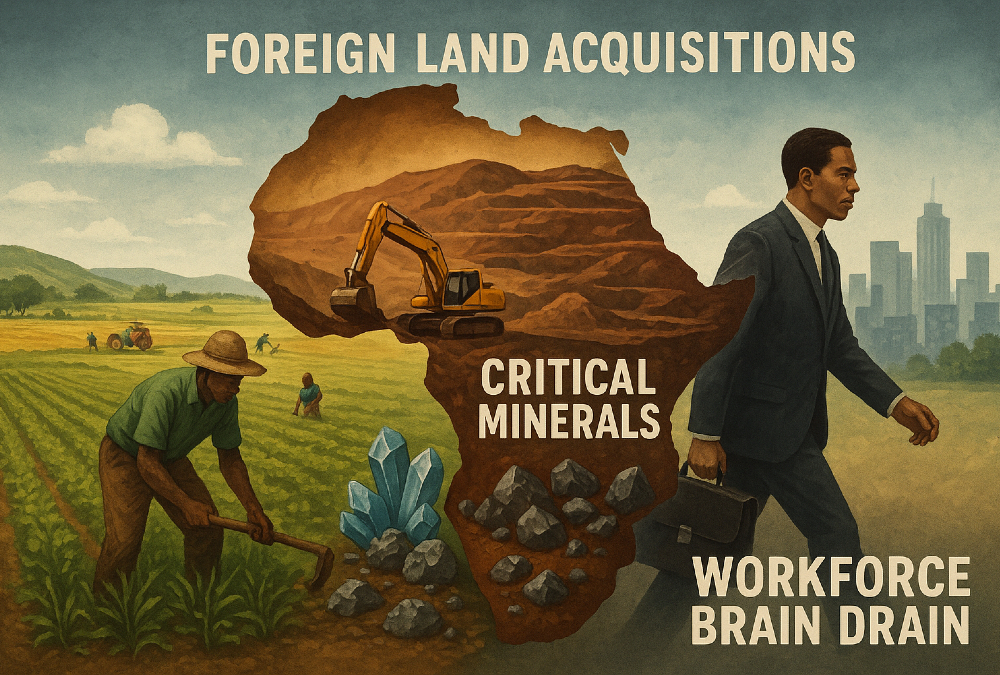
Africa is blessed with natural and human resources. The continent holds 60 percent of the world’s best solar resources, 60 percent of the world’s uncultivated arable land and 30 percent of global critical mineral reserves.
These resources are under threat from foreign interests.
The Threat of Foreign Land Acquisition
Foreign interests are threatening African agriculture and agricultural workers through large-scale land acquisitions, often referred to as “land grabs.” These deals involve wealthy governments, corporations and individuals acquiring vast tracts of land, often without adequately compensating or consulting local communities.
Some notable examples include:
The United Arab Emirates has acquired approximately 180,000 hectares of Sudanese farmland, displacing local farmers and exacerbating food insecurity. China has acquired millions of hectares of land in countries like the Democratic Republic of Congo (DR Congo) and Madagascar for agricultural production, raising concerns about environmental degradation and labor exploitation.
The Persian Gulf’s “Green Pakistan Initiative” has led to the acquisition of 2,000 hectares of land in Pakistan, with similar initiatives targeting African countries. These arrangements pose significant risks to African agriculture, including:
- Loss of land and livelihoods: Local farmers are often displaced without adequate compensation, threatening food security and cultural heritage.
- Environmental degradation: Large-scale agriculture can lead to deforestation, water pollution and soil degradation.
- Labor exploitation: Agricultural workers may face poor working conditions, low wages and limited rights.
To mitigate these risks, it is essential to promote transparent and inclusive land governance, ensuring that local communities are consulted and benefit from these arrangements.
The Global Dependence on African Minerals
Meanwhile, ongoing mineral discoveries notwithstanding, an estimated 97 percent of the world’s platinum is from Africa, as well as 90 percent of the cobalt, 80 percent of the chromium, 64 percent of the manganese, half the world’s gold reserves and as much as a third of all uranium. In recent years, the mineral coltan (columbite-tantalite), largely coming from Africa, has enabled the development of computers, cell phones and other electronic devices.
We would be hard-pressed to construct jet aircraft, automobile catalytic converters or tablets without the minerals found in Africa, and in some cases, almost nowhere else in the world.
More than a decade ago, the 3TG minerals (tin, tantalum, tungsten and gold) mined in conflict areas became a major topic of interest because of their multiple uses in modern society. Tin is used to coat other metals to prevent corrosion and create alloys.
Tantalum stores electricity and is used in alloys for its strength. Tungsten is used in tools, cell phones and in elevated temperature situations in addition to being used in alloys for its strength.
Gold, in addition to its intrinsic value in backing currencies and its use in jewelry, is malleable, not highly corrosive and highly conducive to electricity and heat.
Other strategic minerals, such as lithium and cobalt, have vital uses, for example in electric vehicle batteries or diagnostic machines.
Brain drain costs Africa approximately US$4 billion annually in lost human capital and productivity.
China’s Strategic Dominance in Processing
China, which has increasingly attempted to lock up much of the supply of strategic minerals from African countries, is now the leading processor of what are known as rare earth elements (REEs).
These are 17 chemical elements in the periodic table, which are used in various technological devices, such as superconductors, electronic polishers, refining catalysts and hybrid car components. They are nearly indistinguishable, silvery-white soft heavy metals used in electrical and electronic components, lasers, glass, magnetic materials and industrial processes.
They have become indispensable for renewable energy equipment. These elements are yttrium, lanthanum, praseodymium, scandium, cerium, dysprosium, terbium, promethium, neodymium, europium, thulium, lutetium, samarium, gadolinium, holmium, ytterbium and erbium.
As the world increases the use of electric cars, wind turbines and solar panels, we have seen a scramble to locate these minerals not now under the control of China, and we will see a surge in conflicts in Africa as illegal operators try to cash in on the boom in rare earth minerals.
China has become the dominant player in Africa’s critical mineral sector, leveraging its Belt and Road Initiative (BRI) to secure access to key resources. With 77 percent of Africa’s resources exported in a raw material state, China is winning big, accounting for 23 percent of its total investment stock in Africa in the mining sector.
Through the BRI, China finances and builds infrastructure in exchange for preferential access to natural resources. China secures long-term supplies of critical minerals, such as the Sicomines project in the DR Congo.
China leads in refining 19 out of 20 strategic minerals, with an average market share of 70 percent.
However, concerns arise about Africa’s limited benefits from its natural resources, as most minerals are exported unprocessed, and the continent lacks value-added processing capabilities.
With a new Scramble for Africa underway, sparked by the desire for developed countries to overcome China’s stranglehold on critical minerals required for the 21st century technological economies, African countries now have the opportunity to require new entrants such as the United States, the European Union, the United Kingdom, Germany and others to process more of these minerals in their countries, creating jobs and allowing for expertise and wealth to be accumulated, and success in this effort will influence China to do the same.
Here is where effective leadership on the continent is so critical in protecting these resources and the benefits that should accrue to its people.
The Cost of Brain Drain on Human Capital
Speaking of Africa’s people, the continent’s workforce and consumer base face significant challenges due to brain drain, with thousands of skilled professionals leaving the continent annually. The African Union Development Agency – New Partnership for African Development (AUDA-NEPAD) estimates that about 70,000 skilled professionals emigrate from Africa each year, resulting in a loss of approximately US$2 billion per annum.
This brain drain affects critical sectors like healthcare, education, and technology, with countries like leading Nigeria, Ghana and South Africa experiencing significant losses, but Eritrea, Somalia and Sudan are among the top countries experiencing brain drain.
Africa loses about 30,000 doctors and 60,000 nurses annually, with Nigeria’s doctor-to-patient ratio for example standing at 1:5,000, far below the WHO’s recommended 1:600. The brain drain hinders Africa’s digital transformation, with many tech professionals seeking opportunities abroad.
Brain drain costs Africa approximately US$4 billion annually in lost human capital and productivity.
To address this issue, African governments are implementing strategies to improve salaries, working conditions, and career growth opportunities. Some countries, like Rwanda and Ghana, have introduced initiatives to attract skilled professionals back home.
The push and pull factors powering Africa’s brain drain are complex and multifaceted.
Push Factors:
- Limited Job Opportunities: Many African countries struggle to create sufficient employment opportunities, leading to a surplus of skilled workers seeking opportunities abroad.
- Low Salaries and Poor Working Conditions: Low pay, inadequate infrastructure and limited career growth prospects drive professionals to seek better opportunities elsewhere.
- Political Instability and Corruption: Unstable political environments, corruption and insecurity push skilled individuals to seek safer and more stable environments.
- Lack of Resources and Infrastructure: Inadequate funding, outdated equipment and limited access to resources hinder professionals’ ability to excel in their fields.
Pull Factors:
- Better Job Opportunities and Career Growth: Developed countries offer attractive job prospects, career advancement opportunities and higher salaries.
- Access to Advanced Education and Training: World-class universities and research institutions attract African students and professionals seeking to enhance their skills.
- Improved Living Standards and Quality of Life: Better healthcare, education and overall quality of life are significant pull factors.
- Globalization and Networking Opportunities: Professionals are drawn to global networks, collaborations and exposure to international best practices.
To address this issue, African governments are implementing strategies to improve salaries, working conditions and career growth opportunities. Some countries, like Rwanda and Ghana, have introduced initiatives to attract skilled professionals back home.
While it is true that African countries were set back in their progress by the colonial powers, it is now decades after independence, and in spite of ongoing neocolonial control still wielded by colonial powers, it is vital that African leaders work together to cast off the relations with foreign governments and economic interests that benefit only a few at the cost of the vast number of their people.
It will not be an easy transition, but it is a required one – the sooner the better before detrimental long-term agreements are put in place.
Gregory Simpkins, a longtime specialist in African policy development, is the Principal of 21st Century Solutions. He consults with organizations on African policy issues generally, especially in relating to the U.S. Government. He further acts as a consultant to the African Merchants Association, where he advises the Association in its efforts to stimulate an increase in trade between several hundred African Diaspora small and medium enterprises and their African partners.
