
Editorial
D.R. Congo: President-elect Tshisekedi’s poverty eradication manifesto
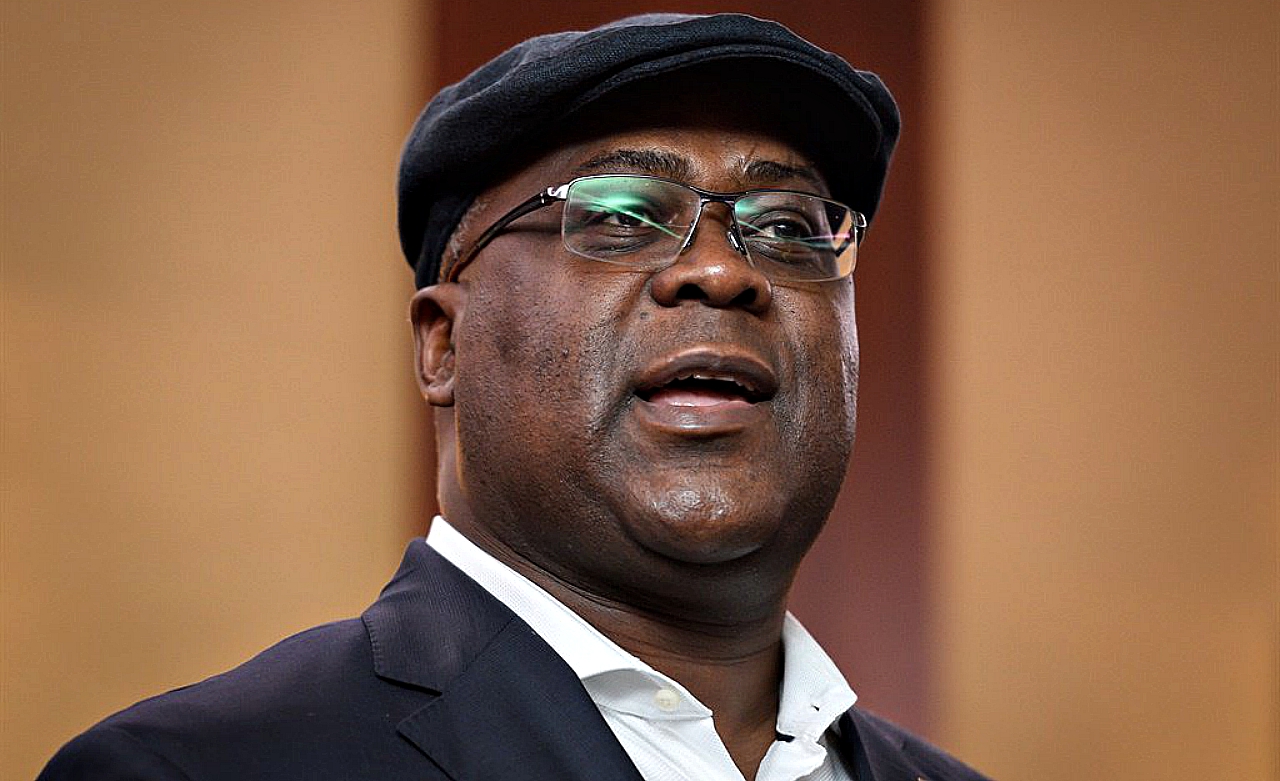
Felix Tshilombo Tshisekedi: A brief profile
It is true; I don’t have experience in bad governance, or in pillaging my country… But I have experience in respecting human rights and civil liberties.
– Felix Tshilombo Tshisekedi | Circa 2018
During a recent visit to the United States, an interviewer asked Felix Tshilombo Tshisekedi if he had the tenacity and overall capacity to fit into the enormous shoes of his father, Dr. Etienne Tshisekedi. Etienne Tshisekedi only passed away in February 2017, and certain sadness flashed across Felix’s face. Then he gave the interviewer what may be a revealing response: Speaking in his impeccable French, he said: “I do not have any ambition to rival my late father: he is my master, and you don’t rival the master.” Felix Tshilombo Tshisekedi might as well have said something about finishing the journey his revered father started. Tshisekedi has become the first democratically elected leader of the Democratic Republic of Congo (D.R. Congo).
At 55, President-elect Tshisekedi is also the president, Union for Democracy & Social Progress (UDPS), the D.R. Congo’s largest and oldest political party. He also leads Rally for Change, a broad coalition of political parties and civil society organizations.
On September 19, 2018, Tshisekedi or ‘Fatshi’ as his popularly known was amongst the 21 Congolese that had entered the race to replace Joseph Kabila as president of the D.R. Congo. Today, alongside a majority coalition of political leaders and their supporters, Tshisekedi has achieved so much is so little time.
Aged 19 when his father started the UDPS in 1982, Fatshi cut his political teeth at the grassroots level; he has over 30 years of political experience. Since taking over the
party in April 2018, Tshisekedi has demonstrated strong leadership; diplomatic skill; effective political acumen; flexibility to negotiate, and an excellent grasp of the global political space.
On the journey to the presidency, he became the party’s chief diplomat; a position that allowed him to influence and be influenced by some of the world’s most effective
Heads of States and Government. In his search to find solutions for the D.R. Congo and Africa’s Great Lakes region, he led opposition delegations to negotiations with the
Kabila Regime, and is credited with the Accord de la Saint Sylvestre which allowed the country to avoid the sort of chaos analysts anticipated when President Kabila refused to step down after his second and last term.
A graduate in Financial Management from the Solvay Brussels School of Economics and Management, Fatshi is the 3rd of his father’s 6 sons. He was elected as a Member of the Parliament in the 2011 elections, and was twice offered the Prime Minister position, but declined because the Kabila Regime is marred by corruption. He chose, instead, to focus his political fight on changing the entire Congolese political economy through free and fair elections.
President-elect Tshisekedi was born in Kinshasa on June 13, 1963 to Marthe and Étienne Tshisekedi. He is of Luba ethnicity, and was under house arrest in the central Kasaï province up until 1985.
An ideal strategic partnership with the U.S.
In 2019, our country, the Democratic Republic of Congo will, no doubt, emerge as one of Africa’s consequential nations. Aside from the palpable atmosphere the D.R. Congo is undergoing this January, millions of Congolese have had their say as to who will govern their country going forward. Essentially, it is up to us as leaders to secure a place amongst the world’s body of democracies.
Looking forward, as leader of the D.R. Congo’s largest and oldest political party, a Tshisekedi Administration would, no doubt, remain an important strategic U.S. ally in areas such as Great Lakes Region security, and an indispensable economic hub & regional commercial anchor. To this, my running mate, Vital Kamarhe and I pledge to embark on a robust peace and security program throughout the country.
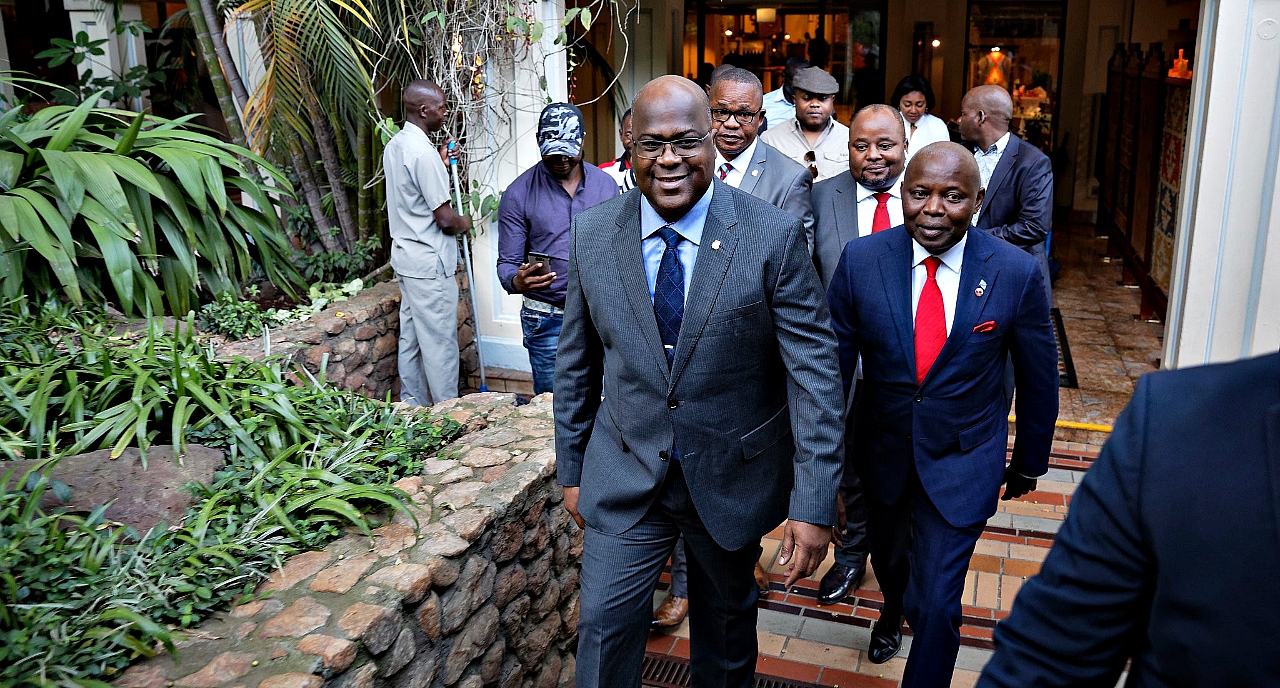
Democratic Republic of Congo’s President-elect Felix Tshisekedi, (l) with hist running mate Vital Kamerhe (r). PHOTO/Ben Curtis/AP
Thus, in this document, we are keen to call for support from the world body of nations to institutionalize the D.R. Congo’s democracy, and the rule of law. This is also a specific request for the United States to stand with the Congolese people in strengthening the private sector and instituting an aggressive anti-corruption campaign.
Additionally, my colleagues and I are keen on support from the Trump Administration in the following aspects:
Promoting regional peace, security, and a culture of democracy; Designing an overarching private sector framework between the 2 nations as a component of economic and security policy.
Amongst our priorities is that the United States, Africa and the international community must certify that the historical presidential election is as free and as fair as possible under the current circumstances. To achieve a true and accurate result, every one of the country’s 84,000 polling stations must receive validation. Short of this, we hope that the United States and other western nations will impose severe sanctions on individuals, groups, or parties engaged in election rigging.
Additionally, it would be fair to request that de jure recognition only go to a presidential-elect chosen by Congolese in a free and fair electoral process. This is the only way to restore the trust of the people in elected government.
After years of suffering at the hand of bad governance, marauding security forces, and ill-funded public entities, choosing their next president is, indeed, the last act of a desperate Congolese populace.
Invariably, a key ally like the U.S. has an immeasurable capacity to stand beside millions of Congolese as they determine their future. Specifically, the U.S. should expect that the election result is free of intimidation, ballot tampering, and other actions that undermine an opportunity for the Congolese to freely determine their future.
A 10-POINT PROGRAM
A Tshisekedi Administration seated in Kinshasa and in the 26 provinces intends to achieve the following in the first 100 days:
1. Create a level Playing Field for U.S. Investors vis-à-vis China. With a pledge to revive the D.R. Congo’s investment policy, the Tshisekedi Administration intends to assure a level playing field for investors of all nationalities, including those from the United States. The policy seeks to review Chinese investments; ensuring that these are aimed at the more immediate and longer-term interests of the Congolese people; sans favoritism;
2. In tandem with (1) above, develop legislation to mandate that all investors abide by multinational rules on investment. In this case, Tshisekedi hopes to leverage the U.S. Anti-Corrupt Practices Act to stave bribes and other corrupt acts to gain access to lucrative contracts and concessions. This would effectively ensure that the benefits of foreign direct investment (FDI) flow to the Congolese people;
3. The Tshisekedi Administration will partner with both public and private sector entities in the U.S. to maximize exports to the D.R. Congo, especially where products are price competitive;
4. Work with U.S. and UN Special Representative for the Great Lakes Region to appoint senior officials to liaise with both parties to achieve peace and security in the Great Lake region;
5. The Tshisekedi Administration hopes to liaise with the U.S. Ambassador to the UN in promote areas of common interest, and seek to avoid the 2017 scenario where the D. R. Congo voted with the U.S. only 19 percent of the time;
6. The Tshisekedi Administration expects to undertake a robust review of USAID’s US$500 million program. Here, Tshisekedi intends to wean his naturally endowed nation off the American taxpayer with funds from budgetary reform and from eliminating wasteful and corrupt expenditure. There will also be vigorous tax collection;
7. The Tshisekedi Administration pledges to work with U.S. agencies to protect the Congo rain forest and its biodiversity.
8. The Tshisekedi Administration shall augment global relief efforts by infusing Congolese resources into the fight against Ebola;
9. The Tshisekedi Administration will set up a credible electoral body, review legislation; assure better future elections;
10. Given the strategic location of the D.R. Congo, the Tshisekedi Administration intends to actively promote integration through multiple memberships in bodies like the Common Market for Eastern and Southern Africa (COMESA), the Southern African Development Community (SADC), and the ongoing implementation of the Tripartite Free Trade Area (TFTA), and African Continental Free Trade Area (AfCFTA).
A solemn pledge
As one that intends to serve as the next leader of our nation, it gives me pleasure to share my hopes, dreams, and an overall enthusiasm for a truly Democratic Republic of Congo.
With the presidential election, our country, the D.R. Congo, could embark on new beginning based on democratic change of government. This change of government will not only put an end to repetitive crises of legitimacy; it will mark a turning point for one of Africa’s most consequential nations. And for me, it will be another opportunity to engage with the millions of Congolese.
If I were asked to illustrate the situation our nation is in today, I would say the D.R. Congo is like a plane trying to land in stormy weather. We are all anxious; wondering what the immediate future holds; unsure of whether we shall ever land and so become a functional democracy. Our concerns are legitimate: to ride out the storm in the air, or yearn to land, so we can turn over a new leaf. In simple terms, ours is a nation in crisis – one that must come to a democratic end over the next few days. We must not let our nation and our people continue down an unsustainable illegitimate path.
A VISION FOR OUR NATION
In the first place, our beautiful country must become a nation free of poverty. I have always sought to ensure the wellbeing of my fellow Congolese, and I am greatly inspired by the Union for Democracy & Social Progress’ (UDPS) poverty eradication social program. In the same vein, because our nation is part of the global collective of nations under the United Nations, our party strongly believes that international security and lasting peace are only possible when everyone’s social, economic and human security needs are met. That’s why we endorsed the Millennium Development Goals (MDGs), and have faith in the wisdom & efficacy of all 17 Sustainable Development Goals (SDGs).
While it is obvious that the Kabila regime has failed to chart a sustainable path forward for our people – they have turned the beautiful promise of the D. R. Congo into an on-going nightmare – my people-focused program will end the nightmare and once again, make our dream a reality. My plan is ambitious but well-within reach. Based on the SDGs,
poverty eradication will be our nation’s Great National Cause; our rallying call to mobilize public and private sector resources towards a common goal.
Our Poverty Eradication program rests on 3 pillars:
– The Congolese people as an engine of development;
– Economic growth to generate jobs and protect the environment;
– Working collectively for societal cohesion in the D. R. Congo.
With over 80 million Congolese, our development plan projects an annual average growth of up to 25 percent. This growth should sustainably ensure job creation, adequate environmental protection, and the eradication of poverty, even though the population continues to grow by an average 3 percent per annum. As you may be aware, the average annual income of an able-bodied Congolese in 2018 was less than US$458 per annum or US$1.25 per day, while the share of the national budget in gross domestic product (GDP) is only US$5 billion. My plan sees annual income growing to US$4,288 a year, or at least US$11.75 a day. Together, we shall pay for this program by mobilizing budget packages with annual increases of 25 percent of nominal GDP, with an eventual record sum of US$86.71 billion over the 10-year period.
While these may seem like a large resources, my belief is that all progress is only worthwhile when it is shared by the people. Essentially, a well-designed and equitable income redistribution policy lies at the heart of our poverty eradication program. With a central tenet to promote an efficient and caring society, we are also conscious that just as one cannot redistribute what has not already been earned, the privileged few should not enjoy most of the national income. Having a more equitable share should make a bigger dent in poverty eradication.
While our nation continues to rank as one of the world’s worst examples of income inequality, our best days are still ahead. We shall find our way out of this, and other humiliating statistics. We shall soon join the other emerging and developing nations. We will soon leave this legacy of illegitimacy behind, achieving all those things our forefathers dreamed and hoped for.
To my fellow Congolese and to the world community, this is my solemn pledge to you. I am accountable to you; on my honor and conscience.
A society with promise
In 2018, our nation celebrated its 58th anniversary as an independent nation. Yet for this half-a-century, some have even suggested that ours is a society in decline. I disagree: Although our people have suffered for far too long; from not being able to legitimately determine who their leaders are, we can no longer tolerate those that act outside their mandates – placing all of us in mortal danger – and sentencing us to a future where our children inherit a society in marked decline.
We Congolese are a hopeful people. We will not lower our expectations because we often escape war, only to emerge in a plundered nation.
It is not acceptable for people in the Center; West, North and South to go hungry; refugees within their own borders; uneducated, unemployed; under-paid and enduring the worst diseases known to man.
– Envisage a nation without corruption, without blurred categories, without repression; instead, a truly Democratic Congo; with governance and rule of law;
– Envisage a future date when life throughout our cities and our countryside is peaceful;
– Envisage our borders being made more secure by the dissuasive presence of a professional army and a D.R. Congo where precious life is protected by a Republican Police force within a free and fair Justice System;
– Envisage a nation where one is not awoken to the nauseating filth of uncollected garbage, but to the promise of children with access to clean water, milk, classrooms and teachers using didactic material;
– Envisage technical colleges and various institutes of higher learning offering world-class education via information technology, libraries and equipment;
– Foresee a slum-free Kinshasa thriving Congolese neighborhoods like Mpasa in Nsele; Mokali in Kimbaseke; Kongo in Ngaliema, or Kauka in Kalamu. Neighborhoods
where life is not = insecurity, poverty, disease; squalor;
– Imagine ‘Cité Salongo’-type cities, built to last, with available and affordable rental property for everyone; where homes have water & electricity;
– We foresee mothers being able to take children to health facilities stocked with everything they need; going to work in markets where good hygiene is followed;
– We intend for a civil society composed of actual tradesmen, and not politicians in disguise;
– We can only imagine a productive nation; supervisors and all kinds of executives; craftsmen, lawyers, teachers, doctors, engineers, and our precious youth resources; sportsmen and musicians earning a livelihood based on their God-given talent;
– Imagine a professionalized civil service, where the government works towards a much better society, and to improve the lives of the citizenry, without the ‘mbudi‘ salary scale;
– Imagine a business climate that allows us to emerge from our cloud of gloom; becoming more transparent, free from corruption, from harassment and from extrajudicial uncertainty;
– Imagine a nation that seeks legitimate institutional investors – both local and foreign companies that infuse their resources throughout our rich and beautiful land.
Proposed reforms
AN INTRODUCTION
At this juncture, our nation has an opportunity to be further inserted into global supply chains and distribution networks. Seminally, our nation is a viable investment
destination. We know what resources lie in our rich earth; we know that millions of jobs could be created overnight in all corners of our territorial borders – well-paying middle-class jobs.
We can attract all those millions of Congolese living across the world; bring millions of local, regional and global tourists to marvel at and enjoy our unique fauna and lush flora.
We can harness our cobalt, coltan, oil and timber to benefit both our people and companies like Tesla and Toyota; Apple, Samsung, Nokia, and Huawei.
While this would be an arduous task, we can achieve it in 10 years. The goals of this ambitious program will be evaluated democratically at the mid-point, in an election
cycle that occurs every 5 years.
As a project of hope and productivity, my program calls on all Congolese to come together to build a more beautiful Congo, a country of peace, stability and prosperity
for our people, for the rest of Africa, and for the world. We have come a long way, and we are aware that to achieve the high ambitions that we have for our country, proactive reforms will be necessary.
These reforms will first and foremost have to be applied generally in our country, as well as in the activities of the State. As a precondition for recovery, the D. R. Congo must become a modern state, that is to stay, a normal country.
Reforms are needed in key sectors which will contribute to achieving the goals of this Program. My program is ambitious. We seek to eradicate poverty. This is our Great National Cause.
Once the country becomes, as a result of reforms which we voluntarily undertake, a modern state, in other words, a normal state, we will need our strategy to be based on 3 key pillars to overcome the scourge of poverty:
– The individual person
– Economic growth
– National solidarity
THE DETAILS
– Budgets based on a realistic poverty eradication macroeconomic framework;
– A fiscal policy that limits public deficit levels and reduces increase of public debt.
– Transparency in management of public resources and reassuring investors, we will modernize and streamline all existing codes. Such regulations govern public procurement, organization of labor, insurance markets, taxes, customs, petroleum, mining and forestry.
– We will rigorously manage public finances by focusing on quality public spending, fighting inflation, and stabilizing both prices and exchange rates.
– We will again take control of our domestic market, reducing the significant dependence of our economy on outward forces, which makes it more vulnerable to disruptions of all kinds.
– We will proceed with revitalizing financial governance and the review of performance contracts.
– We will improve tax control mechanisms, and the fight against corruption and fraud.
– We will re-examine State Portfolio reform laws, which will lead to the creation of a mixed financial holding company, whose mission will be to manage revenues from certain protected areas, including cobalt, coltan, oil and forests.
– We will restructure and reorganize the Central Bank to re-capitalize and end its chronic deficit.
– We will put in place a “Strategic Plan of Economic Development Poles” to revive and diversify our economy.
– We will radically re-examine the role of banking, credit and the savings sector as a strategic instrument for financing the economy.
– Our policies will promote trade, crafts, small and medium enterprises (SMEs) as well as small and medium industries (SMIs). To do this, we will employ appropriate mechanisms such as public credit facilities and grants, tax incentives, crowd funding, vocational training and apprenticeships so as to promote production and exports.
