
News
West African Leaders Vow to Wage a War on Boko Haram
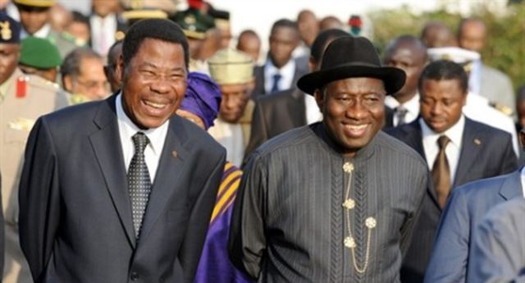
West African leaders on Saturday agreed to work together to wage “total war” on Boko Haram. The leaders said the Nigerian Islamist group had become a regional al Qaeda that threatened all of them. Nigeria’s neighbors Chad, Cameroon, Niger and Benin, and Western officials, met in Paris to flesh out a plan enabling them for the first time to share intelligence, coordinate action and monitor borders.
Although Boko Haram has been fighting for five years, carrying out bombings and attacks on civilians and the security forces, the kidnapping last month of more than 200 girls from a school in the northeast has focused world attention on them. “Boko Haram is no longer a local terrorist group, it is operating clearly as an al Qaeda operation, it is an al Qaeda of West Africa,” Nigerian President Goodluck Jonathan told a news conference in Paris following the meeting.
He said, “We have shown our commitment for a regional approach. Without West African countries coming together we will not be able to crush these terrorists.” So far there has been great outrage over the mass abduction has prompted Nigerian President Goodluck Jonathan, criticized at home and abroad for his government’s slow response, to accept U.S., British and French intelligence help in the hunt for the girls.
British Foreign Minister William Hague, speaking before the start of a meeting, said the Nigerian military was not organized in a way to deal effectively with the group, and offered military advisers to help structure them. “There is determination to tackle this situation head on … to launch a war, a total war on Boko Haram,” Chad’s President Idriss Deby said.
The countries agreed to launch coordinated patrols and rescue operations, share intelligence, put in place a mechanism to prevent weapons’ smuggling and monitor borders. Intelligence services and army heads would also meet soon to come up with a region-wide strategy to fight terrorism.
Spreading Instability
With 6,000 French troops operating in either Mali to the northwest or the Central African Republic to the east, Paris has an interest in preventing a deterioration in Nigeria’s security. Like its Western allies, Paris has ruled out any military operation saying it was primarily for Nigeria to take the lead, although Hollande said Rafale fighter jets based in the Chadian capital N’Djamena , just 60 km from the Nigerian border, would be used for reconnaissance missions.
Paris fears Boko Haram could spread north into the Sahel and beyond Cameroon into the Central African Republic. Boko oHaram has already targeted French interests in Nigeria, kidnapping a French family in northern Cameroon last year. Suspected Boko Haram rebels also attacked a Chinese work site in northern Cameroon on Friday, killing at least one Cameroonian soldier, and at least 10 people are believed to have been kidnapped, the regional governor said.
According to Cameroon President, Paul Biya, “We have affirmed our solidarity and determination to vigorously fight Boko Haram.” He continued, “They have committed one more attack, attacked businessmen and this comes after the French hostages were kidnapped. As we speak we are searching for an Italian priest and a Canadian nun. The problem has become regional, if not a Western problem.”
