
Opinion
Rising Fast, Growing Unevenly: IMF’s 2026 Outlook Hints at Fragile Boom
The IMF’s latest forecasts show Sub-Saharan Africa outrunning the world. The gap between its best and worst performers is the more important story.

By Mark-Anthony Johnson
For years, “Africa rising” was a slogan in search of evidence. This October, the International Monetary Fund supplied some. In its latest World Economic Outlook, the Fund projects that Sub-Saharan Africa will grow by 4.5 percent in 2026, comfortably ahead of the global average of 3.1 percent. At a time when much of the world frets over sluggish demand, tight credit and geopolitical shocks, a region long written off as an afterthought is expanding at nearly one and a half times the pace of the global economy.
That is worth celebrating. It is also worth reading carefully, because the headline number conceals a continent of very different fortunes.
A Leaderboard Shaped by Base Effects
Start at the top. South Sudan leads the continent at 10.5 percent, which looks spectacular until one notes that it follows growth of 41.4 percent in 2025. Rates of expansion that extreme usually say less about economic dynamism than about recovery from a very low base, and they rarely repeat. Ethiopia, at 9.2 percent, and Rwanda, at 7.4 percent, offer a sturdier kind of momentum. Both have spent years investing in infrastructure and building institutions that can absorb capital.
East Africa as a whole deserves credit. Uganda is projected to grow by 6.2 percent and Tanzania by 6.0 percent, both outpacing Kenya, whose growth eases marginally to 4.5 percent, exactly the Sub-Saharan average. The region’s mix of large domestic markets, improving connectivity and diversifying exports is paying off, though Kenya’s relative slowdown is a reminder that even the neighborhood’s pacesetters are not immune to tighter financial conditions.
West Africa tells a similar story of breadth. Guinea leads at 7.2 percent, followed by Benin and Niger at 7.0 percent each. Nigeria, the region’s giant, accelerates to 4.2 percent. Ghana slows to 5.7 percent but remains well above the continental average. Nigeria’s pickup matters more than its modest size suggests: as Africa’s most populous country, its trajectory pulls the regional average up or down more than that of any neighbor.
Volatility is the Rule, not the Exception
North Africa illustrates how quickly fortunes can turn. Sudan tops the group at 7.0 percent, followed by Egypt at 5.1 percent. Libya, meanwhile, faces the sharpest slowdown in the region, from 15.9 percent in 2025 to 3.3 percent in 2026. Swings of that magnitude point to economies dependent on a narrow set of drivers, most likely commodity output, rather than the diversified base that produces steady, compounding gains.
Southern Africa is the most sobering corner. Zambia accelerates to 5.6 percent and Botswana rebounds from a 0.7 percent contraction to 4.4 percent growth, both encouraging. But South Africa, the region’s most industrialized economy, is projected to grow by just 1.0 percent, among the slowest on the continent. Mozambique and Seychelles are also forecast at 1.0 percent. At the very bottom, Equatorial Guinea is expected to contract by 1.7 percent, while São Tomé and Príncipe manages only 0.4 percent.
The spread between a 10.5 percent sprint and a 1.7 percent contraction is not a rounding error. It is the central fact of African economics: there is no single “Africa” to be bullish or bearish about.
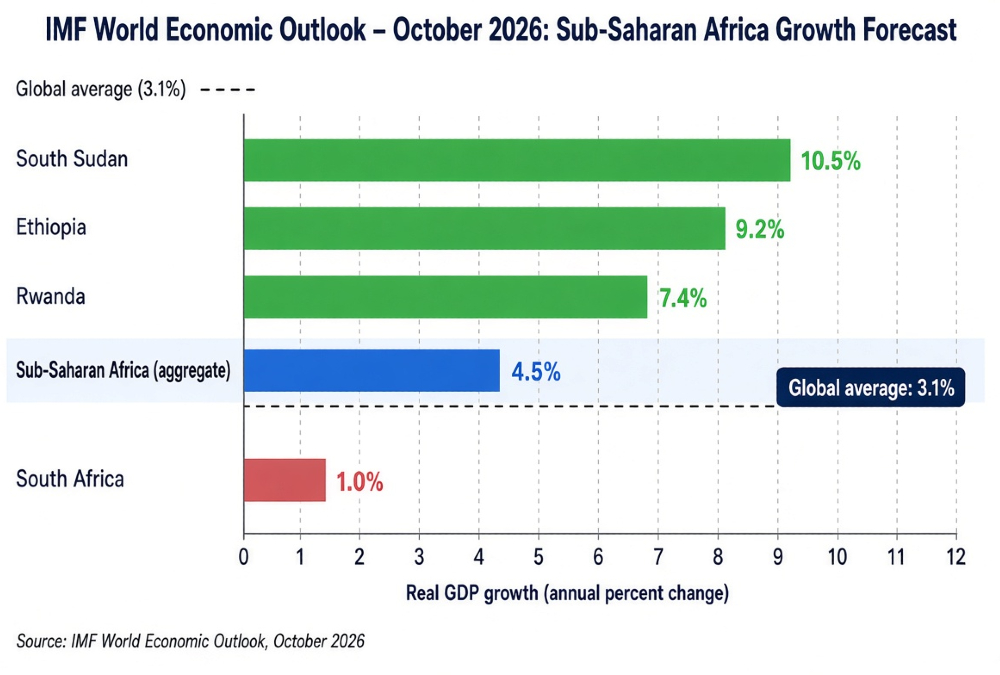
Bar chart comparing IMF 2026 growth forecasts for African economies, led by South Sudan and Ethiopia
What is Working, and What is Not
The IMF’s explanation is instructive. It credits stronger policy frameworks and structural reforms for supporting growth in parts of the continent, a quiet endorsement of the unglamorous work of central bank credibility, fiscal discipline and regulatory improvement. These are choices, not accidents of geography, and that is what makes the good news durable where it appears.
The Fund also identifies what holds other economies back: elevated energy prices, geopolitical disruptions, tighter financing conditions and external vulnerabilities. Fuel-importing countries bear the brunt. They pay more for the energy that powers their factories and farms, borrow at higher rates to cover the difference, and have little cushion when external shocks arrive. For exporters, the same conditions can be a windfall, which helps explain why the continent’s growth map looks so uneven.
The Policy Lesson
Three conclusions follow for governments, investors and development partners.
First, reform pays, but only if it is sustained. The economies growing fastest without relying on a one-off rebound tend to be those that have invested steadily in stability and institutions. Policymakers tempted to treat reform as a box to tick for lenders should note the difference.
Second, dependence is a vulnerability. Whether the exposure is to a single commodity, to imported fuel or to volatile external finance, the countries at the bottom of the table share a lack of buffers. Diversifying energy sources, broadening export bases and deepening domestic capital markets are slow projects, but they are the best insurance against the next shock.
Third, investors should resist the temptation to price the continent as a bloc. A region that includes both Ethiopia and South Africa, Rwanda and Equatorial Guinea, cannot be summarized by an average. The opportunities are real, but they are country-specific, and so are the risks.
A Better Story Than a Slogan
Sub-Saharan Africa’s outperformance of the global economy is genuine and deserves recognition. But the lesson of the IMF’s October forecasts is not that Africa has arrived. It is that Africa is diverging, with reformers pulling ahead and the exposed falling behind. The slogan “Africa rising” was always too simple. The more interesting, and more useful, story is which parts of the continent are rising, why, and whether the rest can follow.
Mark-Anthony Johnson is the founder and CEO of JIC Holdings, a global asset and investment management firm founded in 2009. With over 30 years of experience and strong ties to Africa, his investments span mining, infrastructure, power, shipping, commodities, agriculture, and fisheries. He is currently focused on developing farms across Africa, aiming to position the continent as the world’s breadbasket.
