
Life
Nelson Mandela: His 8 Lessons of Leadership
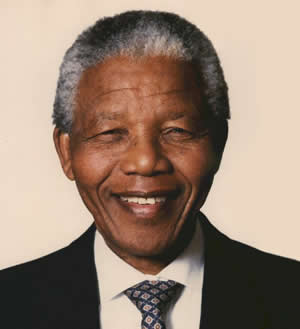
By Richard Stengel
Courage is not the absence of fear — it’s inspiring others to move beyond it
In 1994, during the presidential-election campaign, Mandela got on a tiny propeller plane to fly down to the killing fields of Natal and give a speech to his Zulu supporters. I agreed to meet him at the airport, where we would continue our work after his speech. When the plane was 20 minutes from landing, one of its engines failed. Some on the plane began to panic. The only thing that calmed them was looking at Mandela, who quietly read his newspaper as if he were a commuter on his morning train to the office. The airport prepared for an emergency landing, and the pilot managed to land the plane safely. When Mandela and I got in the backseat of his bulletproof BMW that would take us to the rally, he turned to me and said, “Man, I was terrified up there!”
Mandela was often afraid during his time underground, during the Rivonia trial that led to his imprisonment, during his time on Robben Island. “Of course I was afraid!” he would tell me later. It would have been irrational, he suggested, not to be. “I can’t pretend that I’m brave and that I can beat the whole world.” But as a leader, you cannot let people know. “You must put up a front.”
And that’s precisely what he learned to do: pretend and, through the act of appearing fearless, inspire others. It was a pantomime Mandela perfected on Robben Island, where there was much to fear. Prisoners who were with him said watching Mandela walk across the courtyard, upright and proud, was enough to keep them going for days. He knew that he was a model for others, and that gave him the strength to triumph over his own fear.
Lead from the front — but don’t leave your base behind
Mandela is cagey. in 1985 he was operated on for an enlarged prostate. When he was returned to prison, he was separated from his colleagues and friends for the first time in 21 years. They protested. But as his longtime friend Ahmed Kathrada recalls, he said to them, “Wait a minute, chaps. Some good may come of this.”
The good that came of it was that Mandela on his own launched negotiations with the apartheid government. This was anathema to the African National Congress (ANC). After decades of saying “prisoners cannot negotiate” and after advocating an armed struggle that would bring the government to its knees, he decided that the time was right to begin to talk to his oppressors.
When he initiated his negotiations with the government in 1985, there were many who thought he had lost it. “We thought he was selling out,” says Cyril Ramaphosa, then the powerful and fiery leader of the National Union of Mineworkers. “I went to see him to tell him, What are you doing? It was an unbelievable initiative. He took a massive risk.”
Mandela launched a campaign to persuade the ANC that his was the correct course. His reputation was on the line. He went to each of his comrades in prison, Kathrada remembers, and explained what he was doing. Slowly and deliberately, he brought them along. “You take your support base along with you,” says Ramaphosa, who was secretary-general of the ANC and is now a business mogul. “Once you arrive at the beachhead, then you allow the people to move on. He’s not a bubble-gum leader — chew it now and throw it away.”
For Mandela, refusing to negotiate was about tactics, not principles. Throughout his life, he has always made that distinction. His unwavering principle — the overthrow of apartheid and the achievement of one man, one vote — was immutable, but almost anything that helped him get to that goal he regarded as a tactic. He is the most pragmatic of idealists.
“He’s a historical man,” says Ramaphosa. “He was thinking way ahead of us. He has posterity in mind: How will they view what we’ve done?” Prison gave him the ability to take the long view. It had to; there was no other view possible. He was thinking in terms of not days and weeks but decades. He knew history was on his side, that the result was inevitable; it was just a question of how soon and how it would be achieved. “Things will be better in the long run,” he sometimes said. He always played for the long run.
