
Opinion
GDP per Capita, Not Size, Is the True Guide to Africa’s Economic Promise
Why GDP per capita, not headline GDP, reveals where Africa’s real investment opportunities lie.

By Naomi Mutuku
When investors talk about Africa’s wealth, the conversation almost always starts with the size of a country’s economy. Nigeria has Africa’s biggest GDP. South Africa runs one of the continent’s most industrialized economies. Kenya anchors East Africa. These headline figures are impressive, and they shape how capital gets allocated across the continent.
But headline GDP is a blunt instrument. It measures scale, not substance. The more revealing number – the one serious investors should be watching – is GDP per capita: a country’s total output divided by its population. It strips away the noise of population size and gets to the heart of the matter: how much economic value is actually being created per person.
The distinction matters more in Africa than almost anywhere else in the world, because the gap between the continent’s largest economies and its most productive ones is enormous.
Big Economy, Modest Wealth
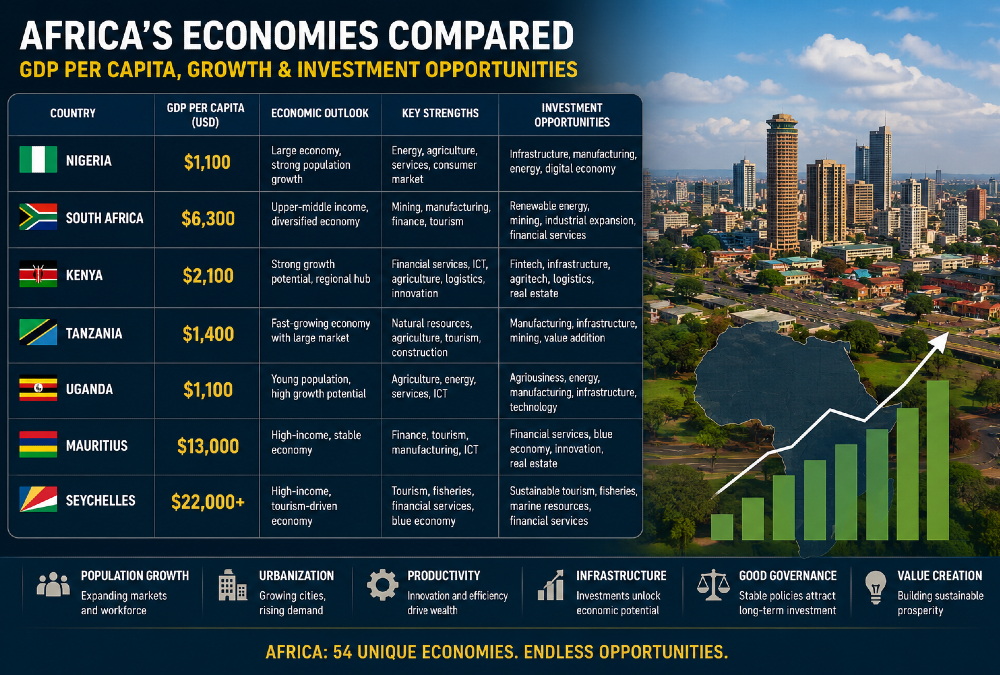
Nigeria is the clearest illustration of the mismatch. With more than 230 million people, it boasts one of Africa’s largest economies by total output. Yet its GDP per capita sits at roughly US$1,100 – a figure that places average economic productivity well behind economies a fraction of Nigeria’s size. Scale, in other words, has not translated into prosperity.
Tanzania tells a similar story. With a population exceeding 70 million and a reputation as one of Africa’s fastest-growing economies, it should be a standout on any investor’s radar. But its GDP per capita hovers around US$1,400, a number that points less to failure than to untapped potential: substantial room for growth through industrialization and value-added production.
Uganda, home to one of the youngest populations on earth, sits in comparable territory, with GDP per capita near US$1,100. The country’s demographic dividend is real, but converting it into wealth will depend on sustained investment in agribusiness, energy, manufacturing, and infrastructure over the coming decades.
Where Productivity Outpaces Size
Contrast those figures with South Africa, whose GDP per capita of roughly US$6,300 makes it one of Africa’s most productive major economies. That productivity is not accidental. It is the product of diversified industry, an established manufacturing base, a mature mining sector, and financial markets sophisticated enough to rival those in many developed economies.
Kenya, East Africa’s largest economy, posts a GDP per capita of about US$2,100 – modest in absolute terms, but built on genuine strengths in financial services, information technology, agriculture, and logistics that continue to draw regional investment and improve productivity year over year.
Then there are the outliers that make the strongest case of all for looking beyond economic size. Seychelles, with a GDP per capita above US$22,000, and Mauritius, at around US$13,000, rank among the wealthiest economies in Africa on a per-person basis. Neither is a large economy by continental standards. Both prove that strong institutions, high-value industries, and sound economic management can matter far more than population or total output.
The Lesson for Investors
The pattern across these countries points to a simple but often overlooked truth: economic size creates opportunity, but productivity creates wealth.
For investors, GDP per capita is a useful proxy for several things that matter directly to returns:
- Purchasing power. Higher per-capita output generally signals a population with more disposable income and stronger consumer demand.
- Labor productivity. It reflects how efficiently an economy converts labor and capital into output.
- Value creation per person. It captures wealth generation in a way total GDP simply cannot.
- Market maturity. Economies with higher GDP per capita tend to have more developed consumer markets and infrastructure to support them.
None of this means GDP per capita should be treated as a stand-alone metric. It shouldn’t be. The smartest investment decisions weigh it alongside market size, population growth, urbanization trends, infrastructure quality, the regulatory environment, and sector-specific dynamics. A country with modest GDP per capita but a large, rapidly urbanizing population and improving infrastructure – Nigeria and Tanzania both fit this description – can still represent a compelling long-term opportunity, provided the fundamentals are heading in the right direction.
Fifty-Four Economies, Fifty-Four Stories
It is worth remembering that Africa is not a single market. It is 54 distinct economies, each with its own strengths, constraints, and trajectory. Treating the continent as a monolith – or judging its opportunities purely by the size of its biggest economies – means missing where the real value is being created.
The next major investment opportunity in Africa may not emerge from the continent’s largest economy. It is far more likely to come from the country generating the most value per person, while still holding significant room to grow. Understanding the difference between economic scale and economic productivity isn’t just an academic distinction – it is the foundation of a sound African investment strategy.
Naomi Mutuku is a trade and investment expert specializing in helping global companies enter Kenya and broader African markets. She focuses on reducing risk, accelerating market entry, and fostering sustainable growth. Based in Nairobi, Naomi is a regular commentator on Africa’s dynamic business landscape and is passionate about the continent’s growth potential. She can be reached via email at: [email protected]
