
A Diaspora View of Africa
East Africa Moving Toward Conflict

By Gregory Simpkins
When Abiy Ahmed Ali, Prime Minister of the Federal Democratic Republic of Ethiopia, received the 2019 Nobel Peace Prize “for his efforts to achieve peace and international cooperation, and in particular for his decisive initiative to resolve the border conflict with neighboring Eritrea”, it seemed a new day of peace was dawning in the East Africa region. Unfortunately, conflict had not left the Horn of Africa nor the greater East Africa region for long.
The Tigray War: Origins and Devastating Toll
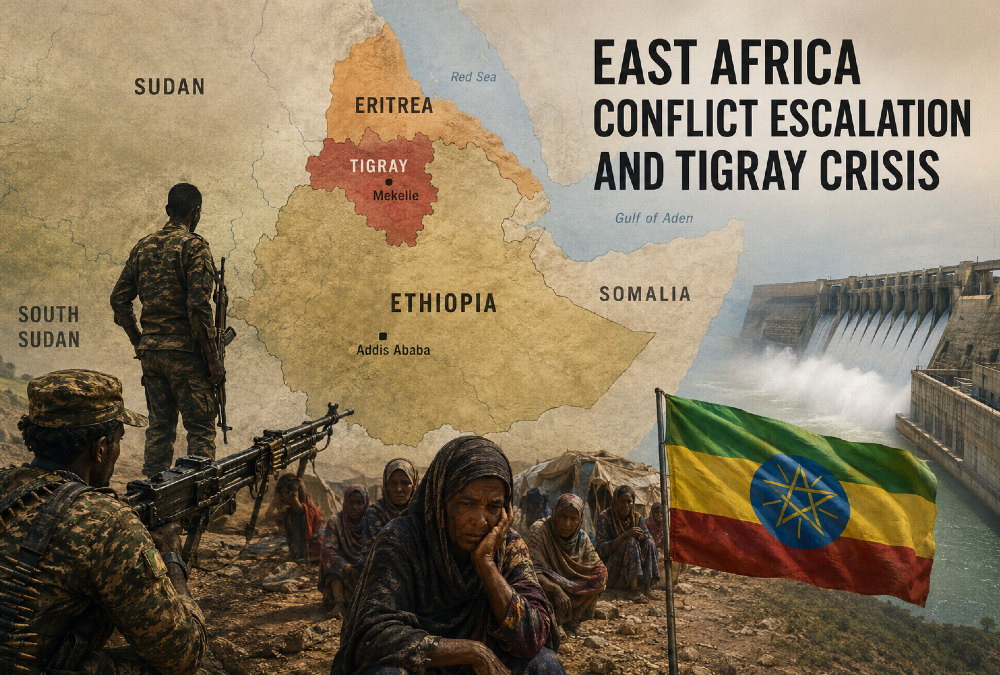
Tensions between the federal government and the Tigray People’s Liberation Front (TPLF) had been building for years. The TPLF dominated Ethiopian politics from 1991-2018.
After Abiy came to power in 2018, the TPLF refused to join his new Prosperity Party, and relations deteriorated. Tigray held regional elections in September 2020 despite the federal government postponing them due to COVID-19. Addis Ababa declared the Tigray government illegal.
The resulting Tigray War – one of the deadliest wars of the 21st century – was a major armed conflict in northern Ethiopia that began in November 2020 and supposedly ended in November 2022. It began when the TPLF attacked federal military bases in Tigray.
Hours later, Abiy ordered a military offensive into the Tigray region.
The main participants in the conflict that eventually spread beyond Tigray were the Ethiopian National Defense Force (ENDF), the Eritrean Defense Forces (EDF), Amhara Special Forces, Fano militias, other Amhara militias, Afar regional forces, the TPLF, Tigray special forces (defected ENDF soldiers), local militias and the Oromo Liberation Army (OLA). International involvement included drones from the United Arab Emirates (UAE), Turkey and Iran reportedly supporting the ENDF.
The United Nations, the African Union and the United States were involved diplomatically.
By the time the conflict supposedly ended with the Pretoria Agreement on November 2 2022, 600,000 people were estimated to have died. One study suggest 300,000-500,000 civilians as well as about 100,000 combatants had died.
It is considered the deadliest conflict worldwide since 1989. Approximately 5.2 million people needed humanitarian aid. Widespread famine conditions, sexual violence used as a weapon of war and massacres were reported by all sides.
Fragile Peace: Renewed Tensions and the Risk of Regional Escalation
If hostilities finally ended there, it would have been catastrophic enough, but apparently, the embers of conflict have been reignited and threaten to spread beyond Ethiopia. According to the Global Conflict Tracker, tensions in Ethiopia’s Tigray region have escalated significantly, threatening to reignite conflict between Ethiopia and Eritrea and destabilize the Horn of Africa.
The TPLF is embroiled in a power struggle with the Tigray Interim Administration (TIA), appointed by Abiy in 2023 as part of the Pretoria Agreement that ended the civil war. This internal division has led to violent clashes, with TPLF-aligned forces seizing control of key areas in Tigray.
Eritrea is reportedly supporting these dissident factions of the TPLF, potentially undermining Ethiopia’s ambitions for sea access. The situation is further exacerbated by the incomplete implementation of the Pretoria Agreement, including the Tigray Defense Forces’ disarmament and the continued presence of Eritrean troops in Ethiopia.
These developments have raised fears of a potential war between Ethiopia and Eritrea, which could have far-reaching consequences for regional stability and humanitarian conditions.
Gettachew Rada, writing in the May issue of Horn Review states that bravado, aggressive warlike rhetoric, a fear of peace and self-aggrandizing claims to be the sole arbiter of Tigray’s future have become defining traits of the rump TPLF. A once-venerated political organization, the TPLF now projects insecurity through unsettling belligerence, as though confrontation were the organization’s sole language, according to Rada.
Having failed to adapt to the demands of postwar recovery, pluralistic politics and democratic governance, the TPLF leadership remains trapped in the habits of militarized politics and an unsettling sense of entitlement – fatal flaws that continue to exact a steep price from the people of Tigray.
Recent remarks by Adisalem Balema, a member of the TPLF Central Committee, are a case in point, Rada states. In a recorded audio of a briefing to Tigrayans in the Diaspora, he made a number of alarming claims that confirmed the TPLF’s casual adventurism.
Adisalem boasts of the fact that Tigray is no longer politically and strategically isolated and that it has cultivated alliances of convenience with armed domestic groups and external actors, including the Eritrean regime, in its confrontation with the Ethiopian federal government. He also asserted that, although the TPLF has shown “restraint” for the sake of peace, it has now finalized preparations with its allies for a militarized route.
Furthermore, he claimed that the Sudanese government has allowed “us” access through Sudanese ports and logistical channels. Needless to say, these are reckless claims tantamount to open political provocation at a moment when concerted efforts towards peaceful solutions are desperately needed.
The International Crisis Group (ICG) is reporting that fighting flared in Tselemti, a district claimed by both Tigray and its neighboring region of Amhara: in January, the TPLF sent forces into the area, where they clashed with federal troops and Amhara militias, raising the prospect that the TPLF might try to recapture better defended Western Tigray, which remains under Amhara control.
The federal government responded with drone strikes and a military build-up on Tigray’s boundaries. These and other disputes, including federal efforts to prevent the TPLF from participating in forthcoming elections as well as pauses in Tigray’s federal budget subsidies, are stoking animosity between Addis Ababa and the Tigrayan capital, Mekelle, as well as embittering relations between Ethiopia and Eritrea.
The possibility of Ethiopia recognizing Somaliland brings Somalia into this toxic political and diplomatic mess – a much-unnecessary further complication.
Regional Complications
Civil war in neighboring Sudan has fuelled these tensions, states ICG. Abiy is close to the UAE, which in turn supports the paramilitary Rapid Support Forces (RSF) in Sudan’s grinding conflict. Eritrea, for its part, has sided with the Sudanese army and the associated government.
It has forged a relationship with another of the army’s backers, Egypt – which happens to be a big rival of Addis Ababa’s at present due to frictions over Nile River waters (more on that later). The TPLF also has tilted toward the army’s side in Sudan.
With a rift also opening between the UAE and Saudi Arabia (which also favours the army), Horn of Africa politics are suffused with mistrust and apprehension about expanding conflict, while foreign mediation faces seemingly insurmountable challenges.
Furthermore, Ethiopia has rejected accusations by the Sudanese government that it was involved in drone strikes targeting strategic sites in Khartoum, including the international airport. The Ethiopian foreign ministry said in a statement that the allegations were “baseless.”
Sudanese government officials and a military spokesperson said earlier they had “definitive evidence” that the attacks were facilitated by Ethiopia. They also alleged that UAE drones had operated out of Ethiopia’s Bahir Dar airport to carry out strikes this year.
Following the developments, Khartoum recalled its ambassador to Addis Ababa for consultations, a diplomatic move that often precedes further escalation.
Addis Ababa said it had exercised maximum restraint and refrained from disclosing “gross violations” of its national security and territorial integrity committed by parties to the Sudanese war. The Ethiopian statement claimed the Sudanese Armed Forces provided weapons and financial support to TPLF mercenaries, facilitating their incursions across Ethiopia’s western border.
Ethiopia’s Nile Dam Expansion Raises Regional Stakes
As if the widening threat to regional peace from linkages established and expanded before, during and after the Tigray conflict were threatening enough, on March 24, Ethiopia’s Water and Energy Ministry announced plans to build three new dams on the Blue Nile – Karadobi, Mandaya, and Beko Abo – at US$3.5 billion each, to be constructed within four to seven years and brought online simultaneously.
The Middle East Forum reported on May 7 that together they will add 5,700 megawatts of generating capacity on top of the 5,150 megawatts already produced by the Grand Ethiopian Renaissance Dam (GERD), inaugurated in September 2025. When the cascade is complete, Ethiopia will control more freshwater infrastructure on the Blue Nile than any downstream state.
Water and Energy Minister Habtamu Itefa framed the US$10.5 billion total investment as fulfillment of Ethiopia’s Energy Master Plan – universal electricity access by 2030 and transformation into the power bank of Africa, exporting surplus generation to Kenya, Sudan, Djibouti, and South Sudan. The three dams are engineered to work in tandem with the GERD: Karadobi capturing upstream sediment to extend the GERD’s operational life; Mandaya providing year-round baseload power; and Beko Abo exploiting the narrowest Blue Nile gorge to maximize hydraulic pressure.
This effectively executes Ethiopian engineering studies that are decades-old, now being built by a government that has proved it can construct at scale without foreign financing, downstream consent or US approval, which at one point was a significant issue.
Egypt’s Alarm and the Politics of the Nile Dispute
Cairo has reacted with alarm. Abbas Sharaky, a professor of water resources at Cairo University, warned that the cascade would give Ethiopia total control over the river’s flow to downstream states and degrade Egypt’s High Aswan Dam’s electricity output, translating directly into economic losses.
Egypt, which relies on the Nile for 98 percent of its freshwater needs and has already spent billions adapting to the GERD through desalination and wastewater treatment, now faces three more rounds of reservoir-filling with no legal framework governing any of it.
None of this is accidental. President Abdel Fattah el-Sisi has spent years using the Nile dispute as a domestic legitimacy instrument and a Washington bargaining chip.
A former US diplomat told Euronews flatly that the GERD dispute “helps him with the United States, because it’s a means of deflection.” Cairo has leveraged the water file to extract US political support, European diplomatic alignment and Arab League solidarity – none of which has altered dam construction.
The Sisi administration, economically brittle and increasingly dependent on International Monetary Fund bailouts, needs external crises to justify internal repression and foreign patronage, according to the Middle East Forum.
The possibility of Ethiopia recognizing Somaliland brings Somalia into this toxic political and diplomatic mess – a much-unnecessary further complication.
The complexity of alliances in East Africa, along with allies in the Middle East and conflicting international mediation efforts, make this looming conflict difficult to unravel. Historic rivalries and animosities, combined with agendas outside East Africa, make the region a powder keg that unfortunately could explode at any time.
Gregory Simpkins, a longtime specialist in African policy development, is the Principal of 21st Century Solutions. He consults with organizations on African policy issues generally, especially in relating to the U.S. Government. He further acts as a consultant to the African Merchants Association, where he advises the Association in its efforts to stimulate an increase in trade between several hundred African Diaspora small and medium enterprises and their African partners.
