
Opinion
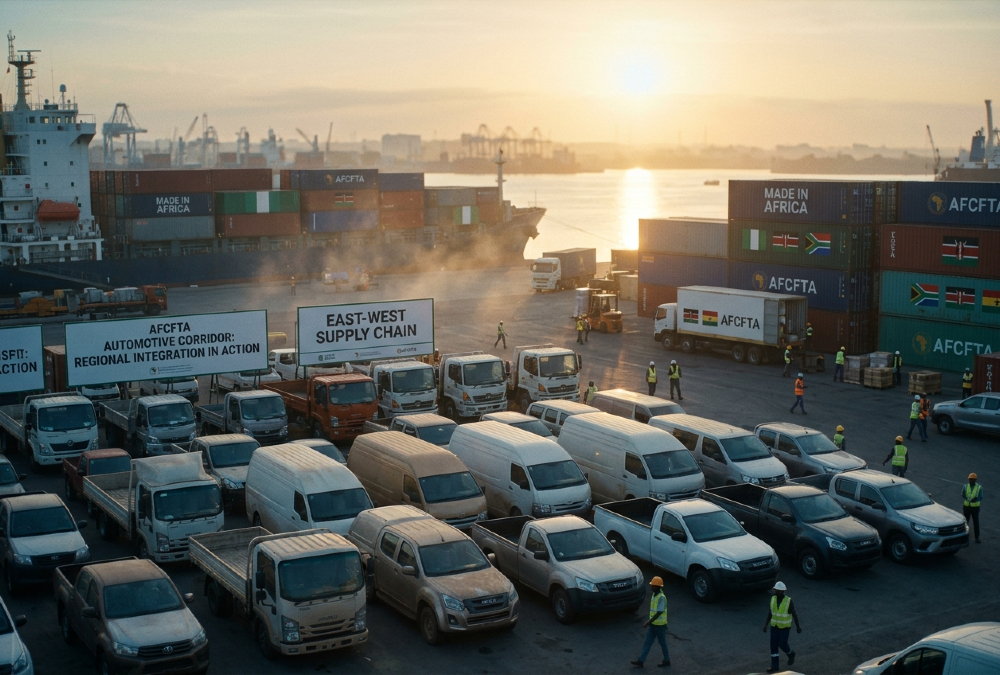
Driving Single-Market Automotive OEM Integration Under AfCFTA
The African Continental Free Trade Area promises to replace a patchwork of national markets with a single automotive bloc. Whether carmakers can capture it depends on borders, standards, and data.

By Des H. Rikhotso
For decades, the story of cars in Africa has been a story of imports. Used vehicles from Europe, Japan and the Gulf have crowded the continent’s roads, while its factories have mostly assembled kits designed elsewhere, with little local value added. Borders have been walls, not doors. A part made in one country and needed in the next could spend days in a customs queue, long enough to halt a production line.
The African Continental Free Trade Area (AfCFTA) is meant to end that arrangement. By removing tariffs on 90 percent of goods and harmonizing trade rules, it aims to stitch fragmented national markets into one economic bloc. For an industry whose profits depend on scale, that is a revolution on paper. Whether it becomes one in practice will be decided less in the conference halls of Addis Ababa and Accra than at the border posts, ports and ledgers where trade actually happens.
From Importing to Building
The first thing to understand is that AfCFTA does not simply make car imports cheaper. It rewards those who build in Africa and penalizes those who merely ship to it. The deal’s rules of origin set minimum local-content thresholds, which are designed to stop foreign manufacturers from landing completely knocked-down (CKD) kits on African shores, bolting them together and claiming duty-free status. A car must carry real African value to enjoy African preferences.
This is the right principle, and an uncomfortable one for many incumbents. Assembly without depth was always a thin form of industrialization. It produced jobs, but not suppliers, engineers or the compounding know-how that makes an industry self-sustaining. Origin rules force the question that policymakers have dodged for a generation: Who, exactly, is making what?
Hubs, Spokes, and Specialization
The likely answer is a hub-and-spoke system. The established manufacturing centers of South Africa, Morocco and Egypt are the natural hubs, with deep supplier bases, mature ports and decades of experience. Around them, countries such as Ghana, Kenya and Rwanda are emerging as spokes for component sourcing and assembly.
The more interesting prospect is specialization. Zambia’s copper, for instance, can feed the continent’s wiring-harness makers. Other countries may find their edge in components, and others still in final assembly. This is the logic of comparative advantage applied to a continent that has rarely been allowed to practice it. A car built under AfCFTA might be a truly pan-African product: wired with Zambian copper, fitted with parts from a regional supplier and assembled near the customers who buy it.
The Obstacles are not Abstract
Enthusiasm for this vision should be tempered by what it takes to move a gearbox from one country to another. Three problems stand out.
The border is the bottleneck. Bureaucratic delays, inconsistent customs paperwork and physical inspections can stall components for days. Just-in-time manufacturing, the discipline that keeps modern factories lean, does not forgive such delays. A line that waits for a part from across the frontier is a line that loses money.
Logistics can cost more than the tariff ever did. Potholed roads, under-equipped ports and expensive rail freight push up the cost of moving goods within Africa. In some cases, shipping within the continent costs more than importing from Europe or Asia. If that persists, tariff-free trade will remain a theory for many manufacturers, because cheap intercontinental shipping will undercut the intra-African alternative.
Standards do not line up. Rules on left- versus right-hand drive, emissions and safety certification vary across the continent’s regional economic communities, including ECOWAS, the East African Community and SADC. Each variation adds cost and complexity, and each undermines the economies of scale that a single market is supposed to deliver.
Tariff cuts, in other words, are the easy part of integration. The harder part is making the physical and regulatory plumbing work.
What the Winners Will Do Differently
Automakers that thrive will treat AfCFTA as an operational challenge, not a political windfall. Three priorities stand out.
First, map the supply chain with the trade corridors in mind. Suppliers should be located where tariff preferences apply, and component production should be distributed according to where raw materials give a country a genuine edge. Because border delays are unpredictable, firms should hold buffer stocks near regional distribution hubs. It is an unglamorous precaution, and the cheapest insurance available.
Second, take compliance seriously, because it is now a source of profit. Duty-free status depends on proving where a product came from, which means meticulous rules-of-origin documentation. Companies should engage national investment promotion agencies and use local policies such as South Africa’s Automotive Production and Development Programme (APDP) and Ghana’s Automotive Development Policy (GADP). They should also standardize component dimensions and specifications so that a single part can serve multiple models and markets. Firms that treat paperwork as an afterthought will find their tariff advantage evaporating at the border.
Third, use technology to compensate for what infrastructure cannot yet provide. Digital freight-forwarding and customs-clearance platforms can speed up handoffs. Internet-of-Things trackers on high-value components can give real-time visibility into delays. Cloud-based inventory systems can coordinate production schedules across factories in different countries. Roads and ports will take years to improve, but software can be deployed much sooner, and it is where nimble competitors can pull ahead.
The Wager
None of this is guaranteed. Free-trade agreements have a history of looking better in the signing than in the implementation, and Africa’s own trading blocs have often promised more than they delivered. Intra-African trade remains small next to the continent’s trade with the rest of the world, a gap that AfCFTA exists to close.
But the opportunity is real, and it favors the prepared. If the agreement works as intended, the next decade will separate carmakers that built regional networks from those that kept shipping kits and hoping for the best. Africa’s automotive future will not be determined by who sells the most cars on the continent. It will be determined by who makes the most of them there.
Des H. Rikhotso is a business commentator and C-suite executive with more than 28 years of leadership experience across Southern, East, and West Africa. He has held senior roles at BMW Group Africa, Volkswagen Group Africa, Toyota/Lexus South Africa, Nissan Group of Africa, and other leading automotive and industrial companies. Rikhotso is the recipient of South Africa’s NAAMSA Accelerator Award as the 2026 Automotive Industry Social Commentator and Influencer of the Year. He writes on business, mobility, industrial policy, and leadership in Africa and the Middle East. He holds undergraduate and postgraduate business degrees from the University of the Western Cape, Wits Business School, and the University of South Africa. He contributes opinion articles in a private professional capacity. He can be reached via email at: [email protected].
