
Opinion
Beyond the Startup: Why Africa’s AI Future Depends on Institutions, Not Just Apps
For five years, Africa has measured its AI ambitions by the number of startups. But to achieve true technological sovereignty, the continent must build AI institutions, not just apps.

By Victory Azimih
For the past five years, Africa’s tech ecosystem has been asking the wrong question: how many AI startups does the continent have? It’s a metric that flatters everyone involved – founders, funders, and governments alike. But it is not a metric that leads to independence.
A startup can build a product. An institution builds an industry.
Consider Silicon Valley. It did not win because its founders were smarter than everyone else’s. It won because it built the machinery behind the founders: universities that converted research into companies, government agencies like DARPA and NASA that became its first serious customers, a financial corridor – Sand Hill Road – that funded infrastructure rather than just apps, and a university, Stanford, that held onto the intellectual property it generated. A single company can capture a market. An institution creates the conditions for the next hundred companies to exist at all.
Africa’s Real Deficit Isn’t Startups – It’s Scaffolding
This is precisely where Africa now stands.
The African Union has already named artificial intelligence a strategic priority, calling for African-owned research, datasets, computing power, and skills. The World Bank has reached the same conclusion from a different direction: an AI economy cannot be built on apps alone. It requires connectivity, computing capacity, local context, competency, and governance working in concert.
Translated into plain terms: Africa’s problem was never a shortage of startups. It is a shortage of institutions.
I see the evidence of this daily. Founders with world-class talent have no compute infrastructure to train their models on. Universities producing brilliant research have no pathway to commercialize it. Governments eager to regulate artificial intelligence have never once been its customer. The result is that African companies keep building products on top of infrastructure they do not own. That is not independence – it is digital tenancy.
The thesis, stripped to its essentials, runs like this: energy provides power, compute provides capacity, data provides context, talent provides capability, and capital provides scale. But it is institutions – and institutions alone – that convert these ingredients into sovereign economic power.
Building the Rails, Not Just the Riders
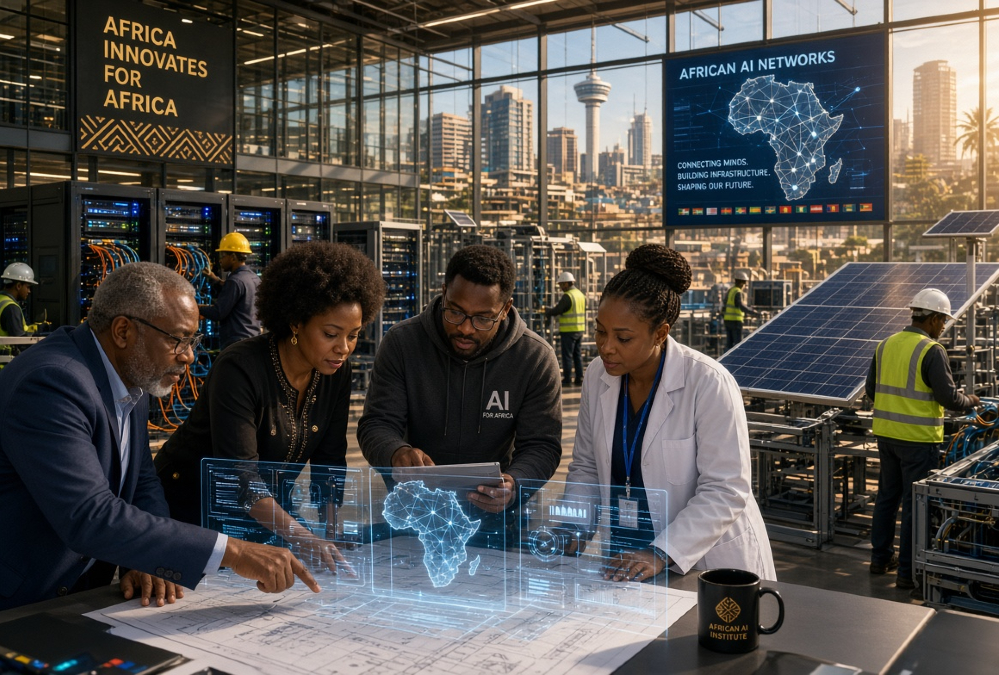
This is the premise behind what we are building at AIxAfrica. It is not another accelerator. It is an attempt to lay institutional rails: sovereign compute infrastructure that African researchers can actually access; university labs oriented toward producing intellectual property, not just publications; capital vehicles built to finance data centers and foundation models rather than minimum viable products; governments willing to become anchor customers for African-built AI; and industrial partners capable of turning artificial intelligence into tangible output – tons of steel, megawatts of power, yield per hectare of farmland.
The logic compounds. A startup creates a company. An institution creates an ecosystem. An ecosystem creates an industry. And an industry, finally, creates independence.
Call it the path from infrastructure to intelligence – independence, redefined.
So here is the question worth asking instead: not who is building Africa’s next AI startup, but who is building the institutions that will still be producing African AI companies, researchers, and intellectual property twenty years from now?
Victory Azimih is a visionary entrepreneur and global investment consultant specializing in Africa’s economic growth and industrial transformation. As the CEO and founder of Azeemi Global, he leads a pioneering firm dedicated to accelerating the continent’s development through cutting-edge technology and infrastructure solutions. Under his leadership, Azeemi Global focuses on harnessing the potential of artificial intelligence, blockchain, and smart infrastructure to unlock sustainable investment opportunities across Africa. Based in Lagos, Nigeria, Azimih is at the forefront of driving Africa’s future as a hub of innovation and industrialization.
