
Opinion
Africa’s Risk Premium: Who Bets on the Continent?
Western lenders priced African risk and stayed home. Beijing priced African relationships and moved in. A Formula 1 contract in Kigali shows the same logic at work.
By Gregory September
Every map of power tells a story, and the story depends on what you choose to plot. Draw the continent’s oil fields, gas projects, coal plants, solar farms, dams and transmission lines, then mark where Chinese capital sits in each. The result is a dense web across roughly 35 African countries, running from the crude-rich coast of Nigeria and Angola to the hydropower valleys of Ethiopia and Zambia. It is less a ledger of loans than a diagram of influence.
Western institutions have long criticized this pattern, often with justification. But the critique has an awkward companion fact. For decades, many of those same institutions declined to finance large-scale African infrastructure. Dams, grids and power plants take years to build and decades to repay, and they carry political, currency and construction risks that sit badly with quarterly returns and cautious credit committees. The gap that resulted did not stay empty. Infrastructure gaps never do.
Two Playbooks, One Result
China’s approach was not simply to lend. It embedded itself in the system. The pattern is strikingly structural. Resource-rich states, such as Nigeria and Angola, tended to receive financing tied to extraction. Infrastructure-poor states, such as Ethiopia and Zambia, tended to receive money for power generation, grids and transmission. The two playbooks differ in detail but converge on the same outcome: long-term relationships between Beijing and African capitals.
Three forces explain why. The first is scale. Chinese lenders and contractors could commit to projects that Western counterparts found too large or too slow to underwrite. The second is speed. A power plant that Western institutions would study for years could be financed, contracted and under construction in a fraction of the time. The third is incentives. African governments facing blackouts, stalled industrialization and impatient electorates made a pragmatic choice. They took the offer that existed over the one that did not.
That last point deserves emphasis, because the popular debate tends to flatten it. The standard caricatures are the “debt trap” on one side and African victimhood on the other. Both deny African governments agency. Leaders in Addis Ababa and Lusaka were not tricked into wanting electricity. They wanted power, and one party was willing to build it.
None of this makes the arrangement benign. Leverage compounds, and it compounds fastest under particular conditions: when infrastructure is financed externally, when contractors remain tied to operations and maintenance, and when repayment structures shape future policy choices. A power grid is never just a power grid. Whoever builds, finances and services it acquires a quiet say in decisions about tariffs, procurement, mining rights and diplomacy, and that say can last for decades. Energy infrastructure is a form of influence disguised as engineering.
A Race Car in Kigali
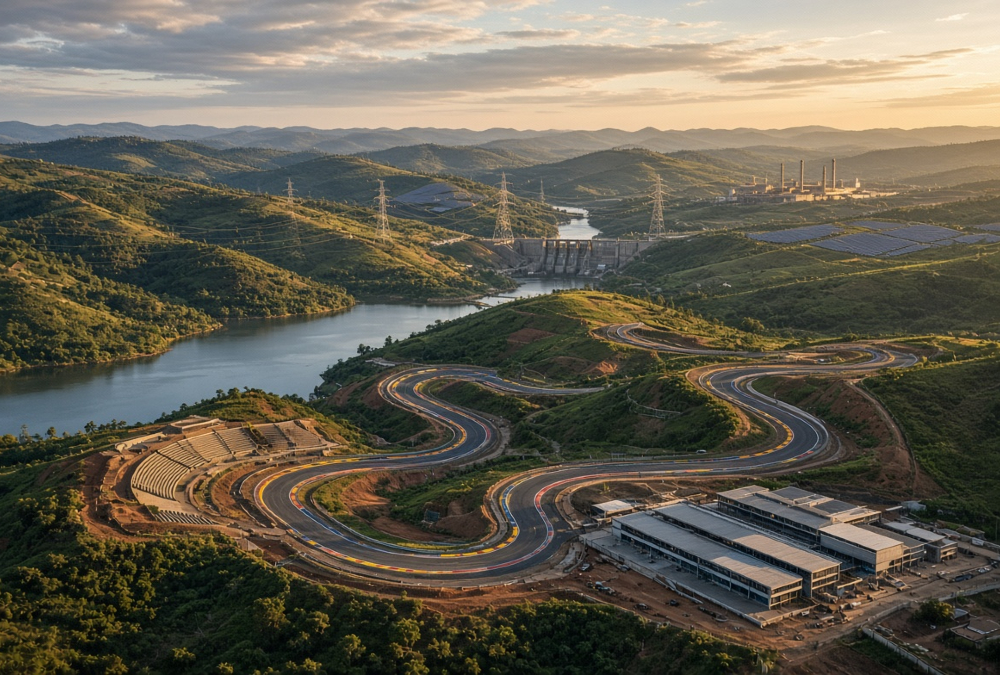
Now consider a seemingly unrelated story. Rwanda is building a Formula 1 circuit from scratch, and the sport has already committed to a 10-year agreement to host an African Grand Prix there. South Africa’s president, Cyril Ramaphosa, welcomed the deal as a recognition of what the Rwandan nation can deliver. The race will join a growing portfolio of international events in the country, including the UCI-classified Tour du Rwanda cycling race.
It would be easy to dismiss this as sports-washing, a glossy distraction for a small, tightly governed state. That reading misses what the contract reveals. A decade-long commitment, signed before the asphalt is poured, is a vote of confidence in an institution’s ability to execute. Formula 1 does not sign such agreements out of sentiment. It signs them because its commercial partners, broadcasters and sponsors need certainty about delivery, security and logistics. Rwanda has spent years cultivating that certainty. It is, in effect, the Western-capital analogue of the Chinese infrastructure story: a bet placed on credibility rather than on collateral.
Then look south. Kyalami, near Johannesburg, hosted Formula 1 from 1967 to 1985 and again in 1992 and 1993. South Africa has the history, the motorsport culture, the sophisticated financial sector and a venue with genuine heritage. Yet the historic circuit has slipped out of modern Formula 1 condition, and the continent’s first grand prix in decades is going to a country that has never hosted one.
So why does the richer, older, better-connected economy lose the contract to the upstart?
What the Risk Premium Really Measures
The tempting answer is that South Africa’s risk premium has grown too large for global capital to stomach. There is something in that. Investors worry about electricity shortages, logistics bottlenecks, institutional strain and the cost of capital. A premium that high can make even a prestige project look unattractive.
But a risk premium is not a law of nature. It is a price, and prices respond to behavior. A government that credibly commits to delivery, as Rwanda has tried to do, can narrow the gap. A government that lets the lights flicker and the asset base decay will widen it, and every missed opportunity makes the next one costlier. The premium becomes a self-fulfilling prophecy: capital stays away because the risk is high, and the risk stays high because capital stays away.
This is precisely the trap that Western institutions helped to set in the infrastructure sector. By treating African power projects as uninvestable for decades, they ensured that the conditions making them look risky persisted. China was willing to price that risk differently, partly because it was pricing something else entirely. Its lenders were buying relationships, resources and long-term strategic position, not merely a yield.
The Uncomfortable Lesson
Three conclusions follow.
First, avoiding risk is not neutral. Every dollar that Western lenders refused to commit to an African grid was a decision about who would eventually hold the keys to that grid. Caution has geopolitical consequences, and they are rarely free.
Second, African governments are not passive recipients of anyone’s strategy. Kigali’s courtship of Formula 1 and Addis Ababa’s embrace of Chinese hydropower finance are two expressions of the same instinct: find the partner who will commit and make the deal. The wise question is not whether Africa picks sides but whether it keeps its options open, and its bargaining leverage with them.
Third, credibility is the scarcest asset on the continent, and it is built, not inherited. South Africa’s heritage at Kyalami does not compensate for decay. Rwanda’s lack of a racing history does not prevent a decade-long contract. In global capital markets, the future tends to outweigh the past.
For Western policymakers, the lesson is humbling. If they dislike the map that Chinese capital has drawn across African energy, the remedy is not another round of criticism. It is to compete, with patient finance, realistic risk-sharing and a willingness to build where others will not. Infrastructure gaps do not remain empty forever, and the world is still deciding who will fill the next one.
Gregory September is a South African academic, author, and geopolitical analyst with extensive experience in government and Parliament. He is the founder and CEO of SAUP (Sustainability Awareness and Upliftment Projects NPC), which focuses on sustainability education and community development. He previously served as Head of Research and Development for the Parliament of South Africa. His work centers on sustainability, African geopolitics, and economic development, and he regularly contributes to analysis of global political and economic affairs.
