
Opinion
Africa’s Quiet Growth Surge: The World’s Fastest-Growing Economies Are Being Overlooked
Six African economies are outgrowing Vietnam. Investors are still lining up for Hanoi.

By John Kourkoutas
Every supply-chain conference has the same panel, the same slide, and the same conclusion: Vietnam is where the growth is. At 7.1 percent projected GDP growth this year, that reputation is well earned. But it is also, increasingly, out of date.
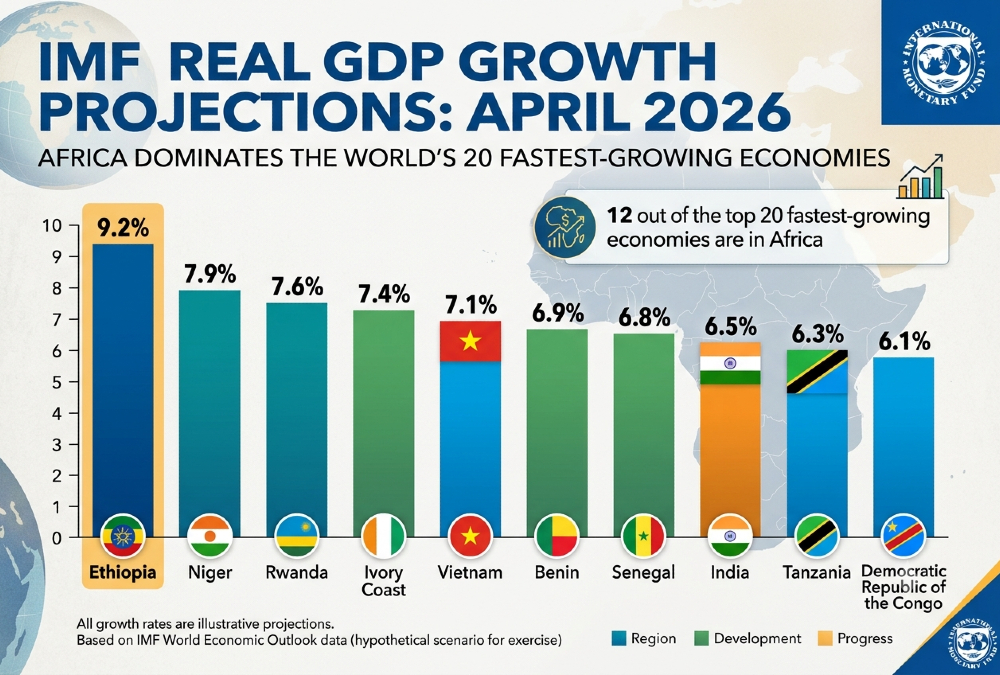
According to the IMF’s April 2026 World Economic Outlook, six African economies are growing faster than Vietnam. Two are growing faster than every other economy on Earth. And almost nobody in the boardroom is talking about them.
The Numbers the Boardroom Isn’t Discussing
Look at where African economies sit in the global growth rankings:
- Of the world’s three fastest-growing economies, two are African.
- Of the top ten, seven are African.
- Of the top twenty, twelve are African.
Here is the leaderboard, with the two benchmarks every strategy deck cites – Vietnam and India – left in for comparison:
| Country | Projected 2026 GDP Growth |
|---|---|
| Ethiopia | 9.2% |
| Guinea | 8.7% |
| Uganda | 7.5% |
| Rwanda | 7.2% |
| Vietnam | 7.1% |
| Benin | 7.0% |
| Niger | 6.7% |
| Libya | 6.7% |
| India | 6.5% |
| Côte d’Ivoire | 6.2% |
| Djibouti | 6.0% |
| Tanzania | 5.9% |
| DR Congo | 5.9% |
| Mali | 5.5% |
Read that table twice. Ethiopia is outpacing Vietnam by more than two full percentage points. Seven African economies are growing faster than India – a market so fashionable that “we need an India strategy” is now a standing agenda item at multinational board meetings. Yet propose an East Africa strategy in the same room, and watch the eyebrows go up.
(Figures cited are as reported in the IMF’s April 2026 World Economic Outlook database; readers seeking precise, current projections should consult the IMF’s public release directly, as estimates are revised quarterly.)
This Isn’t an Information Problem. It’s an Attention Problem
The data above isn’t proprietary. The IMF publishes it every quarter, free, to anyone who cares to look. So the gap between what the numbers show and what the boardroom believes isn’t a research failure – it’s a failure of imagination. Everyone is looking at the same public dataset. Almost no one is reading past the countries they’ve already heard of.
That gap matters more than it might seem, because attention gaps are exactly where margin lives.
Vietnam’s growth story is, at this point, fully priced in. Industrial parks outside Hanoi and Ho Chi Minh City are crowded. Wages have been bid up by a decade of competing manufacturers. Every tender draws ten qualified bidders. The opportunity is real, but so is the competition for it.
Uganda’s growth story and Benin’s growth story are not priced in. The curve looks similar. The competition for position does not.
Why “Quiet” Is the Point
The overlooked word in any chart like this one is quietly. Growth that is happening quietly – without a supply-chain conference built around it – is precisely the growth worth studying first, not last.
Markets that are already loud have already been divided up. The best distribution partnerships are signed. The best industrial sites are leased. The best local talent has been hired away. By the time a market gets loud enough to dominate a conference agenda, the early advantage has already gone to whoever showed up while it was still quiet.
That is not a reason to ignore due diligence, political risk, or the real operational challenges of building in frontier markets – those are serious, and they vary enormously from Kigali to Kinshasa. It is a reason to stop treating “under-covered” as a synonym for “not investable.” Often, it is closer to the opposite.
The Real Question for Strategy Teams
The IMF will keep publishing this table every quarter, whether or not anyone acts on it. The question worth asking in the next strategy meeting isn’t whether Vietnam or India deserves attention – they clearly do. It’s why economies growing faster than both are still absent from the conversation.
The data has been sitting in plain sight. The opportunity, for now, is that most competitors still aren’t looking.
John Kourkoutas is business development expert that specializes in helping companies, export teams, and business leaders succeed in Africa’s dynamic and emerging markets.
