
Opinion
Africa’s Food Security Will Be Won in Mills and on Roads
A rice mill in Burkina Faso and a league table of African highways make the same uncomfortable point: the continent’s challenge is no longer only how much it grows, but how far, how fast and how cheaply it moves what it grows.

By Ratnakar Wagh
Every African harvest season brings its ribbon-cuttings, and most of them celebrate growing more. The one in Bagré, Burkina Faso, celebrates something less glamorous and more consequential: what happens to the crop afterward.
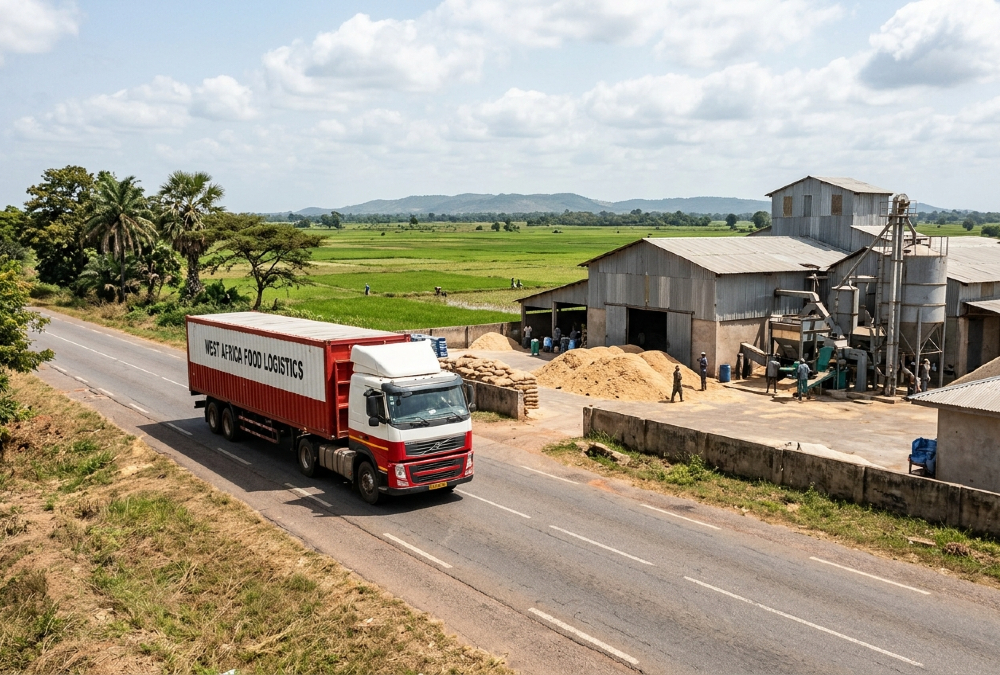
The country has opened its first state-owned rice mill there. Run by the state-owned company Faso Agropôles (SOFA), the facility can process 100 metric tons of paddy rice a day. Were it to run every day of the year, that would come to 36,500 metric tons. It will not, and the gap between nameplate capacity and daily reality is where this story will be decided. On the same visit, officials launched mechanized maize harvesting on SOFA farmland, using a combine harvester.
The most striking detail is the bill. The project was financed with national resources under the country’s agro-pastoral program. That is a statement of intent: Burkina Faso wants to own not merely the harvest but the machinery that turns it into food.
Why Processing Matters More Than Planting
A farmer who sells raw paddy sells the least valuable version of her own crop. Milling locally lets a country keep the margin that would otherwise accrue elsewhere, which is the plain logic of value addition. It also shortens the distance between field and plate, and so reduces exposure to imported food and to supply shocks that originate far beyond any minister’s control.
The benefits do not stop at the mill gate. Mechanized harvesting eases labor constraints and lets producers manage larger acreage. Processing, in turn, pulls in transportation, storage, packaging, distribution and equipment maintenance: the dull trades from which industrial economies are actually assembled.
Yet a mill is easier to commission than to keep fed. Africa’s industrial history has its share of plants that opened with fanfare and idled for want of inputs. Bagré will have to run consistently, secure enough paddy to stay busy, compete with imports on cost and quality, and connect local growers to reliable buyers. A processing plant is a beginning. Its long-term impact depends on the strength of the entire agricultural value chain, and a chain is only as strong as its least glamorous link.
The League Table of African Roads
A road is more than a strip of asphalt. It joins a farmer to a market, a factory to its customers and a port to an inland economy. Measured by sheer length, one country towers over the rest of the continent.
South Africa has more road than the next four African countries combined
Reported total road network length, kilometers, 2026. NB: 1 Kilometer is 0.62 miles
Next four combined: 688,825 km
* Landlocked country. Length is not quality: the figures say nothing about paving, upkeep or safety. Source: Global Firepower, 2026.
South Africa’s reported network is 3.8 times as long as Nigeria’s, the runner-up, and accounts for about 37 percent of the combined length of the ten networks shown. Past the leader, the table is a tight pack, and the interesting question is not who is first but whose roads actually work.
Kilometers are not Connectivity
The temptation is to read the ranking as a scoreboard. Resist it. Global Firepower, better known for ranking militaries, reports total road length, and length says nothing about whether a road is paved, maintained, safe or passable in the rainy season. Nor does it say how efficiently goods travel between production centers and markets. A country can lead the table and still strand a farmer’s tomatoes.
Four of the ten are landlocked: Ethiopia, Mali, Zimbabwe and South Sudan. For them, and for Burkina Faso, the road is not an amenity but the sea lane. Every delay at a border post, every bribe at a checkpoint and every pothole is a tax on trade, and it shows up in delivery times, transport costs, inventory planning and, finally, profit margins.
This is why the African Continental Free Trade Area, for all its promise, will not deliver by treaty alone. Tariff schedules open markets on paper. Roads, border facilities, logistics systems and customs procedures open them in practice. The agreement and the asphalt are complements, and neglecting either wastes the other.
The Case against Self-Sufficiency
Political rhetoric prefers the word self-sufficiency. It is the wrong target, and the mill and the road explain why. A nation that insists on producing and milling everything it eats behind its own borders buys security at the price of efficiency, and it leaves its consumers hostage to a single harvest, a single drought, a single plant that breaks down.
The better aspiration is self-reliance on a continental scale: enough domestic capacity to blunt external shocks, joined to enough open, well-connected regional trade that a bad year in one country is cushioned by a good year in the next. A mill in Bagré is more valuable if its rice can reach neighboring markets quickly and cheaply, and if rice from those neighbors can reach Burkina Faso when its own fields fail. That is food security as insurance, and insurance works only when risks are pooled.
None of this diminishes what Burkina Faso has done. Importing everything is a vulnerability too, and building domestic processing capacity is a sensible hedge. The point is that capacity inside a country is only half of resilience. The other half is the connection between countries.
Where the Next Dollar Should Go
Suppose a minister could back only one investment: new roads, better maintenance and upgrades, faster border crossings, or links between industrial zones, farms and ports and the big markets beyond them. The honest answer is that the question hides its own solution. The last of these is the organizing principle; the middle two are how it is done.
New roads are photogenic, and politicians love to open them. Maintenance is invisible until it fails, which is why it is so often starved. Yet a road that is resurfaced before it crumbles, and a border post that clears a truck in hours rather than days, can add more usable capacity than another stretch of fresh asphalt, and often at lower cost. The test of any project should be simple: does it shorten the path between a producer and a buyer?
By that test, the corridor that links a mill to its paddy fields, its warehouses and its export markets outranks a prestige highway between two cities with little to trade. Governments should map the value chains that matter, then fix the weakest link in each.
Ratnakar Wagh is an entrepreneur, management professional, and CEO of Tanzania-based Kinglion Investment Company, an investment firm driving industrial development across Africa through initiatives in manufacturing, renewable energy, and logistics infrastructure. He specializes in organizational transformation, sustainability, and leadership, with a strong focus on building high-performing teams and creating long-term value across emerging markets.
