
Opinion
Africa’s Dream on Tracks: A High-Speed Vision for the Continent

By Dishant Shah
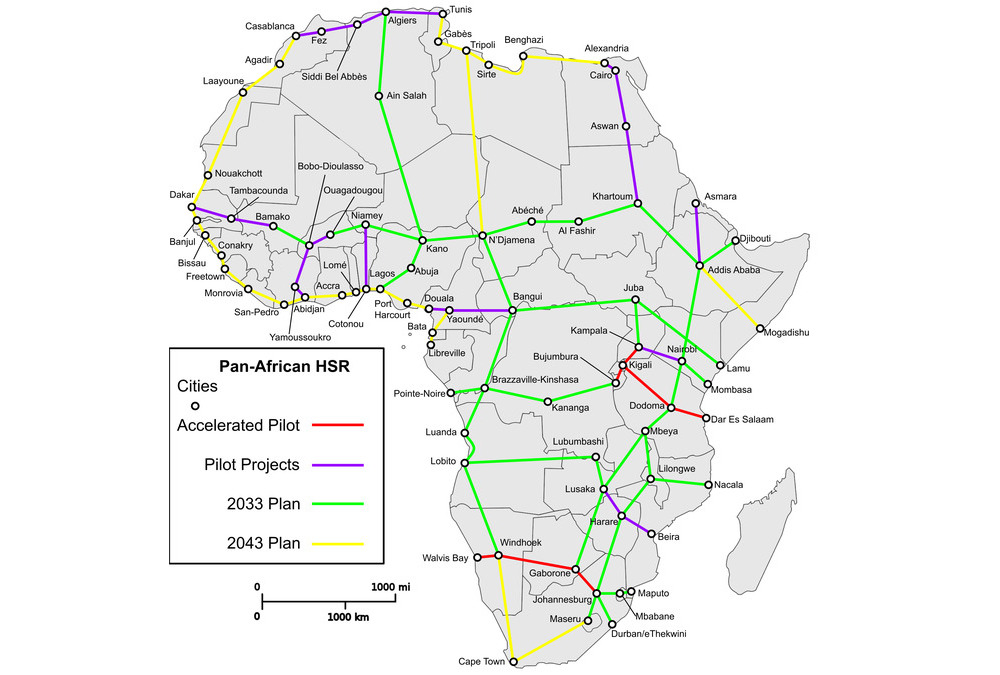
What you are looking at is more than just a map – it is Africa’s future in motion. This is the proposed Pan-African High-Speed Railway (HSR) network, an ambitious, continent-wide initiative designed to connect African nations through modern, efficient rail infrastructure.
Spanning multiple phases through the year 2043, the project outlines a comprehensive plan to revolutionize transportation across the region. Accelerated pilot corridors – marked in red – are already under discussion or in early development stages. Pilot projects are highlighted in purple, while green indicates the strategic framework set for 2033, and yellow outlines long-term plans extending to 2043.
From Cape Town to Cairo, Lagos to Nairobi, and Dakar to Djibouti, this visionary network aims to link over 50 major cities with high-speed trains capable of traveling between 250–300 km/h (155-186 mph). According to the African Union’s Agenda 2063, the initiative would add more than 30,000 kilometers (18,600 miles) of new rail lines, transforming how people and goods move across the continent.
Why Connectivity Matters
Africa’s current transport landscape presents significant challenges. Road networks are often fragmented, while air travel remains costly and inefficient for many.
Freight moves slowly, logistics costs are high, and these inefficiencies undermine the competitiveness of African products, hinder regional trade, and slow down economic integration.
In fact, poor infrastructure alone is estimated to cost the continent around 2 percent of its annual GDP. Meanwhile, intra-African trade accounts for just 15 percent of total exports, compared to 60 percent within the European Union and 40 percent in Asia (African Development Bank Group).
These figures underscore the urgent need for better connectivity.
More Than Just Faster Trains
The Pan-African HSR isn’t simply about speed – it’s about transformation. It represents a bold step toward:
- Enabling seamless movement of people, labor, and goods.
- Boosting tourism and business travel within Africa.
- Linking coastal ports to inland economies.
- Unlocking opportunities in landlocked countries like Chad, Central African Republic, and South Sudan.
- Reducing carbon emissions by shifting freight from roads to rails.
China’s Belt and Road Initiative has already laid some groundwork, funding and constructing key rail lines such as the Mombasa–Nairobi Standard Gauge Railway in Kenya and the Addis Ababa–Djibouti line. However, the Pan-African network seeks to be Africa-led, serving as a flagship project under the African Union’s Agenda 2063 – a vision for inclusive, sustainable development.
Challenges Ahead
There are no illusions about the hurdles. Questions remain around financing , political coordination, land acquisition, and long-term maintenance. Yet, even partial realization of this dream could dramatically reshape the geography of trade, mobility, and opportunity across Africa.
This is not just a railway. It is a test of continental imagination.
Will Africa rise to the challenge – and connect itself on its own terms?
Dishant Shah is a partner at Legion Exim, a company specializing in facilitating the export of high-quality engineering products directly sourced from manufacturers in India to Africa. His areas of expertise include new business development and business management.
