
Opinion
The Railways That Will Decide Africa’s Next Century
Why judging Africa’s infrastructure boom by this year’s headlines misses the point entirely.

By Gregory September
Ask an investor about Africa and you will likely hear about debt burdens, stubborn inflation, an upcoming election, or the price of copper on any given Tuesday. These are the metrics of a one-year lens, and they are not wrong – they simply answer the wrong question for anyone trying to understand where the continent is actually headed.
Zoom out to a 20-year horizon and a different Africa comes into view: one defined by demographics, urbanization, industrialization, and the quiet, unglamorous work of laying track and pouring concrete. A railway that looks like an expensive vanity project this year may, two decades from now, be the reason an entire region’s manufacturing base exists at all. It lowers transport costs, unlocks new industries, expands markets, and stitches cities together. Energy grids, ports, digital cables, and schools work the same way: some investments pay off immediately, while others simply change what is possible later.
This is the trap. Time horizon isn’t a matter of investor taste – it’s an analytical tool, and using the wrong one produces the wrong verdict. The real question is never just “what is happening?” It’s “over what timeframe should this be judged?” Nowhere is that clearer right now than in the scramble over Africa’s copper corridors.
Two Oceans, Two Superpowers, One Copperbelt
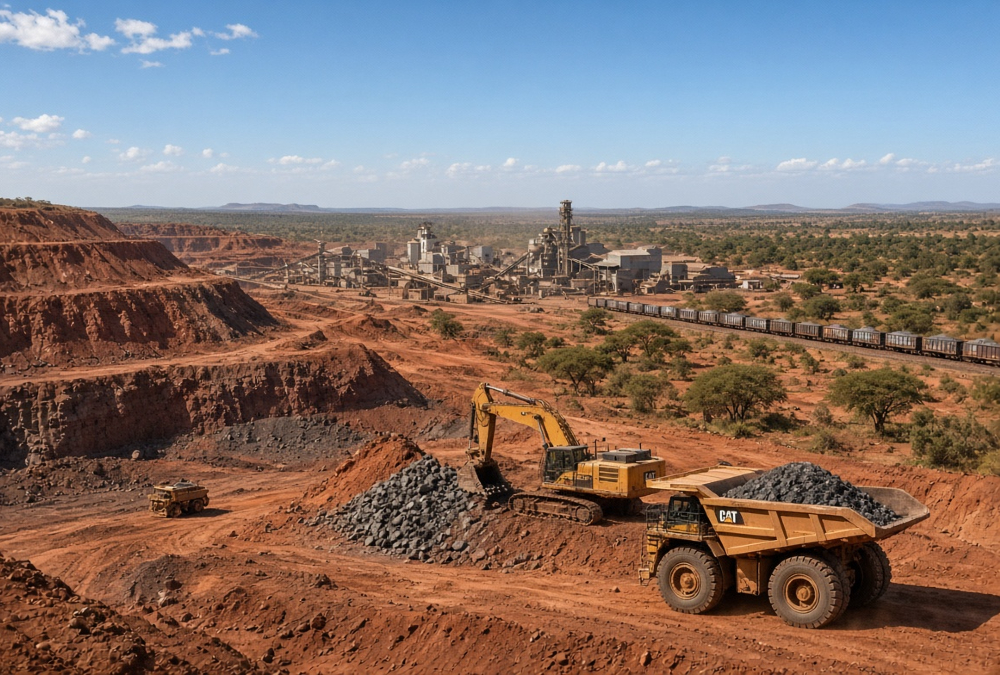
Central Africa’s Copperbelt – straddling Zambia and the Democratic Republic of Congo – is quietly becoming one of the world’s most consequential logistics battlegrounds. Two rival corridors, backed by two rival powers, are racing to move the same minerals to opposite coasts.
China’s answer is TAZARA, the Tanzania-Zambia Railway, running 1,860 kilometers (1,156 miles) from Zambia to the Indian Ocean port of Dar es Salaam. Originally built in the 1970s, it is now getting a US$1.4 billion China-backed revival under a 30-year concession.
America’s answer is the Lobito Corridor, a 1,300-kilometer (808-mile) route running the other direction – from the DR Congo’s Copperbelt through Angola to the Atlantic port of Lobito – backed by roughly US$753 million in U.S. support, also under a 30-year concession. Zambia alone has secured close to half a billion dollars in financing tied to the corridor, which will link its mining and agricultural heartlands to Angola’s coast and is already carrying a growing share of the DR Congo’s mineral exports.
It’s a legitimate question whether these two corridors might eventually merge into a single transcontinental line, linking the Atlantic to the Indian Ocean. For now, though, the more interesting story isn’t which railway wins. It’s what Zambia and the DR Congo are extracting from the competition itself.
Ownership, Not Just Access
For decades, the DR Congo’s minerals left the country through routes it did not control, a fact of colonial-era geography that has shaped – and constrained – its economy ever since. That is starting to change.
In August 2026, the DR Congo signed a US$1.26 billion deal with Portugal’s Mota-Engil covering more than 1,000 kilometers (620 miles) of rail connecting the Copperbelt cities of Kolwezi, Tenke, and Lubumbashi to the port of Lobito. The details matter more than the price tag: the DR Congo will hold a 10 percent equity stake in the concession and collect 7.5 percent of gross revenue. That is a meaningfully different arrangement from simply charging transit fees on minerals passing through – it’s a government positioning itself as a part-owner of its own exit route, not merely a landlord along the way.
Zambia, meanwhile, stands to gain new tax revenue, corridor-side development, and jobs that didn’t exist before. The more ambitious hope is that the corridor eventually carries something other than raw copper ore and cathodes – that it moves copper wire and other finished goods, manufactured in Zambia and the DR Congo rather than shipped out as unprocessed rock.
That distinction – between exporting raw material and exporting value-added product – is where these deals intersect with the UN’s Sustainable Development Goals in a fairly direct way. Equity and royalty income (SDG 8) can fund employment well beyond the mine gate. Better rail links (SDG 9) are what allow raw extraction to evolve into genuine industrial capacity. And a rail line crossing three countries (SDG 17) simply cannot function without real regional cooperation, which gives these infrastructure deals a diplomatic weight that goes beyond steel and concrete.
The obvious follow-up question: if equity stakes work for the DR Congo, why should any resource-rich African state settle for transit fees alone?
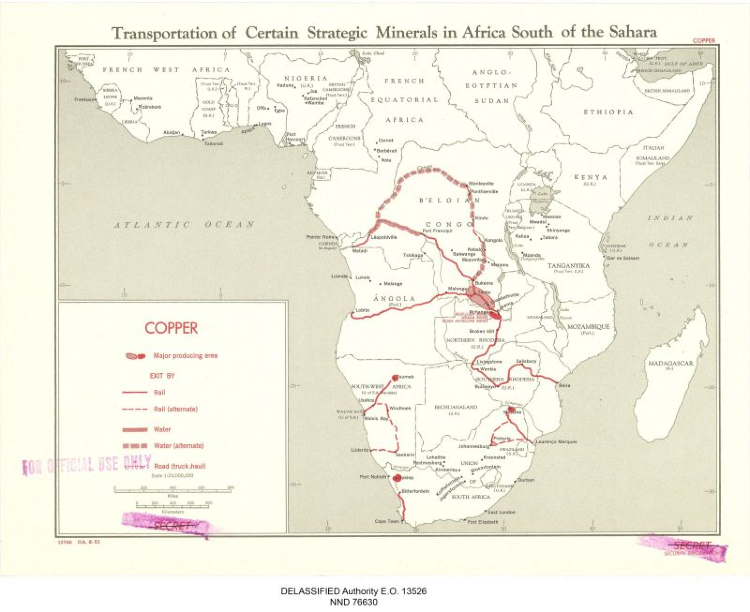
Declassified 1953 CIA map showing strategic mineral transportation routes from Zambia and Belgian Congo to African coastal ports
History Already Drew This Map
None of this is new, even if the financing structures are. In August 1953, the CIA produced a map – that has since been declassified – tracing the very same corridors that determine who controls Africa’s copper, cobalt, and chrome today. It shows rail, road, and river routes running from the mining interior of what was then Northern Rhodesia and the Belgian Congo out to the coast.
The exit ports it identifies will look familiar: Lobito in Angola, reached via the Benguela railway; Beira in Mozambique, a major Indian Ocean outlet; Lourenço Marques – now Maputo; Matadi, in the Belgian Congo – now the DR Congo, reached by a combination of rail and river transport from the Katanga region; and the South African ports of Cape Town, Port Elizabeth, and Durban, linked by an extensive southern rail network.
Seventy years on, the minerals are the same, the geography is unchanged, and the great powers jockeying for position have simply swapped uniforms. What’s genuinely different this time is that the countries sitting on the resources are starting to insist on owning a piece of the route out – not just a toll booth along it.
That is the kind of shift that a one-year lens will always miss, and a 20-year lens is built to catch.
Gregory September is a South African academic, author, and geopolitical analyst with extensive experience in government and Parliament. He is the founder and CEO of SAUP (Sustainability Awareness and Upliftment Projects NPC), which focuses on sustainability education and community development. He previously served as Head of Research and Development for the Parliament of South Africa. His work centers on sustainability, African geopolitics, and economic development, and he regularly contributes to analysis of global political and economic affairs.
