
Business
‘Unemployed need not apply’ stigma keeps blacks jobless
OPINION – Employment advocates maintain that unemployment discrimination could be illegal if there is a disparate impact on groups such as blacks, Latinos, women and the disabled…
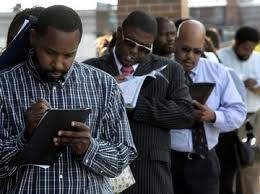
Recently, when Sony Ericsson announced 180 new jobs in Buckhead, Georgia, the company posted an ad for a marketing position on The People Place, a job recruiting website. The ad stressed: “NO UNEMPLOYED CANDIDATES WILL BE CONSIDERED AT ALL.” A posting on the website for a Quality Engineer with another electronics company based in Angleton, Texas, emphasized that “Client will not consider/review anyone NOT currently employed regardless of the reason.”
The protracted level of black unemployment in America is often ignored, and it continues despite the presence of a black man in the White House. African-Americans, who typically suffer from an unemployment rate double their white counterparts, are especially susceptible to cuts in government jobs.
According to a report from United for a Fair Economy earlier this year, blacks are 30 percent more likely to work in the public sector, and 70 percent more likely to work for the federal government. Nearly 21 percent of black adults hold government jobs, as opposed to 17 percent of whites and 15 percent of Latinos. More black men are employees of public agencies than any other employers. For black women, such agencies are the second largest employer.
In addition, as was revealed at a July 26 EEOC public hearing, the disproportionate representation of blacks and Latinos in the criminal justice system translates into more unemployment for minority groups. As of 2008, over 92 million people had a criminal background, including one-third to one-fourth of all adults. And there are 14 million new arrests every year. One in 54 men and 1 in 265 women is imprisoned.
Although 1 in 106 white men is currently behind bars, 1 in 15 black men and 1 in 36 Latino men is incarcerated. Further, 1 in 9 young African-American men between ages 20-34 is in locked up, and 40 percent of black men are unemployed when prisoners are included.
The New York Times reported on a 2005 study by two Princeton professors, which revealed that white men with prison records received far more entry-level job offers than black men with identical records. Moreover, these white ex-cons were offered jobs as often or more than black men with a clean record. While over 7 white men with prison records got a callback or job offer for every 10 white men without convictions who received an offer or callback, only 3 black men with prison time got offers or callbacks for every 10 black men with clean record.
Moreover, as jobs took a backseat to the deficit, the recent debt ceiling deal will likely increase unemployment by reducing government jobs, and fail to extend emergency unemployment benefits for the long-term unemployed.
However, the Congressional Progressive Caucus is in the middle of a nationwide “Speak Out for Good Jobs Now” tour to highlight the problem of long-term unemployment in America. New Jersey has passed legislation prohibiting the exclusion of the unemployed in advertisements for job openings, providing for a $1,000 fine for first-time offenders, $5,000 for repeat offenders, and $10,000 for three or more violations. Other states such as New York and Michigan could follow with similar laws.
Meanwhile, bills have been introduced in Congress to address the issue on a national level. In the House, Rosa DeLauro (D-Connecticut) and Rep. Hank Johnson (D-Georgia) introduced the Fair Employment Opportunity Act of 2011 (H.R. 2501). The purpose of the legislation is to prohibit employment discrimination based on an individual’s employment history or status.
In March, Rep. Johnson drafted another bill, the Fair Employment Act of 2011, H.R. 1113, that would amend the Civil Rights Act to make it illegal for an employer to refuse to hire an individual or to lower compensation for a person based on employment status.
“Discrimination against the unemployed smacks of days gone by when signs read, ‘women need not apply,’ ‘Irish need not apply’ or ‘no blacks allowed.’ I am going to do all I can to fight for the unemployed,” Johnson said in a statement.
In the Senate, a companion bill, also the Fair Employment Opportunity Act of 2011 (S. 1471), sponsored by Senators Richard Blumenthal (D-Connecticut), Kirsten Gillibrand (D-New York) and Sherrod Brown (D-Ohio), would prohibit employers and employment agencies from excluding or screening out applicants solely because they are unemployed.
High unemployment imposes high social and economic costs for this nation, destroying individuals and weakening families and communities. Those of us who have experienced joblessness, whether for a number of months or a year or more, can attest to the isolation and erosion of self-esteem that it brings.
Sadly, as over 14 million Americans are kept out of the job market through discriminatory hiring practices, they find themselves trapped in a cruel catch-22. Unemployed, they are told they need a job to get a job. Their suffering is magnified.
Source: theGrio
