
A Diaspora View of Africa
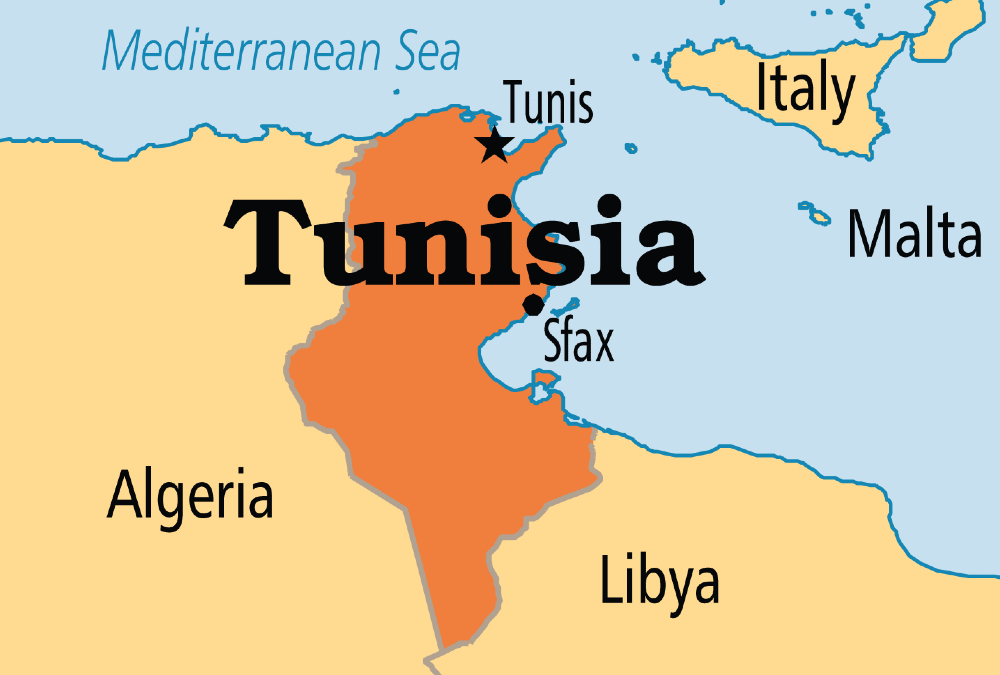
Tunisia again plays the villain on the world stage

By Gregory Simpkins
In December 2010, an incident in Tunisia sparked a youth-led revolt that had an impact far beyond the country’s borders. The so-called Arab Spring it created resulted in a series of anti-government protests, uprisings and armed rebellions that spread across much of the Arab world in the early 2010s but spread even to sub-Saharan Africa.
From Tunisia, the protests then spread to 5 other countries: Libya, Egypt, Yemen, Syria, and Bahrain. It led to 4 national leaders being deposed: Zine El Abidine Ben Ali in Tunisia in 2011, Libya’s Muammar Gaddafi and Egypt’s Hosni Mubarak also in 2011, and Yemen’s Ali Abdullah Saleh in 2012. Even without regime change, there were major uprisings and social violence, including riots, civil wars, and insurgencies. Sustained street demonstrations took place in Morocco, Iraq, Algeria, Lebanon, Jordan, Kuwait, Oman, and Sudan. Protests on a less violent scale took place in Djibouti, Mauritania, Palestine, Saudi Arabia, and the Moroccan-occupied Western Sahara.
Corruption and stagnation
Corruption and economic stagnation had long been a problem in Tunisia, but it took a spark set by a humble vendor to set off this raging wildfire of revolt and protest. Unable to find work and selling fruit at a roadside stand, Tunisian street vendor Mohamed Bouazizi burned himself to death in Sidi Bouzid after being mistreated by security forces who confiscated his wares, likely representing his remaining savings. His self-immolation sparked an unprecedented wave of protests in North Africa and the Middle East and made Tunisia a villain on the world stage.
After President Ben Ali eventually was pushed out of office, it seemed as though the situation had calmed down in Tunisia, and many observers hailed the country for adopting a more democratic system. However, there apparently were ethnic undercurrents that have emerged to again recently to place Tunisia in a negative global spotlight.
North African governments have increasingly acted to stem the tide of sub-Saharan Africans fleeing the continent for Europe. Two years ago, amidst a lack of protection within and outside Libya, thousands of sub-Saharan African migrants were subjected to horrific treatment in their effort to escape abusive detention conditions, threats of torture, sexual violence, enforced disappearance, extortion, and other abuses, according to a United Nations human rights report released in October 2022.
“This desperate situation requires all concerned to ensure that no migrant is compelled to accept assisted return to an unsafe or unsustainable situation in their country of origin,” stated acting UN High Commissioner for Human Rights, Nada Al-Nashif.
Chaos in Libya has forestalled much follow-up criticism despite reports of human trafficking of Africa refugees trying to get to more productive situations in Europe. After previous sanctions had been lifted several years ago, a divided Libya apparently was seen as a poor target for new sanctions or other means of punishment for allowing African refugees to be sold like cattle.
So, the rhetorical attacks were mostly all that could effectively be done to counter this situation since Libya was no longer a member of the international community in good standing and the enslavement of Africans was not seen as a government policy, but rather committed by rogue elements in as country with no stable government.
This situation distracted from a broader trend of discrimination and hatred of the thousands of Africans fleeing their homelands for a better life in developed countries. Now we see that this disdain for Africans was quite developed in Tunisia despite what appeared to be democratic progress.
Migrant crisis
Peter Beaumont, writing in a 30 March article in The Guardian, described the shift in the outlook on Tunisia in recent years:
“Tunisia is in the grip of several overlapping crises. Its economy is struggling and its increasingly authoritarian president, Kais Saied, who has consolidated power since a constitutional coup in 2018, has launched a wide-ranging crackdown on his political opponents and undocumented people from other parts of Africa,” Beaumont wrote.
He described a wave of racist violence unleashed by Saied after a speech in which he said migration that posed a threat to the state has led to a sharp rise in attempts to cross the Mediterranean to Italy – a route described by the UN as the deadliest sea-crossing for refugees globally.
According to UN figures, 12,000 people have reached Italy so far this year having set sail from Tunisia, compared with 1,300 in the same period of 2022. Fatalities from shipwrecks have also risen sharply, with dozens of deaths at sea in recent weeks.
Beaumont said Saied has used the migration issue as a scapegoat to distract attention from his creeping authoritarianism and the country’s economic problems. Living standards have dropped because of rising prices, and low wages, and the youth unemployment rate, which began to fall from a peak of above 40 percent in 2021, is rising again.
Saied has, of course, denied that he was appealing to racism in his anti-immigrant remarks, but in his speech at a February meeting of the National Security Council, as recounted by Al Jazeera, he described undocumented Black African immigrants as “hordes” bringing “violence and crime” to Tunisia. He then went on to embrace the often cited “great replacement” conspiracy theory and allege that immigration from sub-Saharan African countries is aimed at changing Tunisia’s demographic composition.
The president’s blatantly racist comments triggered a wave of violence and abuse against thousands of Black Africans who reside, study, and work in Tunisia, as well as Black Tunisian citizens who make up some 10 percent of the country’s population, Al Jazeera reported.
Xenophobia
Many of the estimated 21,000 sub-Saharan African immigrants in Tunisia lost their jobs and housing overnight. Hundreds have been arbitrarily arrested and placed in wretched detention centers. Black people, even those with Tunisian citizenship, said they started facing racial abuse on the streets. Fearing for their lives, dozens of immigrants from sub-Saharan African countries started camping outside the International Organization for Migration headquarters in Tunis, while others tried to protect themselves by seeking refuge in the embassies of their home countries. Several African countries, worried about the well-being of their citizens residing in the country, launched repatriation schemes.
Al Jazeera reported that on social media, racist accounts moved to amplify Saied’s divisive message using xenophobic rhetoric and started encouraging mob violence against “criminal” Black Africans. In local radios and newspapers, many journalists and commentators have tried to defend the president’s anti-Black and anti-immigration tirade by pointing to strict immigration policies of some Western and African states. They also claimed the xenophobic crackdown on so-called “illegal immigrants” is a legitimate and necessary measure to maintain order and protect the sociocultural character of the country. Clearly, the message Saied wanted to send was received by many in the other 90 percent of Tunisia’s population.
Only when the African Union (AU) and the World Bank paused their partnerships with Tunisia over the president’s remarks, and international rights organizations issued strong condemnations, did the president and his supporters start to backpedal.
Nationalism is not automatically a dreadful thing if it means defending your country’s interests, questioning trends that appear to threaten those interests and so long as it does not lead to negative outcomes for those seen as “others.” In this case, Tunisians have gone far beyond mere nationalism into xenophobia, and they are again playing the villain on the world stage for their endemic racism.
The 5 North African nations have always been apart of the AU and its predecessor, the Organization of African Unity (OAU). They have played a vital role in decolonization and independence for sub-Saharan African nations. However, the massive flight of Africans seeking to go through this region to get to Europe has uncovered the racism that evidently always underlaid their societies. This must be seen as an opportunity to face this phenomenon and find ways to eliminate racist tendencies if Africa is truly to become one market and in time one political entity
Gregory Simpkins, a longtime specialist in African policy development, is the Principal of 21st Century Solutions. He consults with organizations on African policy issues generally, especially in relating to the U.S. Government. He also serves as Managing Director for the Morganthau Stirling consulting firm, where he oversees program development and implementation. He further acts as a consultant to the African Merchants Association, where he advises the Association in its efforts to stimulate an increase in trade between several hundred African Diaspora small and medium enterprises and their African partners.
