
News
Nigerians vote for new president in tight election race
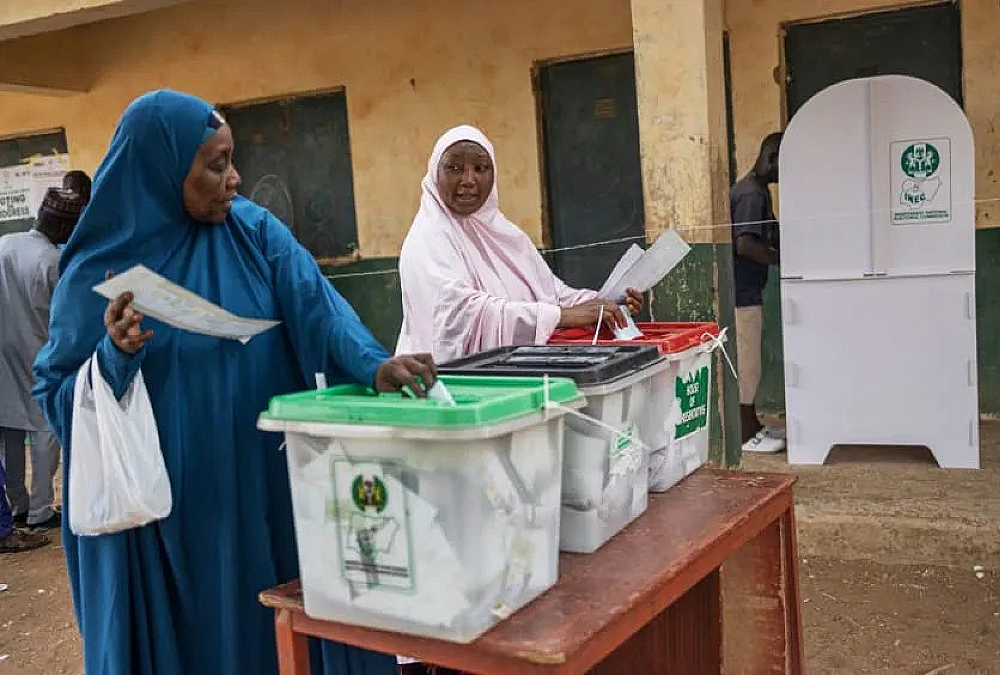
AFP | Nigerians voted on Saturday for a successor to President Muhammadu Buhari in a tightly fought race, with three frontrunners for the first time in the country’s modern history.
Nearly 90 million people are eligible to vote in the election, which is taking place as Africa’s most populous democracy grapples with a multi-front security crisis, a sluggish economy, and widening poverty.
For the first time since the end of military rule in 1999, a third serious candidate has emerged to challenge the dominance of the ruling All Progressives Congress (APC) and main opposition Peoples Democratic Party (PDP).
With Buhari stepping down after two terms in office, the APC’s Bola Tinubu, 70, a former Lagos governor and political kingmaker, says “It’s my turn” for the presidency.
He faces a familiar rival – PDP candidate and former vice president Atiku Abubakar, 76, who is on his sixth bid for the top job.
But the emergence of a surprise third candidate appealing to young voters, Labour Party’s Peter Obi, 61, has thrown the race open with his appeal for change from his old-guard rivals.
Nearly 10 million new voters registered this year, most of them under 34, representing an essential bloc if they come out to vote.
Voters will also cast their ballot for Nigeria’s two houses of parliament, the National Assembly and Senate.
The Independent National Electoral Commission (INEC) has given no timeline for results, but votes are expected to be tallied within a few days. Under a 2022 law, the official results have to be confirmed within 14 days.
To win the presidency, a candidate must get the most votes but also win 25 percent in two-thirds of Nigeria’s 36 states. If no candidate wins, a runoff will take place within 21 days between the two frontrunners, an unprecedented outcome that some analysts say is a possibility this time around.
“It’s difficult for us to make an easy prediction as to what is going to be the likely outcome,” said Kano State College public affairs lecturer Kabiru Sufi.
The rules reflect a country almost equally split between the mostly Muslim north and predominantly Christian south, and with three main ethnic groups across the regions: Yoruba in the southwest, Hausa/Fulani in the north, and Igbo in the southeast.
This time, Tinubu is a southern Yoruba Muslim, Atiku is an ethnic Fulani Muslim from the northeast, and Peter Obi is a Christian Igbo from the southeast.
