
Business
From Ledgers to Gigawatts: Why Small Firms Need Better Track Records
The continent’s entrepreneurs keep losing deals not because investors lack appetite for risk, but because they lack evidence of execution. Fixing that requires cheaper accounting, smarter project structures.

By Martin Mpukani
Ask an African entrepreneur why investors keep walking away, and the answer is usually a complaint about money: too little of it, at too high a price, offered too rarely. Ask the investors, and you hear something different. The money is there. What is missing is evidence.
Africa’s small and medium-sized enterprises do not merely have a capital problem. They have a track record problem. In investment, a track record is not a formality but the currency itself.
A Conversation Cut Short
Investors ask for clean books, reliable financial statements and, where possible, positive earnings before interest, taxes, depreciation and amortization. Too many African businesses cannot supply them, and the conversation ends before it has begun. Opportunity is rarely the obstacle. A credible financial history is.
This argument does not seek to assign fault to the entrepreneur. During a recent discussion on the subject, Zambian entrepreneur Christopher Simukulwa raised a compelling objection that warrants serious consideration: How can a firm generating US$300,000 in annual revenue alongside US$450,000 in expenses reasonably afford audited financial statements? For a struggling enterprise, compliance costs often represent an unaffordable luxury reserved for already established companies.
He is right, and that is precisely why prescriptions alone will not do. Telling a business to “get audited” is like telling a hungry person to eat well. What the market needs are practical, proportionate tools: affordable bookkeeping, phased financial reporting, and compliance support scaled to the size of the firm. A business can build a credible record long before it is ready for a full audit. Accountants, regulators, development banks and industry associations all have a role in making that path cheaper and shorter.
The Quick Cash Trap
There is a second problem, discussed far less often, and it is partly self-inflicted.
Local entrepreneurs frequently win projects and then hand the entire job to larger, established contractors. Others sell the contract at a discount for quick cash. The immediate relief is real. The long-term cost is enormous.
The contractor builds the track record. The original promoter walks away with little evidence of execution, no meaningful project financial history and fewer credentials for the next opportunity. When another project comes along, the cycle begins again. The entrepreneur has effectively rented out the one asset that investors value most.
Investors cannot fund stories alone. They fund documented delivery. That means retaining a stake where it is commercially sensible, formalizing subcontracting arrangements in writing, keeping separate project accounts, and collecting completion certificates and client references. Even a new venture with no operating history is not necessarily shut out: signed contracts, predictable cash flows and a sound financial model can support a credible case.
Seen this way, bookkeeping is not administrative drudgery. It is the asset that gets you funded.
The 250-Gigawatt Lesson
The same logic operates at the scale of nations, and nowhere is it clearer than in energy.
In the first half of 2025, China installed well over 200 gigawatts of new solar capacity, a volume that rivals the entire American fleet built over decades. The speed was not an accident of sunshine. It was the product of industrial capacity, consistent policy, mobilized capital and an ability to execute at scale. China did not announce ambitions. It accumulated a track record, then used it to attract still more investment.
The lesson for Africa reaches well beyond solar panels. It concerns what happens when policy stays consistent long enough for investors to believe it.
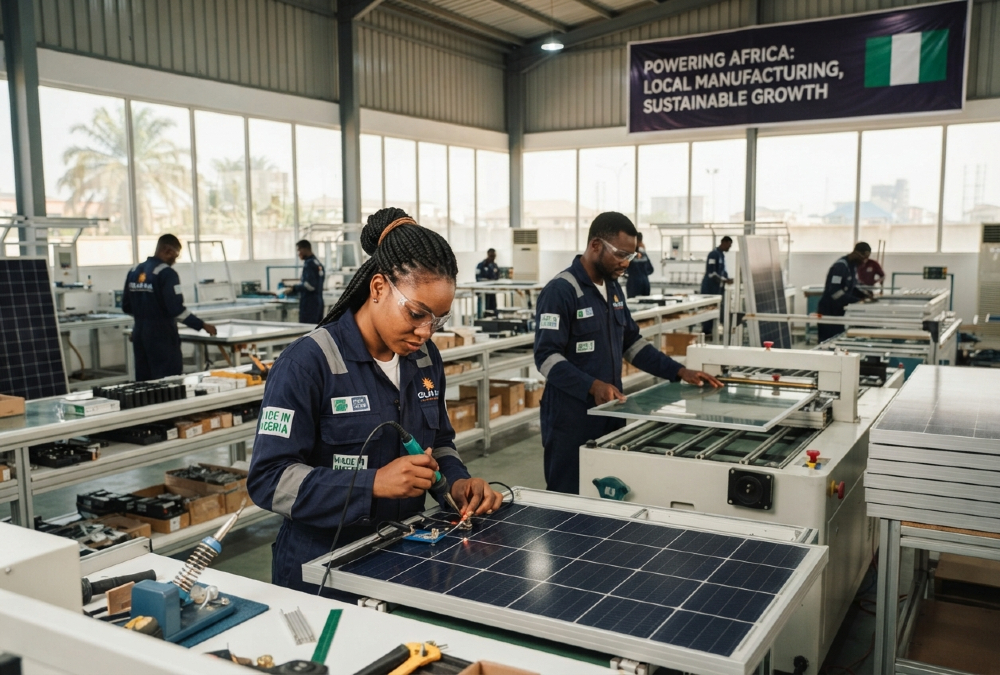
Consider Zambia. It has abundant sunshine, growing electricity demand, an expanding mining sector and an urgent need to diversify an energy mix still vulnerable to drought. Solar there is not only a way of generating electricity. It is an opening for local manufacturing and assembly, component supply chains, distributed energy systems, commercial and industrial installations, battery storage and new financing models.
The risk is that Africa settles for the role of customer. Importing ever more solar equipment is better than blackouts, but it leaves the continent at the bottom of the value chain, paying for technology whose profits accrue elsewhere. The more ambitious question is how to participate meaningfully in that chain, and that is a question about capability, not just capital.
One Problem, Two Scales
The small contractor and the national energy strategy face the same test. Capital flows toward credibility: clean records for the firm, consistent rules for the country. A business that sells away its projects forfeits its history. A government that changes its energy and tax rules with every budget forfeits investor confidence. Each, in its own way, is choosing short-term relief over long-term standing.
None of this is an argument for pessimism. China’s example should unsettle our assumptions about what is possible. Impossible, as the slogan has it, is nothing. But slogans do not build solar plants or balance sheets. Ambition must be matched by policy, by investment and, above all, by execution that can be seen, audited and verified.
Africa does not need to wait for more capital to arrive. It needs to become the kind of place, and the kind of business, that capital can recognize. The ledger comes first.
Martin Mpukani is a serial entrepreneur and the Founder & CEO of The Business Place Network, as well as the founder of AfriLeap Capital, a hybrid early-stage venture pipeline builder and impact finance partner focused on informal and climate ventures across Africa. He is dedicated to supporting entrepreneurs in low-income communities, empowering young people with limited opportunities, and driving scalable ventures that foster economic growth and social impact.
