
Opinion
Ethiopia’s EV Gamble – An Automotive Success Story in Leapfrogging
The country that banned gasoline and diesel car imports before anyone else is now a test case for how the developing world can leapfrog the fossil-fuel era.

By Des H. Rikhotso
When Ethiopia announced in January 2024 that it would stop importing gasoline and diesel passenger vehicles, the skeptics had an easy line: Can a low-income African country that struggles with power cuts really run on electricity? Rich countries had set distant deadlines for phasing out combustion engines. Ethiopia simply drew a line and stepped over it.
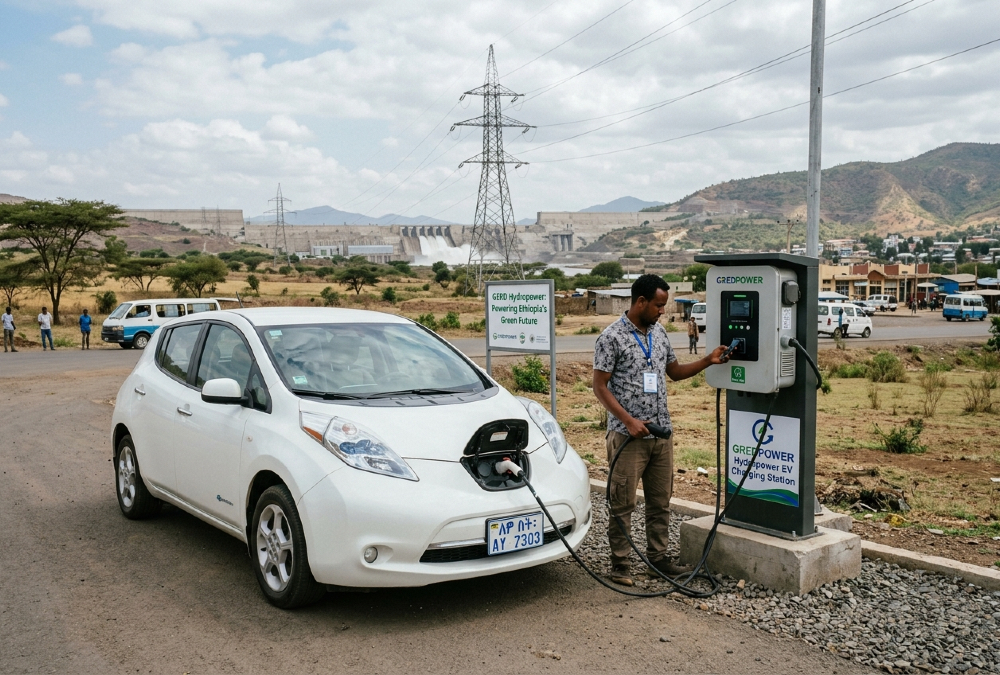
Two years later, the doubters look less confident. Government and industry figures put the number of electric vehicles on Ethiopian roads at more than 115,000, roughly 8 percent of the national fleet. Electric buses, taxis and private cars are now a common sight in Addis Ababa. A handful of local assembly plants are putting young Ethiopians to work. For a country long defined abroad by drought and aid appeals, this is a striking change of image.
A Policy Driven By Arithmetic
Ethiopia did not ban combustion cars out of climate idealism alone. It did so because of the numbers. The country has no meaningful oil production, and every liter of fuel must be bought with scarce hard currency. Officials have cited a fuel-import bill of about US$7.6 billion in 2023, a staggering sum for an economy that has repeatedly struggled with foreign-exchange shortages. Every dollar spent on petroleum is a dollar not spent on medicine, machinery or debt service.
Electricity, by contrast, is something Ethiopia has in abundance. Nearly all of its power comes from renewable sources, overwhelmingly hydropower, and the Grand Ethiopian Renaissance Dam, Africa’s largest, has roughly doubled national generating capacity. The logic is simple: swap an imported, volatile commodity for a domestic, renewable one.
The household math is just as compelling. Early adopters report spending around US$4 a month to charge a car that would otherwise cost about US$27 in fuel. In a country where incomes are low, that gap is not a rounding error but a meaningful change in family budgets.
What the Skeptics Got Right
It would be dishonest to present Ethiopia as a finished triumph. The caveats are real.
Charging infrastructure remains thin outside the capital, and anyone who has lived through Ethiopian power rationing knows that generation capacity does not guarantee reliable delivery. The vehicles themselves are largely imported, mostly from China, which means the foreign-exchange savings on fuel are partly offset by the cost of the cars. Heavy trucks and long-haul transport are far harder to electrify than city taxis. And the ban’s most celebrated figures come from official sources that outside analysts have not independently audited.
Nor is it clear that every poorer country can replicate the model. Ethiopia’s advantage is hydropower on an unusual scale, built over more than a decade at enormous cost and with considerable diplomatic friction along the Nile. A country that relies on gas-fired or diesel generation would simply be moving its emissions from the tailpipe to the power plant.
The Lesson for the Rest of Africa
Still, the broader point stands. Africa’s car fleet is young in the sense that it is still being built. Most of the continent’s drivers have yet to buy their first vehicle, which means the choice between combustion and electricity is still open. Countries that lock in petrol infrastructure now will pay for it for decades. Those that build charging networks, local assembly and clean grids instead may find themselves ahead of wealthier peers saddled with legacy systems.
That is the real meaning of “leapfrogging.” Africa skipped landlines for mobile phones and bank branches for mobile money. Electric mobility could be the next such jump, but only where three conditions hold: abundant clean power, a reliable grid and a government willing to commit.
Nigeria, Ghana and Kenya each have some of these ingredients. Kenya already generates most of its electricity from geothermal, hydro and wind. Ghana has hydropower and growing solar capacity. Nigeria has the largest market and the most to gain from cutting its dependence on imported refined fuel, but its grid problems are well known. None needs to copy Ethiopia’s outright ban. Tax breaks, import-duty cuts, public-transport electrification and support for local assembly could all move in the same direction.
Acting While Others Debate
Ethiopia’s experiment will not be judged on press releases. The test is whether the grid holds as the fleet grows, whether charging reaches beyond the capital, and whether local manufacturing deepens rather than stalls. Those questions will take years to answer.
But the country has already shown something important. A poor nation can set an ambitious deadline, align it with its natural resources and start building. While wealthier governments continue to debate timelines, Ethiopia is learning by doing. For the rest of Africa, that may be the most valuable export of all.
Des H Rikhotso (PgDip-BA, MBL) is a seasoned C-suite Multi-Industry business executive with 25+ years of Business Leadership Experience across the South, East and Western Sub-Sahara Africa Region. Based in Kampala, Uganda he serves as East Africa Region Business Executive, driving Business Strategic Growth and Operational Excellence – contributing his Leadership Voice and Clarity to the Region. Des has held Business Leadership roles at BMW Group Africa, Volkswagen Group Africa, Peugeot Motors South Africa, Toyota/Lexus South Africa, Nissan Group of Africa, G.U.D Holdings (Africa Exports Operations Division) and The HDR Group of Companies. He holds Under-Graduate and Post-Graduate business degrees from the University of the Western Cape, Wits University (Wits Business School) and the University of South Africa.
