
Business
Black Economic gains reversed in Great Recession
BALTIMORE (AP) – For the black community, where unemployment continues to rise, job loss has knocked them out of the middle class and back into poverty…
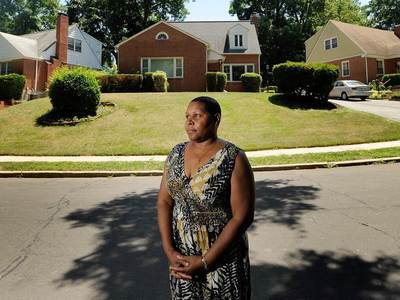
Growing up black in the segregated 1960s, Deborah Goldring slept two to a bed, got evicted from apartment after apartment, and watched her stepfather climb utility poles to turn their disconnected lights back on. Yet Goldring pulled herself out of poverty and earned a middle-class life — until the Great Recession.
First, Goldring’s husband fell ill, and they drained savings to pay for nursing homes before he died. Then Goldring lost her executive assistant job in the Baltimore hospital where she had worked for 17 years. The cruelest blow was a letter from the bank, intending to foreclose on her home of almost three decades.
Millions of Americans endured similar financial calamities in the recession. But for Goldring and many others in the black community, where unemployment has risen since the end of the recession, job loss has knocked them out of the middle class and back into poverty. Some even see a historic reversal of hard-won economic gains that took black people decades to achieve.
Goldring remembers her mother taping the window shades to the wall so no one could see them stealing electricity. She remembers each time she sat on the curb with her three brothers, surrounded by her family’s belongings, waiting for a new place to live. Sitting on those curbs, she promised to always pay her bills on time.
Now, after finding herself poor again, “the only word I can say is devastated,” says Goldring, 58.
“For me to live that life we were so comfortable in, we never had to worry about finances, we always had money where I can help my kids and my grandchildren — to go to calling my daughter to borrow $100 because I can’t pay a bill …” Goldring’s voice trails off as she struggles to hold back tears.
Economists say the Great Recession lasted from 2007 to 2009. In 2004, the median net worth of white households was $134,280, compared with $13,450 for black households, according to an analysis of Federal Reserve data by the Economic Policy Institute. By 2009, the median net worth for white households had fallen 24 percent to $97,860; the median black net worth had fallen 83 percent to $2,170, according to the Economic Policy Institute (EPI).
Algernon Austin, director of the EPI’s Program on Race, Ethnicity and the Economy, described the wealth gap this way: “In 2009, for every dollar of wealth the average white household had, black households only had two cents.”
Since the end of the recession, the overall unemployment rate has fallen from 9.4 to 9.1 percent, while the black unemployment rate has risen from 14.7 to 16.2 percent, according to the Department of Labor.
“I would say the recession is not over for black folks,” Austin says. He believes more black people than ever before could fall out of the middle class, because the unemployment rate for college-educated blacks recently peaked and blacks are overrepresented in state and local government jobs that are being eliminated due to massive budget shortfalls.
Maya Wiley, director of the Center for Social Inclusion, says the anti-discrimination laws passed in the 1960s took decades to translate into an increase in black economic security — and that was before the recession.
“History is going to say that the black middle class was decimated” over the past few years, Wiley says. “But we are not done writing history.”
Goldring was born and raised in Baltimore, and her mother was single for much of Goldring’s childhood. At 16, she dropped out of school and went to work cleaning hotel rooms.
“That’s when I first met white people. Some of them would stay a month at the hotel. They would have all their children with them,” she remembers. “I thought, one day I’d like to hang out at a hotel.”
She didn’t know any middle-class people in her all-black neighborhood. “Where we lived, everyone struggled. We just struggled a little harder,” she says. “If the lights stayed on for a whole year, if we didn’t get put out, I thought we were doing really, really well.”
At 21, pregnant with her second child, Goldring decided to get her GED. Then she went to community college, got a degree in secretarial work, and began a career.
She met her husband in 1983. He had a steady job as a heating and air-conditioning installer, and owned a brick two-bedroom home in Morgan Park, a leafy, integrated neighborhood.
With two incomes, money was not a problem. He liked to travel. She had never been out of Maryland.
“I thought, ‘Is this how rich people live?'” Goldring remembers. “From where I was to where I ended up, it was way different.”
Her husband had been married before. As a condition of the divorce, his daughter’s name was added to the deed of the house. After Goldring’s husband died in 2007, Goldring took out a 30-year fixed-rate mortgage, with a 6.5 percent interest rate, to purchase the house outright.
Everything was fine until her hospital “restructured” in 2009. Her boss, a senior vice president, was transferred to the corporate office. Executives were now sharing secretaries. A few months later, they let Goldring go.
But what Goldring misses the most is her checkbook. Her unemployment payments arrive on a debit card.
“Just being able to pull out my checkbook and pay a bill, even though there might not be much left in there,” she says. “I really miss that checkbook with my name on it.”
This May, black male employment fell to the lowest level since the government began keeping track in 1972. Only 56.1 percent of black men over age 20 were working, compared with 68.3 percent of white men.
