
Business
The Fruit Map That Transforms Global Trade Strategies

By John Kourkoutas
A groundbreaking map showing the two most consumed fruits in every country reveals an irrefutable truth with profound implications for international fruit trade and agribusiness: climate – not economic zones – is the decisive factor shaping agricultural markets. This simple, colorful visualization explains why fruit export businesses thrive in some countries but falter in others, offering a clear roadmap for smarter, climate-aligned strategies.
Climate as the Compass of Consumption
The correlation is clear: climate determines agriculture; agriculture drives consumption; consumption creates market opportunities. For decades, many exporters and investors have erred by ignoring this chain, targeting markets by GDP or economic blocs rather than climatic compatibility.
The map’s patterns speak volumes:
- Bananas dominate tropical zones across Africa, South America, and parts of Asia.
- Apples reign supreme in temperate Europe, North America, and parts of Asia.
- Oranges flourish in Mediterranean climates and select regions of the Americas.
- Coconuts thrive in tropical coastal regions of the Pacific and Southeast Asia.
- Grapes favor Mediterranean zones.
- Watermelons are prevalent in hot, arid areas like the Middle East and Central Asia.
- Mangoes exhibit strong presence in significant swaths of Africa and tropical Asia.
These climatic realities are the bedrock on which successful fruit export strategies must be built.
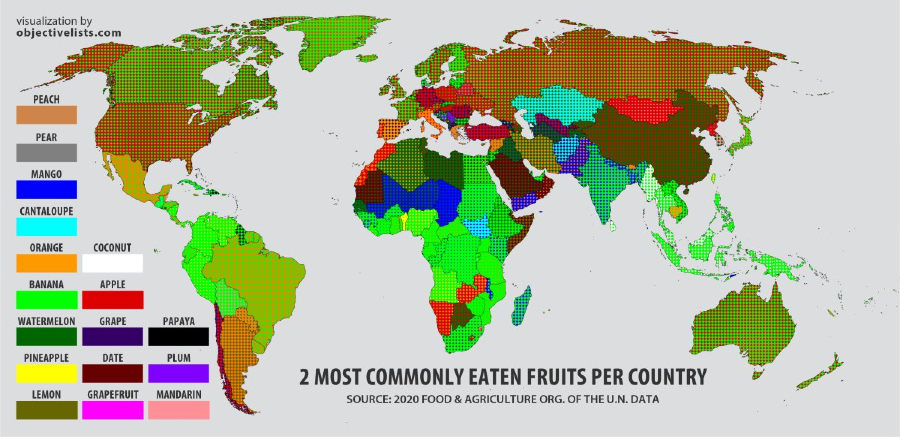
Map showing the two most consumed fruits by country, highlighting climate zones that influence global fruit trade patterns and export strategies
Lessons from 100+ African Food Projects
Experience gathered from numerous food projects across Africa validates the critical takeaway: successful fruit export and processing strategies must align with climate zones rather than artificial economic boundaries.
Export failures often stem from predictable yet avoidable mistakes:
- Exporting apples to tropical African markets results in limited sales due to lack of local production, high import premiums, and niche luxury status.
- Conversely, trading bananas within the tropical belt leverages climate familiarity and mass-market demand.
The same principle applies to processing equipment and ingredient marketing. Targeting banana-processing machinery to tropical regions or apple-processing lines to temperate zones avoids the costly pitfalls of mismatched investments.
Strategic Business Implications
- Fresh Fruit Trade: Matching exports to climate zones fosters scalable trade. Tropical-to-tropical (Africa and Latin America) and temperate-to-temperate (Europe and North America) flows succeed, while cross-climate fruit trade tends to remain niche.
- Processing Equipment: Fruit-processing investments must reflect local production. Banana lines suit tropical yellow zones, apple lines belong in temperate red zones.
- Ingredients & Flavors: Culinary tastes resonate with familiar climates. Banana-flavored products thrive in tropical markets, while apple flavors have temperate appeal.
- Supply Chains: Local fruit supports shorter, cost-effective supply chains and mass consumption. Imported fruit demands costly, longer chains and luxury positioning, necessitating cold chain investments aligned with local dominant fruits.
Avoiding Market Missteps
The critical lesson is to stop trying to “sell snow to the desert” or “sunshine to the Arctic.” Regional fruit preferences, production, and infrastructure follow geographic and climatic conditions more closely than economic classifications or income levels.
The fruit map is not merely a colorful guide; it is a strategic tool essential for exporters, processors, marketers, and supply chain planners worldwide who seek enduring, scalable success.
The Way Forward
Businesses must recalibrate their fruit strategies: invest in infrastructure where the fruit grows, target imports as premium products in non-growing regions, and craft supply chains embedded within climatic corridors. Aligning fruit trade with the climate promise unlocks vast market potential hidden by conventional economic thinking.
What fruits does your business focus on, and are you truly targeting climate-compatible markets? The answer could redefine your path to growth and sustainability.
John Kourkoutas is business development expert that specializes in helping companies, export teams, and business leaders succeed in Africa’s dynamic and emerging markets.
