
Business
Africa’s Battery Ambition: Moving From Mines to Gigafactories
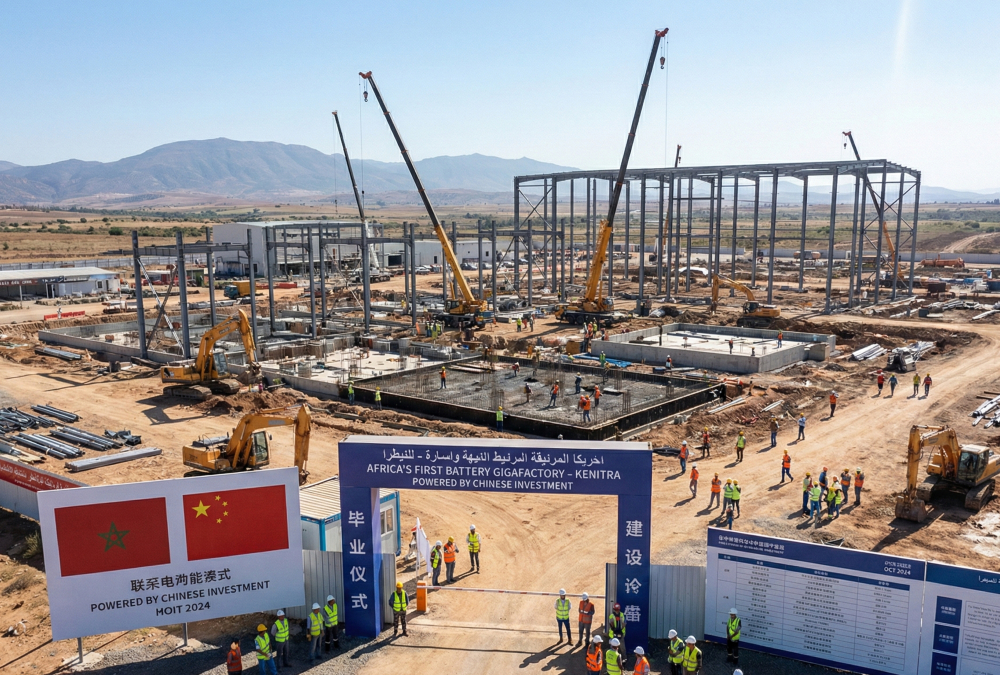
Africa is stepping decisively beyond raw mineral exports, with Morocco, the Democratic Republic of Congo (DR Congo), Zambia, and South Africa leading a strategic push into battery and electric vehicle (EV) manufacturing.
Construction has begun in Kenitra, Morocco, on the continent’s first battery gigafactory – a US$5.6–6.5 billion investment by China’s Gotion. Designed to produce 20 GWh annually and scale to 100 GWh, the plant targets Europe’s booming EV and energy storage markets and is projected to generate thousands of jobs.
More than an industrial facility, it signals Morocco’s intent to anchor itself in the green manufacturing value chain, not just supply its raw materials.
Further south, the DR Congo and Zambia are forging a joint battery and EV corridor, backed by the African Development Bank. Industrial zones in the Copperbelt and Katanga aim to process cobalt, nickel, manganese, and lithium locally – retaining value and control long ceded to foreign refiners.
South Africa completes the emerging triangle. Its new critical minerals strategy and EV roadmap seek to transform exports of manganese, platinum, and vanadium into made-in-Africa battery components and systems.
The rationale is clear: Africa holds roughly one-third of the world’s critical minerals for the energy transition. Yet for decades, nearly all downstream value has been captured abroad.
Today, at least five African nations possess four or more key battery materials – and reaching competitive cell production scale (10–15 GWh) is feasible if projects target global, not just domestic, demand.
But industrial ambition alone isn’t enough. Success hinges on governance.
These same minerals sit at the center of a global geopolitical scramble. Overly restrictive export bans or poorly calibrated local-content rules risk deterring the very investment needed to build refineries, cathode plants, and gigafactories.
Morocco’s gigafactory, the DR Congo–Zambia corridor, and South Africa’s incentives are still works in progress – political, imperfect, and evolving. Yet together, they mark a pivotal shift: from extraction to strategy, and from commodity dependence to industrial agency.
