
Business
The Agricultural Opportunity Map: Where Global Supply Chains Meet Market Potential

By John Kourkoutas
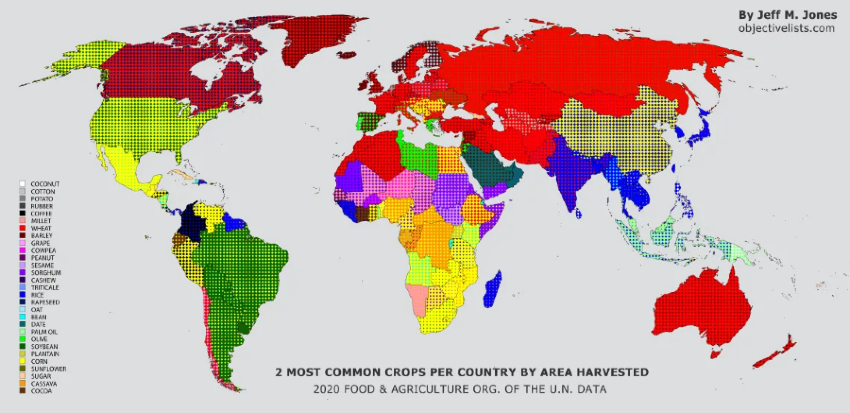
A glance at a global map of the two most widely cultivated crops per country reveals more than just farming patterns – it exposes the hidden architecture of economic resilience, supply chain vulnerability, and untapped commercial opportunity. From wheat belts in Canada to cassava heartlands in the Democratic Republic of Congo (DR Congo), the colors tell a story: agricultural diversity isn’t just a farming metric – it’s a strategic compass for global business.
Consider the palette:
- (Red) Wheat dominates temperate zones – North America, Russia, Australia—anchoring economies built on grain exports.
- (Green) Soybeans define South America’s agro-export engine.
- (Blue) Rice underpins food security across Asia.
- (Yellow) Corn/Maize fuels both food systems and livestock feed in the U.S. and Sub-Saharan Africa.
- (Purple) Millet and sorghum thrive in the arid belts of West Africa and India, offering climate-resilient sustenance.
- (Orange) Cassava sustains millions in Central Africa as a low-input, high-yield root crop.
After 15 years working across Africa’s agricultural landscapes, one insight stands out: the more diverse a country’s crop profile, the more complex – and lucrative – its value chain opportunities become. Conversely, monoculture economies, while efficient at scale, carry concentrated risk: a single pest outbreak, price shock, or climate event can destabilize entire national economies.
Why Crop Diversity Matters to Business
For investors, agribusinesses, and technology providers, this map is not just informative – it’s prescriptive. It reveals where generic “agricultural solutions” fail and where precision wins.
- Monoculture zones (think solid blocks of wheat or soy) offer scale but limited entry points – and high systemic risk.
- Diverse agricultural regions present multiple niches: from seed inputs to post-harvest handling, each crop demands its own ecosystem of services, infrastructure, and innovation.
- Crop-specific requirements dictate everything: storage conditions, transport logistics, processing machinery, and even financing models.
Regional Opportunities – Decoded
West Africa (Millet, Sorghum, Cassava):
This is the frontier for drought-resilient agritech. Opportunities abound in:
- Mechanized processing for cassava (a crop that spoils within 72 hours of harvest)
- Hermetic storage for low-moisture grains like millet
- Digital platforms linking smallholders to regional food security programs
East and Southern Africa (Maize, Cassava):
Here, the bottleneck isn’t production – it’s post-harvest loss. High-potential sectors include:
- Small-scale milling and grain drying tech
- Climate-smart fertilizer formulations tailored to maize
- Hybrid cropping systems that integrate legumes to restore soil health
North Africa (Wheat, Barley):
Heavily reliant on imports, these nations need:
- Efficient grain terminal infrastructure
- Water-efficient irrigation for Mediterranean crops
- Bakery and flour-processing equipment aligned with local consumption patterns
The Missed Opportunities
Too many companies enter emerging markets with a one-size-fits-all playbook. They pitch “agricultural solutions for Africa” – a continent of 54 countries, 30+ major crops, and wildly divergent agro-ecologies.
The result? Misaligned products, wasted capital, and missed impact.
The truth is starkly specific:
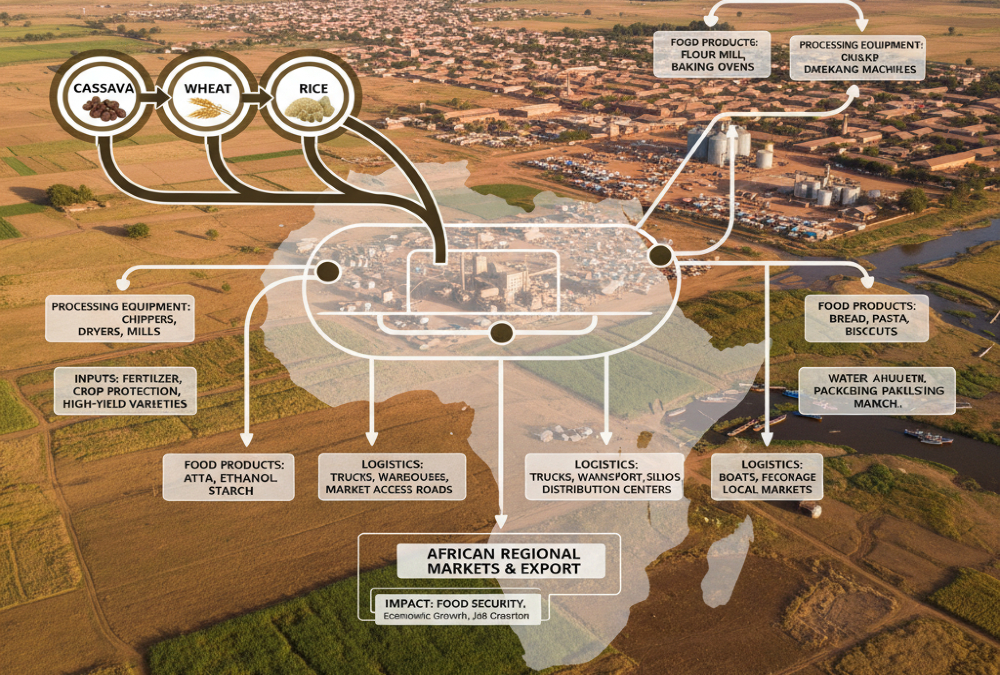
- Cassava processing equipment bears no resemblance to wheat mills or rice polishers.
- Fertilizer blends for sorghum in Niger differ fundamentally from those for maize in Zambia.
- Logistics for perishable roots demand cold chains or rapid processing – unlike bulk grain transport.
And food manufacturers? Their raw material constraints are dictated by what grows where.
You cannot build a maize-based snack brand in a cassava-dominant region without first solving supply chain fundamentals.
A New Playbook for Agribusiness
The companies thriving across Africa share a common trait: they design solutions crop-by-crop and country-by-country.
- They sell cassava grating machines to Nigeria, not “farm equipment to Africa.”
- They deploy maize hermetic storage in Zambia, not generic silos.
- They introduce sorghum seed varieties in Niger, calibrated to local rainfall patterns.
This isn’t just good development practice – it’s smart business. Precision reduces customer acquisition costs, accelerates adoption, and builds defensible market positions.
Your Move
Look again at the map. It doesn’t just show what grows where – it reveals where your expertise fits, where competition is saturated, and where unmet needs await your solution.
So ask yourself: Which segment of the agricultural value chain does your business truly serve? And which countries on this map need exactly that – right now?
The future of global agribusiness won’t be won by those who see “Africa” as a single market. It will be claimed by those who see Nigeria’s cassava belt, Ethiopia’s sorghum highlands, and Kenya’s maize corridors – and act accordingly.
The crops are on the map. Your strategy should follow.
John Kourkoutas is business development expert that specializes in helping companies, export teams, and business leaders succeed in Africa’s dynamic and emerging markets.
