
Business
Africa’s Agriculture Is Being Rebuilt From the Inside Out
The signals coming out of Nairobi suggest that the continent’s food systems may finally be turning a corner – not through aid, but through architecture.

By Sheena Raikundalia
There is a familiar rhythm to agricultural conferences in Africa: a recitation of what is broken, a gallery of problems, a polite agreement to do better. The Agriculture Side Event at the Kenya International Conference (KIICO 2026), which this writer had the privilege of moderating last week, offered something rarer – a room populated not by theorists, but by builders.
Private-sector operators, government officials, and investors gathered not to diagnose failure, but to report progress. The distinction matters more than it might seem.
Patient Capital Is Making a Comeback
Elgon Kenya Ltd has been operating in Kenya for more than a century. Rather than retreating, the company is deepening its commitment – expanding into fertilizer distribution, forging partnerships with academic institutions, and establishing the Kantaria Agriculture Technology and Innovation Centre, a facility designed to rethink the fundamentals of how farming is practiced and supported.
This is patient capital – the kind that does not demand returns within a quarterly earnings cycle. It is also, historically, the kind most conspicuously absent from African agriculture. Its return is significant.
Waste, Reframed as Revenue
Del Monte Foods, present in Kenya for over 60 years, is converting pineapple waste into commercial value. This is not a corporate social responsibility initiative dressed up in green language.
It is a straightforward business calculation: lower input costs, greater operational efficiency, and entirely new revenue streams extracted from material previously discarded.
“Waste is no longer waste,” a company representative noted – a formulation that sounds like a slogan but is, in practice, a business model.
The Capital Was Always There
Perhaps the most clarifying moment of the event came from KCB, one of Kenya’s largest commercial banks. The constraint on agricultural lending, the bank’s representatives argued plainly, is not a shortage of capital. It is a failure of risk architecture. Structure the risk better – through blended finance, guarantees, or insurance mechanisms – and the money follows.
This reframing is consequential. It shifts the conversation away from mobilizing new resources and toward redesigning the terms on which existing resources are deployed. The implication is that much of what has been framed as a financing gap is, in fact, a structuring problem.
Infrastructure as Competitive Advantage
TradeMark Africa reported that the time and cost required for certain cross-border trade transactions at the Port of Mombasa have fallen by as much as 80 percent. That figure deserves to be read slowly.
An 80 percent reduction in trade friction does not merely improve logistics – it restructures the economics of entire supply chains, making Kenyan agricultural exports more competitive and regional integration more viable.
Government as Enabler, Not Obstacle
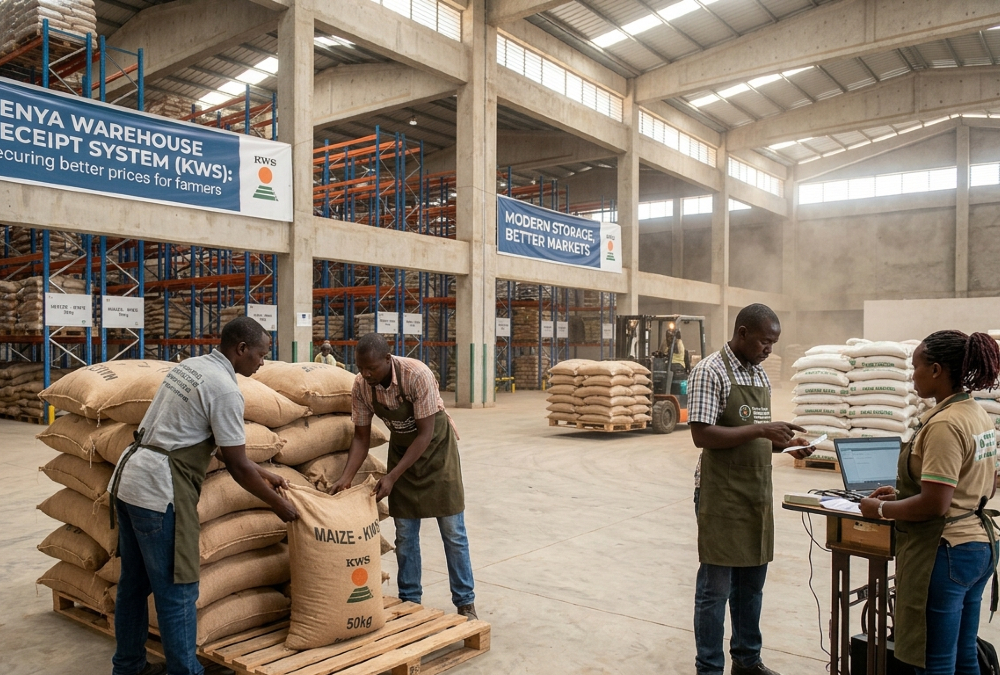
Among the government initiatives discussed, two warrant particular attention. The Warehouse Receipt System – which allows farmers to store produce and borrow against its value rather than selling immediately at distressed prices – is already changing outcomes at the farm level.
One story from the event illustrates the mechanism concisely: a woman farmer stored maize valued at Ksh2,800 (US$22) per unit and sold it later at Ksh4,000 (US$31). Before such a system existed, that maize might have spoiled or been sold at a loss.
With it, she had timing, documentation, and meaningfully better income. The Irrigation Authority’s efforts to expand water access compound this logic: more reliable water supply means more reliable production, which means more reliable collateral, which means more lending.
A System Beginning to Cohere
What made KIICO 2026’s agriculture session genuinely striking was not any single initiative, but the way the pieces appeared to be connecting. More water feeds more production.
Better storage reduces post-harvest loss. Smarter risk structures unlock more lending. Private-sector investment drives innovation. Circular-economy thinking generates new value from existing resources. And the African Continental Free Trade Area (AfCFTA) provides the market scale that makes all of it commercially viable.
This is what a functioning agricultural system begins to look like – not a single intervention, but an architecture.
Additional signals reinforce the thesis. Dangote’s fertilizer operations are entering the Kenyan market, increasing supply and reducing import dependency.
The Dutch Business Council is facilitating engagement from more than 150 companies. The conversation across the sector is shifting from farming in isolation to value chains in their entirety, with academia-industry partnerships adding intellectual infrastructure to physical and financial capital.
The Risks Are Real – and That Is Precisely the Point
None of this is to suggest that African agriculture has solved its structural vulnerabilities. Climate volatility, geopolitical disruption, and supply-chain fragility remain genuine threats.
When conflicts erupt between distant nations, commodity markets, shipping routes, and input supplies can all be affected – sometimes severely.
But that observation leads not to pessimism, but to urgency. The case for building resilient, integrated, domestically anchored agricultural systems is not merely developmental.
It is strategic. The countries that construct the right architecture now – connecting water, storage, finance, private investment, and regional trade – will be the ones least exposed when the next external shock arrives.
Last week in Nairobi, there was evidence that Kenya, at least, is building.
Sheena Raikundalia is an accomplished entrepreneur, former lawyer, government policy advisor, and angel investor with deep expertise across the legal, financial services, and impact investment sectors in Europe and Africa. She has played a pivotal role in advancing Africa’s technology and innovation ecosystems, leveraging a career that spans top-tier London law firms, leadership as Country Director of the UK-Kenya Tech Hub for the UK Foreign, Commonwealth & Development Office (FCDO), and her current position as Chief Growth Officer at agri-tech company Kuza One. Sheena is recognized for her strategic vision, commitment to fostering innovation, and strong advocacy for Africa’s growth potential in technology, entrepreneurship, and impact investment.
