
Business
The Way Forward for the BRICS New Development Bank
2013 was a difficult year for the five BRICS countries. China and Brazil faced slowing growth, South Africa and India were hit by currency instability, and concern over Russia’s governance deepened (before recent events in the Ukraine pitched them into all-out crisis). As doubts have mounted, investors have increasingly turned back to traditional investment destinations like the United States and Europe, as well as to new formations like the MINTs (Mexico, India, Nigeria and Turkey).
Talk over a decline of the BRICS is overstated, but to ride out this difficult period for the group, renewed effort needs to be placed on developing hard institutions, most importantly the BRICS development bank. When the Group of 20 (G-20) countries meet for their annual summits, attention invariably turns to the negotiated outcomes of the meetings, and expectations run high on the likely actions the group will take.
Outcomes matter because although the grouping is relatively informal and driven by summits, the G-20 has some level of institutional capacity through pre-existing international organisations, such as the IMF and World Bank. BRICS summits are different. The undoubted importance of the group of five emerging superpowers draws similar attention, but expectations are constrained by the limited capacity of the BRICS to act as a coordinated group, rather than as five distinct countries. The advent of a BRICS-led New Development Bank, or NDB, would change that.
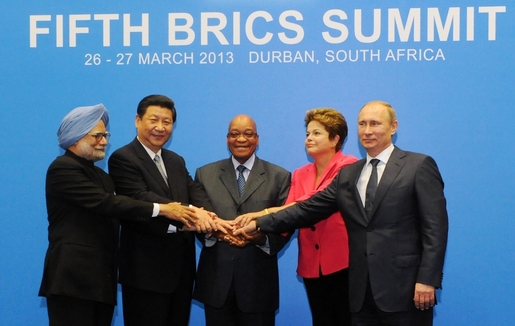
The idea of a BRICS Development Bank was mooted at the 2011 summit in New Delhi, and announced officially at the Durban summit in 2013. Since then, negotiations have been ongoing on how the NDB should work in practice. As BRICS events kick off for 2014, with the group’s Academic Forum in March, three big issues remain up for debate.
Funding and Decision-Making
Perhaps the biggest question, and the one on which the greatest progress has been made, is how the bank is going to be funded. Understanding who should contribute how much matters because of the high levels of asymmetry within the BRICS grouping: China’s economy is much larger than Brazil, Russia, or India; while South Africa lags some way behind any of the other countries. The BRICS bank could either be made small enough for all countries to afford equal participation and thus democratic governance; or it could accept different countries having differing contributions and unequal influence, but in so doing create a larger and more powerful fund.
Reports suggest that the bank is likely to settle on the first option, with each country contributing USD$ 10 billion, for an initial capitalisation of USD$ 50 billion and a democratic governance structure. This is despite calls by China for a capitalisation of USD$ 100 billion, with it contributing the largest share. To put these numbers into perspective, the World Bank has a capitalisation of USD$ 223 billion and an annual budget of around USD$ 5 billion.
On balance, the choice of a small capital base with equal contributions is probably the best option, for three reasons. First, the BRICS development bank is born out of frustration with the Bretton Woods Institutions, the World Bank and IMF, both of which are funded by unequal contributions from member states, and thus have unequal voting power.
