
Business
The Way Forward for the BRICS New Development Bank
This gives disproportionate influence to rich countries such as the United States. This imbalance has been roundly criticised by all five BRICS countries, which call for reform of the institutions. If the BRICS’ response was a development bank that itself was undemocratic, it would undermine their criticisms and their efforts for broader reform of global economic governance.
Secondly, the democratic model makes it easier to facilitate the entry of other developing countries into the development bank. Rhetoric around the bank has shifted from talk of a ‘BRICS Development Bank’ to that of a ‘BRICS-led New Development Bank.’ The change seems to reflect the desire to bring other leading emerging countries, such as Indonesia or Turkey, and possibly some developed countries into the NDB.
If voting rights in the bank were distributed according to percentage contribution to overall capital, then the entry of new members would require a difficult renegotiation of voting rights and a shift in power. Entry would be much easier under the democratic model: any new country would simply have to match the USD$ 10 billion contribution and any entry conditions, and would then be free to join.
Finally, it must be remembered that initial capital does not determine how much money the NDB will have available to spend. Initial capital acts as seed funding for the Bank, which would then raise more substantial amounts in capital markets, to pay for its operations. Some commentators remain concerned about the ability of a BRICS bank to obtain the type of credit rating that would allow it to tap into low cost credit markets, given that the five countries have a diverse set of sovereign debt ratings, mostly lingering around the BBB level.
However, it seems unlikely that investors would see the bank’s credit rating as some aggregate of the five countries, but rather as a sort of China-Plus bank, with all the reliability of China and the Chinese Development Bank’s impressive ratings, now supported by four other large emerging economies. An impressive credit rating, with low cost loans, would surely follow.
What to Spend on
The most likely focus of BRICS development bank spending will be on infrastructure development. This seems a natural fit: infrastructure is a problem in all five countries, development banks are good at big projects like infrastructure development, and the combined size of the bank would give it the capacity to fund such large projects. Beyond infrastructure, two questions remain.
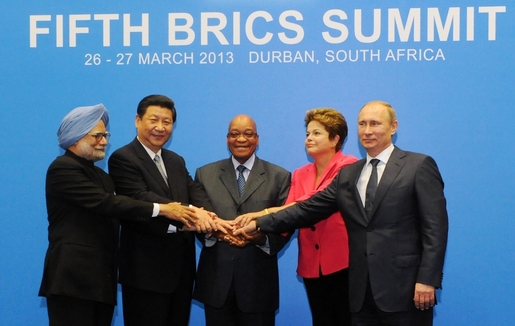
The first is whether spending will also extend into other areas. The eThekwini Action Plan, produced at the Durban BRICS summit in 2013, states that the bank will work in both infrastructure and sustainable development, but it is unclear what the second term encompasses. It seems to include green energy issues, but sustainable development is a very broad term and there is a substantial range of areas the NDB could enter into.
