
Opinion
The $1 Trillion Aid Experiment That Failed African Farmers
Fifty years and $1 trillion in foreign aid later, sub-Saharan Africa’s farmers are still at the mercy of markets they can’t control. The fix isn’t another grant cycle – it’s domestic demand.

By Juwon Akin-Olotu
Sub-Saharan Africa has received close to US$1 trillion in foreign aid over the last five decades. Most people hear that number and assume agriculture – the sector that employs the majority of the continent’s population – received a serious share of it.
It didn’t. Agriculture’s share of total aid fell from 17 percent in the 1980s to under 8 percent by 2009, according to OECD-tracked data, and it has stayed roughly there ever since.
That is not just a funding gap. It is a funding choice – made repeatedly, by donors and governments alike, who decided agriculture was not where the money should go.
Worse, the smaller share that did arrive mostly built projects, not institutions. Training centers that closed when the grant ended. Programs with no local body left to run them once the consultants flew home. Money spent on activity – not on the policy infrastructure that would let African countries build and fund this for themselves.
That is the gap our AgriImpact Policy Lab exists to close. Not by asking for a bigger slice of aid, but by building the people and institutions who can make policy work without waiting for the next grant cycle.
Nigeria Grows World-Class Cocoa and Barely Drinks It
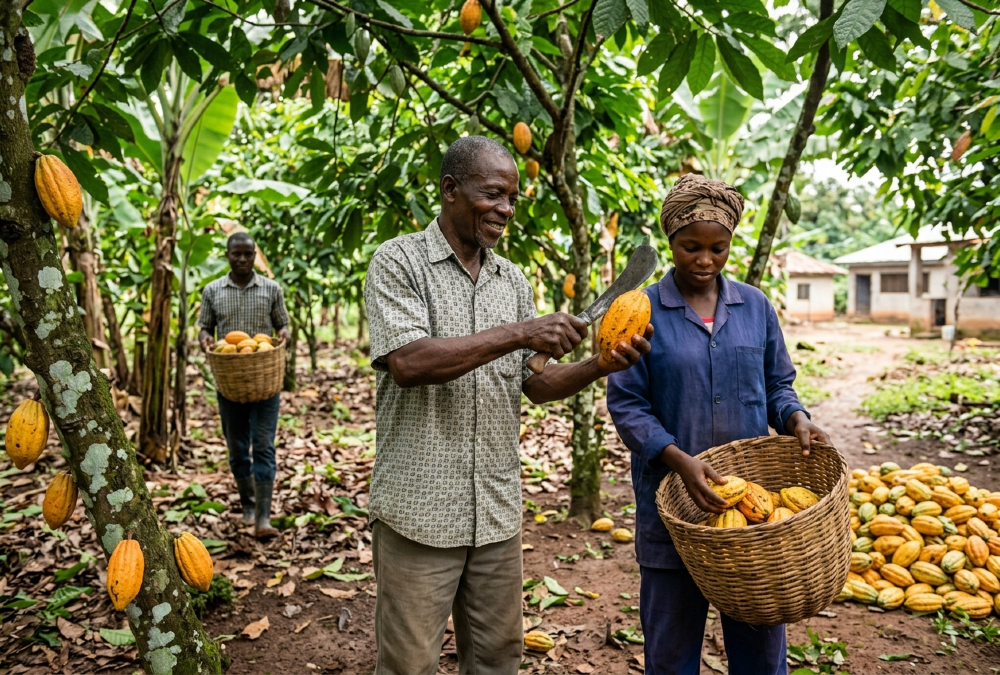
Consider cocoa. Nigeria produces some of the best cocoa in the world – and consumes almost none of it. Domestic beverage consumption sits at around 5 percent of what we grow.
That leaves our farmers standing entirely on international price swings they cannot control. Cocoa hit nearly US$13,000 a tonne in December 2024. By April 2026, it had crashed more than 75 percent to around US$3,000. Farmers with no local market to fall back on and no alternative buyer took the full weight of a collapse they had nothing to do with. Some were left choosing between school fees and food for their own children.
Meanwhile, we still import cocoa powder from our own ECOWAS neighbors while exporting raw beans by the trillion naira. We ship out the raw material and buy back a finished version of it from countries producing a fraction of what we do.
Compare that with Ethiopia. Ethiopians consume 50 to 55 percent of their own coffee domestically and remain one of the largest coffee exporters on earth. Domestic demand did not weaken their export position – it protected it. When international coffee prices swing, Ethiopian producers still have a market that does not move with London or New York. Nigerian cocoa farmers have no such floor.
Value Addition Without a Market Is a Bet, Not a Strategy
We are trying to build processing capacity in the southwest without first building the market to absorb it. Value addition without local consumption is manufacturing capacity looking for a customer – and a farmer base with no protection when that customer disappears overnight.
This is not a problem marketing budgets solve. It is a policy problem. Cocoa belongs in the Home Grown School Feeding Programme, the same way Ethiopians grow up on coffee. Raise a generation of cocoa drinkers and chocolate eaters, and you give farmers a demand base that international speculation cannot crash.
Africa will feed Africa – once it chooses to build the institutions, and the appetites, to make that true.
Juwon Akin-Olotu is the founder and CEO of Forthwith Global Limited, an agribusiness and consultancy advancing sustainable farming and modern agricultural solutions across Africa. A recognized voice in the continent’s agricultural sector, he champions technology adoption, human-capital development, and leadership grounded in service. Akin-Olotu is also a frequent speaker and moderator at international forums, where he addresses sustainable agriculture, agri-technology, and entrepreneurial education.
