
Business
Is Africa Finally Rising?: Determining Myth or Reality
Current State of Economic Development

Statistics highlighting African development reveal a mixed picture. According to the African Development Bank study, 61 percent of Africans live on less than $2/day. Africa’s middle class of 313 million have $2-$20 to spend daily. However 180 million of them are vulnerable to economic shocks, as they only have $2-$4 to spend daily. There are also massive disparities on the continent: 100,000 of the richest Africans own 60 percent of the Africa’s GDP.
Africa’s GDP growth is promising. Sub-Saharan Africa has been growing an average five percent annually for the decade; growth dipped in the last two years due to the financial crisis, but is expected to rise 5.5 percent in 2011 and 5.8 percent in 2012. Natural resources accounted for 24 percent of Africa’s GDP growth from 2000 to 2008; the rest is attributed to other industries.
A Harvard Business Review article cites three factors contributing to Africa’s GDP growth:
1) decline in serious conflicts,
2) healthier governments due to decreased budget deficits and decreased inflation, and
3) adoption of market friendly policies, such as the privatization of state-owned enterprises, reduced trade barriers and corporate taxes.
Yet, that growth might not be sustainable. The Africa Progress Panel states that the GDP growth is of low quality because there has been little structural transformation and diversification. In 2009, 16 of 47 African economies earned 50 percent of their earnings from a single export and for a few African countries one commodity, oil, accounts for 90 percent of the country’s GDP. There are exceptions: Kenya, South Africa, and Tanzania, have all diversified their exports.
Much of Africa’s GDP growth is due the increased price of commodities. Africa has 10 percent of the world’s oil reserves, 40 percent of its gold ore, and 80-90 percent of chromium and platinum deposits. The increased price for commodities, such as gold and oil, as well as food products, has been a boon and a liability for the continent. Africa’s commodities have attracted a lot of foreign investment, particularly by the BRIC countries – Brazil, Russia, India and China. China is mainly interested in commodities, especially oil, while India has also invested in the telecommunications sector.
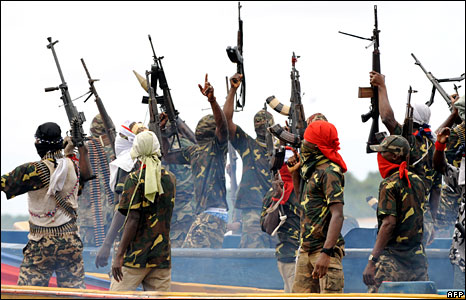
Unfortunately much of the gains have not trickled down to the citizens, and remains in the hands of the multinationals and the corrupt officials. Nigeria, the largest African oil exporter, has earned an estimated $6 trillion from oil, yet 70 percent of its citizens live in poverty. Violence and kidnapping(s) in the Niger delta is/are widespread.
The high price for food products and oil has been problematic for the urban poor, leading to protests and violent demonstrations in numerous countries, such as Uganda and Burkina Faso. African countries that are dependent on food imports are the most vulnerable to the high food prices. In general because of the recent economic crisis and the last food crisis in 2008, most governments have few funds to help the most vulnerable in the present food crisis.
