
A Diaspora View of Africa
High Government Debt Bedevils African Countries

By Gregory Simpkins
High levels of debt have long plagued some African countries (as well as other countries worldwide). High government debt can have far-reaching impacts on government, business and consumers.
For governments, high debt servicing costs may limit government’s ability to invest in public services or respond to crises. Higher interest rates on debt can divert funds from essential services, increased borrowing costs and reduced investor confidence.
For businesses, increased borrowing costs can reduce investment and growth. There could be decreased demand for goods and services. High debt can create economic instability, deterring investment.
Consumers would see reduced public services or increased taxes. There would be increased costs for mortgages, loans and credit. Potential job insecurity and reduced spending power also are likely.
Examples of how high debt negatively affects countries include Greece, which faced severe austerity measures, and Argentina, which struggled with high inflation and debt crises.
The average debt ratio among African nations is 63.2 percent. The top 10 African countries experiencing high debt in 2025 were: Cape Verde (107.21 percent), Mozambique (96.47 percent), Republic of Congo (89.04 percent), Malawi (87.28 percent), Mauritius (80.94 percent), Senegal (80.48 percent), Burundi (80.36 percent), Gabon (79.96 percent), Ghana (79.51 percent) and South Africa (77.40 percent).
Each one reached this point by different means.
The African Exponent website did analysis of several of these countries from their position in 2025 (Top 10 African Countries with the Highest Debt-to-GDP Ratios in 2025).
Country Profiles: Causes and Paths Forward
Cape Verde: As a small island developing state with limited natural resources, its economy is highly dependent on tourism. The COVID-19 pandemic caused a profound economic shock, wiping out its primary source of revenue and forcing a sharp increase in public borrowing to support the economy and fund essential imports.
The government is pursuing an IMF-supported program focused on fiscal consolidation and promoting a resilient and inclusive recovery. Key measures include improving the efficiency of public investment and strengthening financial sector supervision. Cape Verde’s case highlights the plight of Small Island Developing States (SIDS) facing climate change and economic remoteness.
The international community is discussing specialized support for such nations, including more concessional financing and climate-resilient debt clauses, which would pause debt payments following a natural disaster.
Mozambique: The country is still grappling with the aftermath of the hidden debt scandal of 2016, which led to a suspension of direct budget support from international partners. While the discovery and development of vast offshore natural gas fields promise a future revenue windfall, project delays and security insurgencies in the gas-rich Cabo Delgado province have postponed the fiscal benefits.
The government remains reliant on IMF support through an Extended Credit Facility, which focuses on improving governance, strengthening public financial management and enhancing transparency, especially in the management of future natural resource revenues. The long-term outlook hinges on stabilizing the security situation and successfully bringing the LNG projects to production.
When operational, these projects could transform the economy and drastically improve debt sustainability. However, in the short term, the population continues to bear the burden of austerity measures and high living costs
Republic of Congo: The country’s finances are overwhelmingly dependent on oil revenues, making them highly volatile. A period of low oil prices prior to 2022 led to a rapid accumulation of debt, including commodity-backed loans with non-Paris Club creditors, which often carry less favorable terms.
While higher oil prices provide temporary relief, they do not solve the structural issues. Sustainable debt management will require breaking the cycle of oil dependency, improving transparency in the hydrocarbons sector and investing oil revenues into sectors that can generate more broad-based economic growth and jobs.
The country reached a debt restructuring agreement with the Paris Club and other creditors and is under an IMF program. The government is attempting to diversify the economy and improve the management of its oil revenues, but progress has been slow.
Governance challenges and a reliance on a single commodity continue to pose significant risks.
Malawi: The country has been severely battered by climate shocks, including Cyclone Freddy in 2023 and subsequent droughts, which have devastated agricultural output, the backbone of the economy. This has led to a high dependency on foreign aid and concessional borrowing to fund food imports and basic services, further increasing the public debt stock.
A massive currency devaluation of more than 40 percent in 2023 dramatically inflated the local currency value of its external debts, pushing the nation into debt distress. The government is engaged in negotiations with the International Monetary Fund (IMF) for a new financial arrangement and is seeking debt relief under the Common Framework.
The social impact is severe, with high inflation eroding purchasing power for millions. Malawi’s debt sustainability is intrinsically linked to its climate vulnerability.
Accessing climate finance for resilient infrastructure and adopting climate-smart agriculture are not just developmental goals but essential strategies for debt management.
Ghana: The country’s debt distress, which culminated in a domestic debt restructuring program in 2023, was triggered by a combination of large fiscal deficits, currency depreciation and rising global interest rates. While the official creditor deal provides some fiscal breathing room, servicing the restructured debt still consumes a significant portion of government revenue.
The government, under its US$3 billion IMF Extended Credit Facility program, is implementing stringent fiscal consolidation measures. These include new tax measures, cuts to energy sector subsidies, and efforts to bolster tax administration.
The long-term outlook for Ghana depends on its ability to leverage its natural resources, such as gold and cocoa, to boost exports and strengthen the its currency the cedi. Diversifying the economy away from primary commodities and improving public financial management are critical to avoiding future debt cycles.
However, the nation remains vulnerable to external shocks, and its debt sustainability is fragile.
Zambia’s economic trajectory matters beyond its borders. It’s proving that African sovereign debt restructuring is possible, that Chinese and Western creditors can reach agreement and that a commodity-dependent economy can survive default and restructure without permanent damage to its investment relationships
African Debt Successes
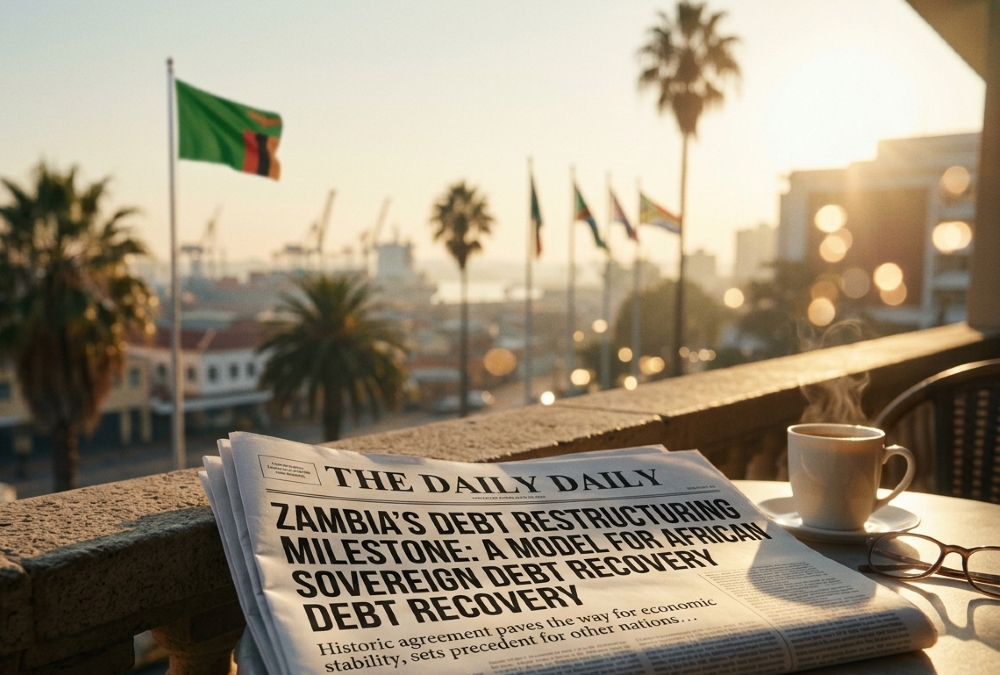
Lest anyone get the erroneous idea that debt is a universal burden on African countries, there is the example of Zambia. As Africa Unfiltered discussed in a recent LinkedIn post, after defaulting on its Eurobonds in 2020, Zambia became a closely watched test case for how African sovereign debt restructuring works in the era of Chinese bilateral lending.
The negotiations were long, complicated by the fact that Chinese state creditors and Western bondholders had fundamentally different restructuring frameworks, and the G20 Common Framework process was being tested in real time. Still, Zambia got its restructuring done.
Zambia’s economic trajectory matters beyond its borders. It’s proving that African sovereign debt restructuring is possible, that Chinese and Western creditors can reach agreement and that a commodity-dependent economy can survive default and restructure without permanent damage to its investment relationships.
The narrative about African debt tends to focus on the crisis. Zambia’s unfolding recovery is the less-told part of the story that matters more for future lending decisions.
African countries with the lowest debt burdens include:
- Democratic Republic of Congo: 26 percent of GDP
- Ethiopia: 28.4 percent of GDP
- Equatorial Guinea: 31.5 percent of GDP
- Chad: 32.3 percent of GDP
- Comoros: 37.6 percent of GDP
Other countries with relatively low debt include Botswana, Sierra Leone, and Cameroon, with debt-to-GDP ratios ranging from 37.9 percent to 41.3 percent.
Countries like Somalia have made significant progress in reducing their debt burden, with a public debt-to-GDP ratio of just 6 percent after securing debt relief through the Heavily Indebted Poor Countries (HIPC) Initiative.
Recovering from a high debt burden can be accomplished. It takes fiscal discipline, good governance (especially eliminating corruption), successful resource management and not a little luck with weather and natural disasters.
African governments are learning how to do this. May they be even more successful as time passes.
Gregory Simpkins, a longtime specialist in African policy development, is the Principal of 21st Century Solutions. He consults with organizations on African policy issues generally, especially in relating to the U.S. Government. He further acts as a consultant to the African Merchants Association, where he advises the Association in its efforts to stimulate an increase in trade between several hundred African Diaspora small and medium enterprises and their African partners.
