
Business
CARICOM requires co-ordinated action to protect regional banking sector
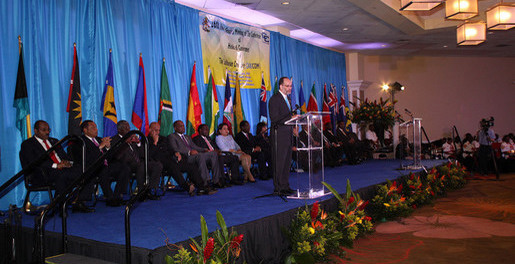
“Countries in the Caribbean Community (CARICOM) are marginalized in the international community, with no voice or vote in international financial institutions, and are coerced into adopting policies that harm regional economies while serving the interests of others.” This was the stance taken by prime minister of Antigua & Barbuda, Gaston Browne, who called for a mechanism to prevent devastation in the regional banking sector.
Browne is the outgoing chairman of CARICOM, and spoke at the 26th inter-sessional meeting of the Conference of Heads of Government of the Caribbean Community in Nassau, Bahamas late last week. He warned that for the region to labeled as a “high-risk” area for financial services – as it now is – is “a new and potentially devastating threat.”
“I call on this conference to agree to establish a committee of finance ministers to work with the Caribbean Association of Banks to develop a plan to deal with this matter, including by making strong representations at the World Bank, the IMF, within the Commonwealth and La Francophonie and, if necessary, at the United Nations,” Browne said. He argued that only united action would allow CARICOM to take advantage of opportunities that could better the lives of people in the region, adding that collaboration, cooperation and unity within the region are needed to surmount obstacles, overcome limitations and advance CARICOM interests.
“Extra-territorial laws and policies made in other countries and regions are imposed upon us without consultation – indeed without the slightest interest in such consultations,” Browne said. “We are made to implement the agenda of others, even to the point of spending our own scarce resources to act as their tax collectors, or we suffer the consequences of not surrendering to their will.”
According to Browne, the Caribbean banking sector is facing a new and potentially devastating threat. The negative impact of labelling the CARICOM region as a high-risk area for financial services has resulted in international banks focusing and evaluating risks as opposed to doing doing business with indigenous Caribbean banks.
Browne said the claim could lead to the closure of indigenous banks in CARICOM countries, not because of any inherent difficulties in the banks themselves, but because they are constrained from transacting business abroad.
“I need hardly say that the impact of such a development on our economies would be calamitous. It is time that we raise our voices and not meekly accept the continuing emasculation of our financial services, particularly after we have spent millions of dollars on making our jurisdictions compliant with every demand that has been made of us. The situation is unfair and unjust,” Browne said.
