
Business
Africa’s Hidden Growth Arithmetic: Why Its Youthful Markets Will Shape Global Business
With Nigeria outpacing Europe in annual births, global executives must rethink their African market entry strategies and abandon the myth of the monolithic market.

By John Kourkoutas
Nigeria produces more babies every year than the whole of Europe combined. Let that sink in. Europe has 746 million people; Nigeria has 228 million – roughly a third as many. Yet Nigeria delivers 7.5 million births annually against Europe’s 6.3 million. It is, quite possibly, the most growth statistic that most corporate executives have never seen.
A Demographic Reckoning
Every consumer market is ultimately a wager on people: how many there are, how young they are, and how fast their numbers are growing. By that measure, Europe is in quiet retreat. Its population is aging, shrinking, and saturated. The customer base that built the continent’s great brands is contracting, year after year.
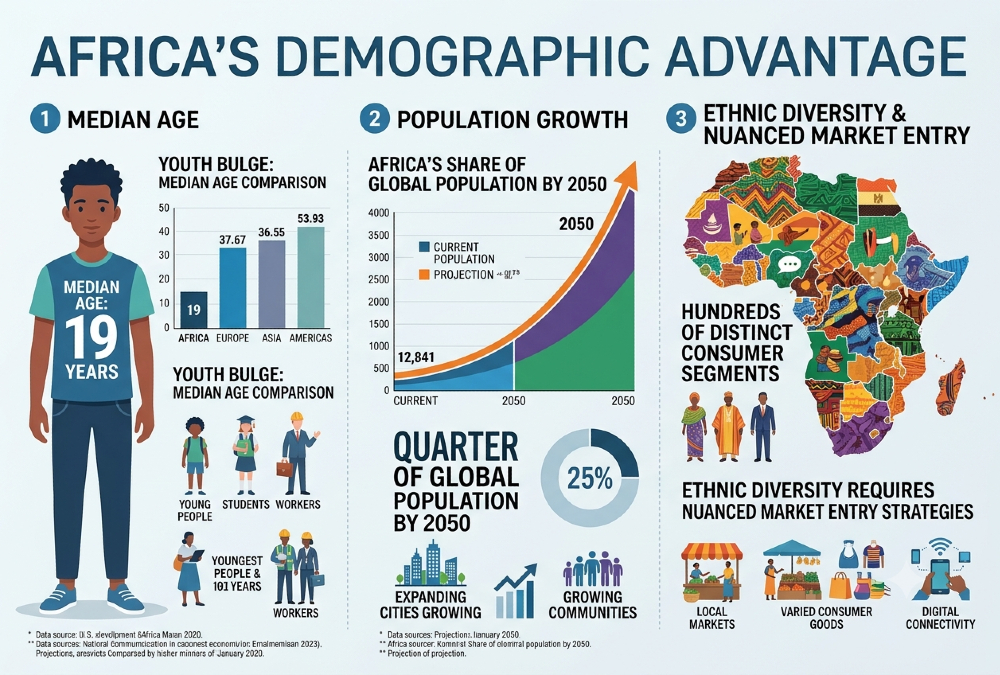
Africa tells the opposite story – and Nigeria is merely its leading edge. By 2050, the continent is projected to be home to roughly a quarter of humanity, with a median age near nineteen. The largest, youngest, fastest-growing generation of consumers on Earth is being born right now, largely in places that global business still treats as an afterthought.
Here is the detail that should unsettle every strategy team: brand loyalty is formed early. Companies that engage this generation while its preferences are still taking shape will capture relationships that compound for decades. Those that wait for the data to become impossible to ignore will be buying back that loyalty at a steep premium, from whoever arrived first. A handful of firms have already grasped this and are positioning themselves now, while the opportunity remains both early and inexpensive. The choice facing most businesses is simple: compete for share in a shrinking market, or help build one that is only getting bigger.
One Country, Hundreds of Markets
The fastest way to fail in Africa is to treat any single country as a unified market – and the data on ethnic composition explains why.
Consider the continent’s largest ethnic groups by country. In Nigeria, the Hausa-Fulani account for just 29 percent of the population. In Kenya, the Kikuyu make up 17 percent. In Tanzania, the Sukuma represent 16 percent. In South Africa, the Zulu fall just under 23 percent. In nearly every case, the country’s largest single group is still a minority overall.
That fact alone should rewrite most market-entry strategies. Too many foreign companies arrive in the capital, sign a single distributor, and assume the country is now covered. Sales stall soon after, and few can explain why. The answer lies in the demographic map: a distributor who dominates the south may carry no weight in the north. The marketing language that resonates in Lagos may fall flat in Kano. A brand trusted by one community can be overlooked entirely by its neighbors.
Africa is not 54 markets, as the conventional count suggests. It is hundreds. Within nearly every national border lie distinct buyers, distinct languages, distinct trust networks, and distinct ways business actually gets done.
This complexity is not a reason to stay away. It is precisely why poorly prepared entrants fail and well-prepared ones thrive. The intricacy that deters competitors becomes the competitive moat for those who take the time to understand it. The first task in any serious market entry, then, is never the product – it is the map: who actually buys, where, in which language, and through whose network. Treat a country as a single block, and it will treat your revenue as optional.
Which African country do you think outsiders most underestimate for its internal diversity?
John Kourkoutas is business development expert that specializes in helping companies, export teams, and business leaders succeed in Africa’s dynamic and emerging markets.
