
Life
Why Don’t Black People Visit National Parks?
This is so random, but interesting nonetheless!
The past as prologue
Sixteen years ago, Audrey Peterman experienced that disconnect when she and her husband, Frank, loaded up their pickup truck in Fort Lauderdale, Fla., and embarked on a 12,000-mile, eight-week tour of the country. “I’d never been to a national park,” said Peterman. “I didn’t even know there was such a thing as a National Park system.”
For Peterman, that all changed at their first stop, Acadia National Park, in Maine: “I was so overwhelmed by the beauty, it was transformative. It was like I’d been living in a mansion, but had only seen the kitchen. Now I’d stumbled into the grand living room.”
As Peterman tells it in their 2009 book, “Legacy on the Land: A Black Couple Discovers our National Inheritance and Tells Why Every American Should Care,” only one thing surprised her more than the spectacular scenery:
“Where were the black folks? Where were Asian-Americans? Eight weeks, 14 national parks coast to coast and in that whole time we saw less than a handful of people of color.”
Clearly, some things have changed since then. Although still underrepresented compared to the larger population, African-Americans accounted for 7 percent of park visitors in 2008–2009 vs. 4 percent in 2000. But for many, both within and outside the Park Service, the issue still lingers.
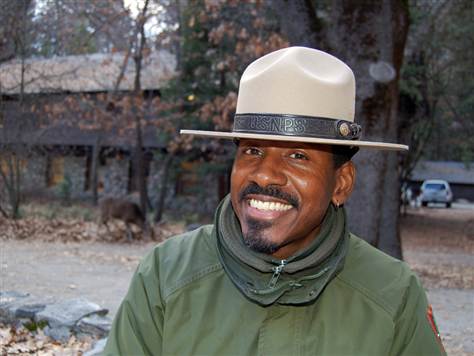
Part of the reason is a simple lack of experience; “You can’t make people like something they haven’t tried before,” said Bill Gwaltney, assistant regional director for the National Park Service’s Intermountain region, but the disparity also touches on what he calls “shadow answers.”
“People say, ‘I don’t know anybody there; I don’t know the tenor of say, law enforcement,’ ’’ said Gwaltney. “Am I going to have to worry about driving while black or driving while brown?”
A changing U.S. population
In roughly 40 years, the U.S. Census Bureau projects that non-white minorities will constitute at least half of the American population, up from roughly one-third in 2008.
And, as numbers in the new report reiterate, the impending majority tends to engage less with the national parks than the existing one, for a whole host of reasons, ranging from the obvious — such as cost and accessibility — to more subtle ones dealing with imagery, identity and what constitutes the “appropriate” way to experience the parks.
One problem, suggests Gwaltney, is that unfamiliarity breeds apprehension: “If someone says, ‘Let’s go to Yosemite,’ the answer becomes, ‘Well, where’s that? I don’t know anybody who’s been there. Let’s go to visit Grandma in South Carolina instead’.”
Another is that outdoor recreation tends to be portrayed in very specific ways that don’t speak to all ethnic groups. “People think that if you go to the parks, you have to hike and camp,” said Finney. “Some people just want to be outside or hang out with their families, but those things aren’t necessarily included under ‘recreation’.”
The challenge is ultimately a two-fold one — getting people of color to come to the parks and ensuring they’re welcome once they do. Regarding the former, the new survey suggests that the single biggest impediment for non-visitors was that they didn’t know much about the National Park system (60 percent).
“A lot of it depends on how you were exposed to the outdoors,” said Sid Wilson, owner of A Private Guide Inc., in Denver, who credits his own love of the outdoors to fishing trips with his father as a young boy in Brooklyn. “After you start doing it, you start to find others like yourself.”
The other part of the challenge; making people feel welcome; may prove even tougher. When asked if “NPS units are unpleasant places for me to be,” just 5 percent of white respondents agreed. By comparison, 9 percent of African-Americans and 23 percent of Hispanics did so.
“Basically, we have to get caught doing good in a public place,” said Gwaltney. “We have to welcome everybody and let them know that we pay attention to the many stories of different groups of people.”
