
Zina’s Youth View on Africa
Why Are Some African Leaders Clinging to Power? The Erosion of Democracy and the Cost to Stability

By Godfred Zina
Across Africa, a troubling pattern is emerging – one that threatens the hard-won gains of democratic governance over the past three decades.
In several countries, long-serving leaders are rewriting constitutions, manipulating legal frameworks, and sidelining opposition to extend their grip on power. What was once an exception is now becoming a concerning trend: leaders clinging to office not through popular mandate, but through institutional manipulation.
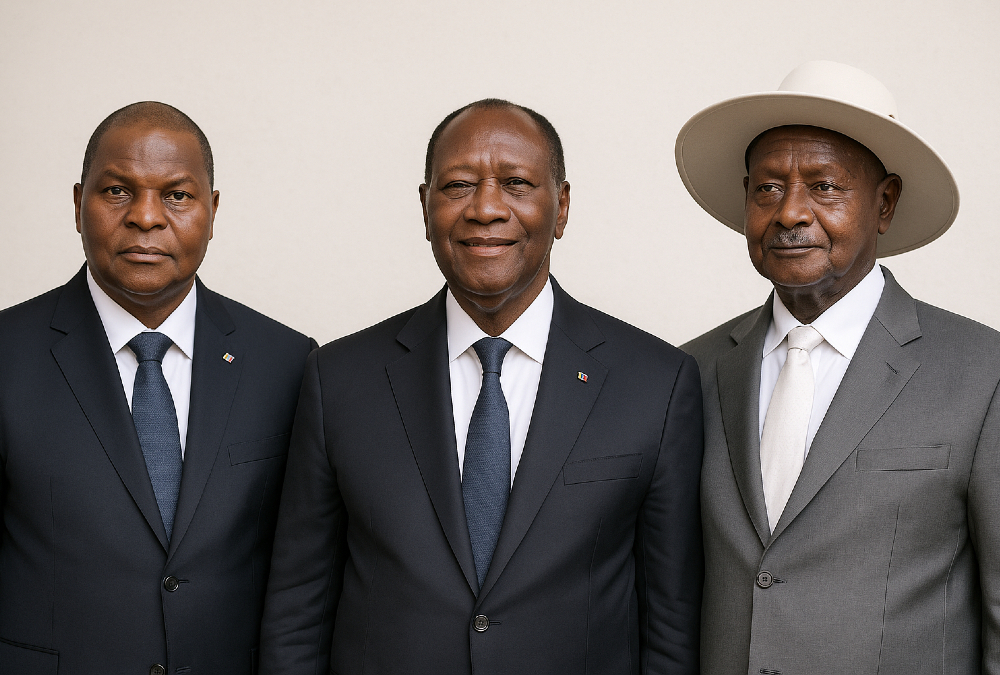
From the Central African Republic to Uganda, from Côte d’Ivoire (Ivory Coast) to Cameroon, the erosion of term limits is undermining democratic norms and fueling political instability. These actions are not merely about individual ambition – they signal a broader weakening of democratic institutions, with profound implications for governance, human rights, and regional peace.
Constitutional Engineering and the End of Term Limits
In the Central African Republic (CAR), President Faustin-Archange Touadéra’s bid for a third term followed a 2023 constitutional referendum widely criticized as neither free nor fair. The vote abolished presidential term limits, a move opponents say was orchestrated to consolidate power amid an ongoing conflict and growing dependence on Russian-backed military forces.
With civil society leaders silenced and opposition figures marginalized, calls for a national dialogue have intensified. Yet without genuine inclusivity and independent oversight, the upcoming election risks entrenching authoritarian rule under a veneer of legality.
In Ivory Coast, President Alassane Ouattara’s decision to run for a fourth term – after a constitutional revision effectively reset term limits – sparked nationwide protests and deepened political fractures. Key opposition leaders were disqualified from running, raising serious concerns about electoral fairness.
While Ouattara insists his re-election is necessary for economic continuity, critics see a troubling precedent: the use of legal reforms to justify political longevity, regardless of public will.
Cameroon’s President Paul Biya, now 92 and in power since 1982, is poised to seek an eighth term. His prolonged rule stands as one of the longest in modern African history.
Despite mounting calls for generational change, Biya’s government has maintained tight control over political space, restricted press freedom, and suppressed dissent – particularly in the Anglophone regions, where a separatist conflict has simmered for years. The absence of meaningful political transition raises urgent questions about national unity and democratic legitimacy.
Uganda presents a similar case. President Yoweri Museveni, in power since 1986, removed term limits in 2017 to extend his 40-year rule.
Since then, the political environment has grown increasingly repressive. Opposition leaders like Bobi Wine have faced repeated arrests, harassment, and violence.
While the government touts infrastructure development and macroeconomic stability, these achievements are overshadowed by systemic human rights violations and the hollowing out of democratic institutions.
The Cost of Prolonged Rule
The consequences of these power extensions are far-reaching. When leaders manipulate constitutions to stay in office, they weaken the very foundations of democracy: independent electoral commissions, impartial judiciaries, and accountable legislatures.
Elections, once a mechanism for peaceful transitions, become performative exercises designed to legitimize autocracy.
This institutional decay fuels political tension. In countries like CAR and Ivory Coast, contested elections have sparked violence, displacement, and humanitarian crises.
Refugee flows into neighboring countries strain regional stability, while armed groups exploit governance vacuums to expand their influence.
Moreover, when citizens see democratic participation as futile, faith in the system erodes. Disillusionment can give rise to radicalization, underground resistance, or apathy – each of which undermines long-term development and social cohesion.
A legitimacy crisis ensues, not just for individual leaders, but for the state itself.
A Call for Democratic Renewal
Africa is not monolithic. Many nations – such as Ghana, Senegal, and Botswana – have demonstrated that peaceful transitions and strong institutions are possible.
Civil society, youth movements, and independent media continue to demand accountability across the continent. The African Union and regional bodies like The Economic Community of West African States (ECOWAS) and the African Court on Human and Peoples’ Rights must strengthen their commitment to upholding constitutional order and protecting democratic norms.
Donors and international partners also have a role to play – not through interference, but by conditioning support on respect for term limits, electoral integrity, and human rights. Diplomatic pressure, targeted sanctions, and support for independent institutions can help rebalance power in favor of the people.
The Way Forward
The question is not just why some African leaders cling to power – but what kind of future they are willing to sacrifice for it. Sustainable development, inclusive growth, and lasting peace cannot flourish under prolonged autocratic rule.
True leadership means knowing when to step aside and make space for new voices, ideas, and generations.
Africa’s democratic journey is still evolving. But to move forward, its leaders must honor the constitutions they swore to uphold – and remember that power belongs not to individuals, but to the people.
Godfred Zina is a freelance journalist and an associate at DefSEC Analytics Africa, a consultancy specializing in data and risk assessments on security, politics, investment, and trade across Africa. He also serves as a contributing analyst for Riley Risk, which supports international commercial and humanitarian operations in high-risk environments. He is based in Accra, Ghana.
