
Business
Rwanda’s politicians and business brains step up to the challenge
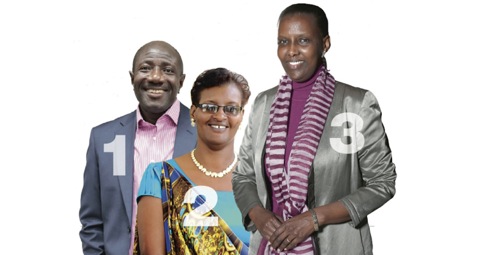
A new slate of leaders in the public and private sectors are seeking to prove their independence, improve credibility and attract investment. Rwanda’s great and good are in a period of flux, with new faces and old hands in fresh roles.
As Ebenezer Asante (1) settles into office as the new chief executive of MTN Rwanda, he is faced with the task of ensuring the telco maintains its market share in the face of cut-throat competition. The first telecom company to launch mobile telephony operations in Rwanda, its subscriber base has stagnated at just over three million while its rivals, Tigo and Airtel, are eating into its data and voice segments.
The year 2014 could be the tipping point as Airtel, the new entrant, consolidates its growth. It is all change in the state-directed sector, too. In May 2013, the government appointed Jack Kayonga as the new board chairman of Crystal Ventures, the investment arm of the ruling Rwandan Patriotic Front (RPF) and the biggest local investment company. The youthful Kayonga is an investment banker credited with turning around the Rwanda Development Bank, where he served as CEO for four years from 2009.
The top management of Crystal Ventures has proved to be result oriented, with zero tolerance for under- performance. To keep his job, Kayonga will have to improve the efficiency of its businesses, as the company continues to fight claims that it depends on lucrative government contracts.
In October 2013, the fresh-faced Richard Muhumuss replaced Martin Ngoga, the long- serving prosecutor general. Muhumuza, who has served in the prosecutor general’s office for the past 14 years, is the fourth prosecutor general since 1994, when the RPF took power.
He will continue to hunt for the key fugitives believed to have master-minded the 1994 genocide, but he will also face pressure to charge members of the old guard who have since joined the opposition and become outspoken critics of the current regime.
No to witch-hunt
The long list includes Faustin Kayumba Nyamwasa, who fled to South Africa in February 2010, and Gerald Gahima, who had served as the country’s first prosecutor general after the 1994 genocide. If he does not want his office to be seen as a tool for criminalising political dissent, Muhumuza will have to exercise maximum restraint.
