
Business
Rugwabiza says for a stronger private sector growth, governments must get it right
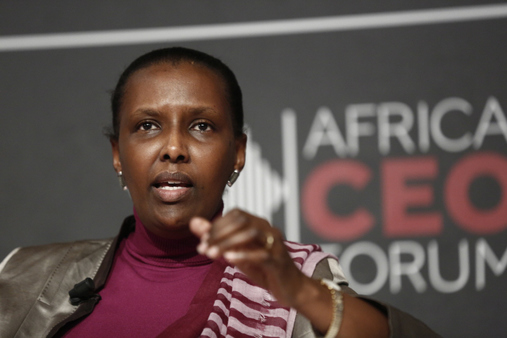
Businessmen and policy-makers at the Africa CEO Forum in March agreed that in addition to focusing on major national companies, SME networks need to be strengthened. Each day brings the private sector closer to being capable of spearheading the African continent’s transformation.
Without a doubt, the private sector is a key driver of economic growth, employment creation and the reduction of poverty. The strength of Africa’s private sector was confirmed at the Africa CEO Forum in Geneva, Switzerland on 17-19 March. However, for the private sector to play its full role, small and medium enterprises (SMEs) need to be given the top priority, as they play a major role in most African economies.
Valentine Sendanyoye Rugwabiza, CEO of Rwanda’s Development board and panelist at The Africa CEO Forum, said, “Africa is still at a stage where the public sector provides the most investment.” She also said that a better behavior from African governments is therefore needed to enable the private sector reach its full potential.
Rwanda, which has been ranked as the best place to do business by the World Bank on numerous occasions, is a pace setter in the removal of developmental bottlenecks. According to the Africa Development Bank (AfDB), the private sector represents about 70% of Africa’s total gross domestic product, much in line with the average number observed across other emerging markets.
In several countries and in particular low-income ones, micro-enterprises with fewer than 20 employees account for more than two-thirds of Africa’s private sector. Nonetheless, “their total output contribution remains limited”, according to the AfDB. In addition, Rugwabiza added, “It is critical for government to get it right if we want to see the emergence of a dynamic business sector.”
But the situation is set to change as “we are now seeing a new style of African business leader emerging; leaders who are building, investing, growing for Africa’s future,” noted Carlos Lopes, executive secretary of the United Nations Economic Commission for Africa, and Nigeria’s Tony Elumelu in an opinion piece on CNN’s website late last year.
The Nigerian businessman at the head of Heirs Holding is an advocate of ‘Africapitalism’. The concept argues that local businessmen much must invest in sectors such as energy and agriculture through long-term strategies. Furthermore, Elumelu and Lopes argued that “business leaders must wake up to the fact that short-term profit contributes little if anything to sustainable growth.”
According to Hischam El-Agamy, executive director of the Institute for Management Development, SMEs “should be valued” and prioritized if we are to have empowered national and regional champions.
Source: The Africa Report
