
Business
International oil companies look to East Africa for growth
World-class gas
Sebastião said Sonangol planned a great deal more offshore drilling, particularly in blocks that had been neglected by the major players. He also said that the government’s plan is to boost production from to 1.8 million barrels per day (bpd) to 2 million barrels per day and to sustain that level for 10 years at least.
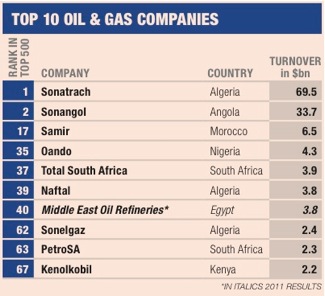
In December 2013, Sonangol, Cobalt and BP announced that they had discovered world-class gas reserves in the Lontra deepwater well. Currently in Nigeria, local oil companies are set to take advantage as multinational oil companies shed some of their onshore oil blocks. In fact Nigeria’s Oando (#35) aims to complete its $1.7 billionn acquisition of US company ConocoPhillips’ Nigerian assets by the end of January 2014. If successful, the deal will boost Oando’s oil output from just 4,000 bpd currently to more than 43,000 bpd.
Oando’s chief executive, Adewale Tinubu, told the Africa Oil Week in Cape Town that ongoing disinvestment from Nigeria by major international companies was creating “valuable new opportunities” for Nigerian companies which would ultimately boost national oil production. Prior to now, Oando has been predominantly a downstream company, but Tinubu said that after the acquisition, three-quarters of the company’s assets would be in the upstream sector.
Total eclipse
Total (#37) is set to become not only South Africa’s largest fuel company but also one of its main producers of solar energy. In November 2013, South Africa’s Department of Energy selected US photovoltaic manufacturer Sun-Power, which is majority-owned by Total, as the preferred bidder for a $200m project to build an 86MW solar farm in Prieska in Northern Cape Province.
Egypt’s minister of petroleum also announced, in November 2013, that it is considering selling a 20% stake in Middle East Oil Refineries (#40), known as MIDOR. He stated the government expects to make $1-1.5 billion from the sale. As Egypt owes at least $6.2bn to foreign creditors in the petroleum sector, revenue from the sale of the MIDOR stake will go towards settling these debts.
Another company with cash flow problems is South Africa’s state owned PetroSA (#63), which is at an advanced stage in talks to buy Engen’s petrol stations in the country for R11-18bn ($1-1.7bn). If PetroSA cannot find the money by then, it expects to ask the government to make up the difference. However, PetroSA urgently needs to find new sources of gas for its Mossel Bay gas-to-liquid refinery, as the nearby offshore well it has used is nearly exhausted.
Currently, it is feverishly drilling at the nearby F-O field in the hope of a major find but has had in the meantime to import liquefied natural gas from the Middle East to keep the refinery ticking, which has put additional strains on its cash reserves.
Source: The Africa Report
