
Zina’s Youth View on Africa
Ex-DR Congo President Sentenced to Death: Justice Served or Political Maneuvering?

By Godfred Zina
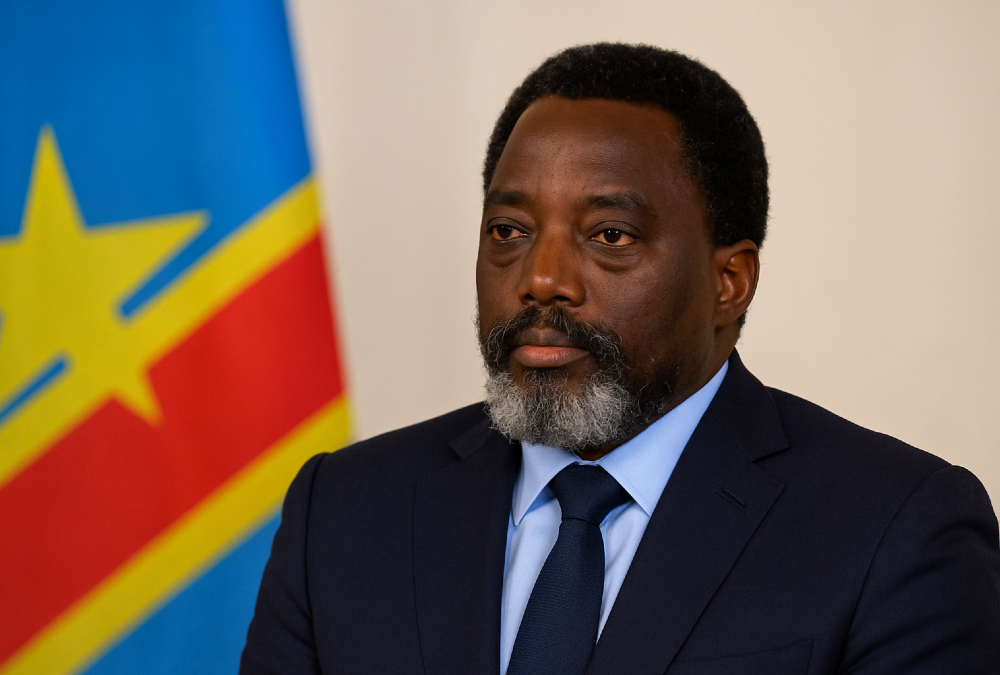
In a dramatic turn that has sent shockwaves across Africa and beyond, former Congolese President Joseph Kabila has been sentenced in absentia to death by a military court on charges of treason, war crimes, and crimes against humanity. The verdict, handed down after the Congolese Senate stripped him of presidential immunity earlier this year, marks a pivotal – and deeply controversial – moment in the Democratic Republic of the Congo’s (DR Congo) turbulent political history.
The charges stem from Kabila’s alleged support for the M23 rebel group, a militia accused of killing approximately 7,000 civilians and displacing millions in the mineral-rich eastern provinces of the DR Congo as of January 2025. Kabila, who ruled the country for 18 years before stepping down in 2019, has dismissed the trial as “arbitrary” and condemned the judiciary as a tool of political oppression under his successor, President Félix Tshisekedi.
This case cannot be viewed in isolation. It unfolds against a backdrop of escalating regional tensions, with the M23’s recent capture of strategic towns reigniting fears of a broader conflict.
Persistent accusations – backed by mounting evidence – point to Rwanda’s involvement in backing the rebels, a claim Kigali vehemently denies. Despite a fragile ceasefire brokered in July 2024, violence in eastern DR Congo continues unabated, underscoring the deeply internationalized nature of the crisis.
A Precedent for Accountability – or Political Score-Settling?
Kabila’s sentencing raises profound questions about the rule of law in the DR Congo. On one hand, it could represent a historic step toward accountability – a signal that even former heads of state are not above the law.
If upheld, the verdict might set a precedent for future leaders, including Tshisekedi himself, reinforcing the principle that immunity ends with office.
On the other hand, the timing and context fuel legitimate concerns about political motivation. Kabila had recently re-entered the political arena, positioning himself as a potential peace broker in the east and signaling ambitions for a political comeback.
His prosecution under a Tshisekedi-aligned judiciary risks being perceived not as justice, but as retribution – potentially deepening national divisions at a time when unity is most needed.
Regional Repercussions and the Fragility of Peace
Moreover, the verdict is likely to strain already tense relations between Kinshasa and Kigali. Should Kabila’s alleged ties to M23 be substantiated, it would further complicate diplomatic efforts in the Great Lakes region, where peace remains elusive and mistrust runs deep.
Ultimately, the world is watching. Will this landmark ruling strengthen Congo’s democratic institutions and advance genuine accountability? Or will it become another chapter in a cycle of politically weaponized justice that undermines the very stability it seeks to restore?
As the DR Congo navigates this precarious moment, the distinction between justice and vengeance has never been more critical – or more fragile.
Godfred Zina is a freelance journalist and an associate at DefSEC Analytics Africa, a consultancy specializing in data and risk assessments on security, politics, investment, and trade across Africa. He also serves as a contributing analyst for Riley Risk, which supports international commercial and humanitarian operations in high-risk environments. He is based in Accra, Ghana.
