
Zina’s Youth View on Africa
Drone Warfare in Sudan: How a Civil War Is Reshaping Regional Security
How a technologically escalating conflict is reshaping the security architecture of an entire region.

By Godfred Zina
Since the outbreak of fighting in April 2023, Sudan’s civil war has undergone a profound and dangerous transformation. What began as a conventional armed struggle between the Rapid Support Forces (RSF) and the Sudanese Armed Forces (SAF) has hardened into a grinding war of attrition – one in which neither side can secure a decisive victory, yet both retain sufficient capacity to inflict catastrophic harm.
The result is a conflict that is no longer merely destroying a nation; it is destabilizing a region.
The Drone Revolution on the Battlefield
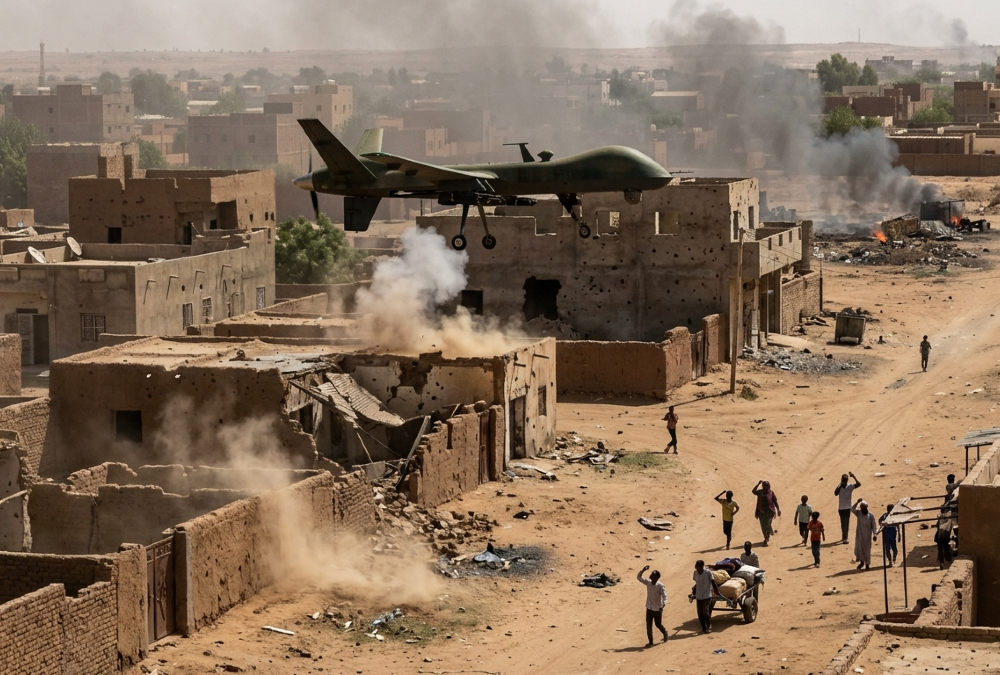
Perhaps no single development has altered the dynamics of this war more fundamentally than the proliferation of drone warfare. Unmanned aerial systems have given both the RSF and the SAF a low-cost, accessible, and lethally precise tool that has dramatically expanded the scale and geographic reach of their operations.
The consequences for civilians have been devastating.
Repeated strikes on open-air markets, transit corridors, and residential communities signal a serious and accelerating erosion of civilian protection. The strike on the El Daein hospital is not an isolated incident – it is symptomatic of a broader pattern in which civilian infrastructure has become a de facto theater of war.
Since 2023, more than 200 attacks on health facilities have been documented, effectively collapsing a healthcare system that was already fragile. Millions of Sudanese now have no meaningful access to basic medical services.
The long-term consequences of that collapse – in terms of preventable deaths, untreated disease, and deepening social trauma – will outlast the conflict itself by years, if not decades.
A War Without Borders
The notion that this remains a contained, internal conflict is no longer defensible. Cross-border drone strikes into Tiné, in eastern Chad, have provided the starkest confirmation yet that Sudan’s war is metastasizing beyond its own frontiers.
Chad’s response – including border closures, accelerated troop deployments, and open consideration of retaliatory options – reflects a government that understands it may be on the edge of direct involvement in a conflict it did not choose.
Meanwhile, the battlefield inside Sudan has fragmented significantly. Multiple armed factions now operate across shifting and poorly defined frontlines, creating conditions in which fighters and weapons move across international boundaries with near impunity.
The infrastructure of containment – diplomatic, military, and logistical – has largely ceased to function.
Eleven Million Displaced, and Counting
The human cost of this conflict demands more than a footnote. Sudan has produced one of the most severe humanitarian emergencies on the planet, with over 11 million people displaced from their homes.
Food insecurity is widespread and worsening. Public services – never robust – have largely ceased to function across swaths of the country. Mortality rates are rising not only from direct violence but from famine, disease, and the absence of medical care.
These are not background conditions. They are strategic variables. A population that is starving, sick, and displaced is a population uniquely vulnerable to further radicalization, forced migration, and long-term institutional collapse.
So What Does This Mean?
The trajectory of this conflict points in a troubling direction on every axis. Militarily, the increasing sophistication and availability of drone technology suggests that civilian casualties and infrastructure destruction will continue to rise.
Diplomatically, ceasefire mechanisms have so far proven structurally weak, undermined by a fundamental absence of trust and sustained by the continued flow of weapons, intelligence, and logistical support from external actors – none of whom appear inclined to withdraw. That external involvement does not merely prolong the war; it internationalizes it, reducing the space for any near-term resolution.
Regionally, Sudan risks becoming the central node of a widening arc of instability. A spillover into Chad – whether through further drone incursions, refugee pressure, or armed cross-border movement – could trigger a chain of military confrontations involving states that are themselves fragile.
The strategic consequences of that scenario, for the Sahel and for the broader African continent, would be severe.
The international community’s response has, thus far, been inadequate to the scale of the crisis. That inadequacy is not merely a moral failure – it is a strategic miscalculation.
A Sudan left to burn does not stay contained. Its instability exports itself, in the form of refugees, weapons, extremist networks, and regional conflict. The window for meaningful intervention is narrowing. What happens next in Khartoum and Darfur will not stay there.
Godfred Zina is a freelance journalist and an associate at DefSEC Analytics Africa, a consultancy specializing in data and risk assessments on security, politics, investment, and trade across Africa. He also serves as a contributing analyst for Riley Risk, which supports international commercial and humanitarian operations in high-risk environments. He is based in Accra, Ghana.
