
Business
Demographics Don’t Lie: The Global Market Is Shifting Toward Africa


By John Kourkoutas
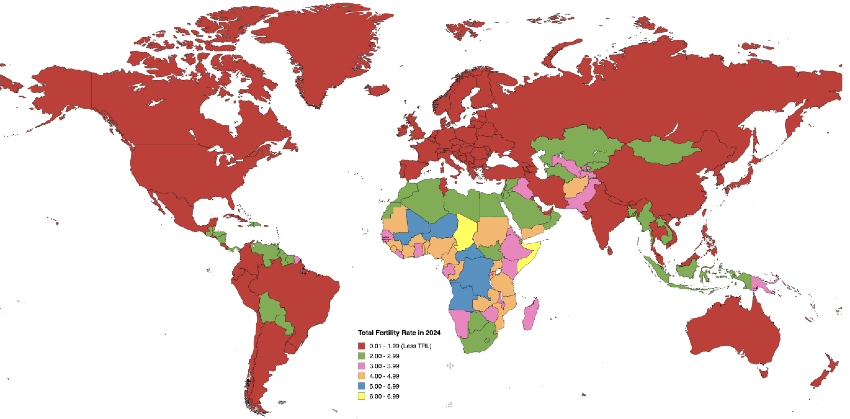
If you want to glimpse the future of global business, forget the stock tickers and quarterly earnings reports for a moment. Instead, look at the world through a different lens: the global fertility map.
What you will see isn’t just a demographic snapshot – it’s a strategic blueprint for where growth, innovation, and opportunity will unfold over the next two decades.
A single glance reveals a stark divide:
Red zones – spanning Europe, North America, and much of East Asia – are experiencing fertility rates well below replacement level (below 2.1 children per woman). In Germany, the rate hovers around 0.8; in Italy, it’s just 1.2.
These are aging, contracting societies where populations are shrinking faster than they can replenish.
Green and vibrant zones, by contrast, light up across sub-Saharan Africa, where fertility rates range from 2.0 to nearly 7.0. Nigeria’s rate stands at 5.2, with a population exceeding 220 million and a median age of just 18.
Kenya, at 3.4, tells a similar story: youthful, dynamic, and expanding.
In plain terms? The world’s consumer base is shifting continents.
The Developed World’s Demographic Dilemma
In high-income economies, demographic headwinds are no longer theoretical – they are structural realities reshaping entire industries:
- Aging populations are fueling demand for healthcare, eldercare, and retirement services – but simultaneously reducing demand for education, housing, and family-oriented goods.
- Shrinking workforces are driving up labor costs, straining public finances, and limiting productivity gains.
- Declining consumer bases mean saturated markets with little room for organic growth, forcing companies into zero-sum competition.
- Innovation plateaus as mature markets prioritize efficiency over expansion.
These trends aren’t cyclical – they are secular. And they demand a fundamental rethinking of business strategy in the world’s wealthiest nations.
Africa: The Emerging Engine of Global Growth
Meanwhile, Africa is undergoing a demographic and economic transformation that rivals the industrial booms of past centuries. This isn’t just about population growth – it’s about economic awakening.
Consider the data:
- Africa is home to the world’s youngest population, with over 60 percent under the age of 25.
- Urbanization is accelerating, creating massive demand for housing, transportation, energy, and digital infrastructure.
- A burgeoning middle class – projected to reach 1.1 billion by 2050 – is gaining purchasing power and embracing consumerism.
- Digital adoption is surging, with mobile money, e-commerce, and EdTech platforms scaling rapidly.
This isn’t speculative optimism. It’s a measurable shift in human capital, consumption patterns, and market potential.
Forward-Thinking Companies Are Already Acting
The most agile global enterprises aren’t waiting for perfect conditions – they are planting flags where tomorrow’s customers are being born today:
- Consumer goods giants are reformulating baby food, hygiene products, and household essentials for African families.
- EdTech startups are building localized digital learning platforms to serve a youth bulge hungry for skills and opportunity.
- Infrastructure and construction firms are partnering with governments to build the cities of the future.
- Financial services providers are leveraging mobile technology to bring banking to the unbanked at unprecedented scale.
While legacy players fight over shrinking slices of mature markets, visionaries are baking growth into their long-term strategies by investing early in high-potential regions.
The Strategic Imperative: Choose Your Battlefield
Business leaders now face a defining choice:
Do you compete in aging, saturated markets – or invest in young, fast-growing ones with unmet needs and untapped potential?
The red zones offer stability, predictability, and institutional maturity – but also stagnation.
The green zones bring volatility, complexity, and risk – but also explosive opportunity.
Demographics may not be the only driver of economic destiny – but they are among the most powerful and predictable. Unlike fleeting trends or policy shifts, birth rates unfold over decades, offering a rare window for proactive strategy.
The Map Is the Strategy
Over the next 20 years, the companies that thrive won’t be those clinging to yesterday’s geographies. They will be the ones who read the fertility map correctly – and acted decisively.
Because in a world of disruption, the clearest signal of future demand isn’t found in boardrooms or balance sheets. It’s found in nurseries.
So ask yourself: Where is your business positioned for the next generation of global consumers?
John Kourkoutas is business development expert that specializes in helping companies, export teams, and business leaders succeed in Africa’s dynamic and emerging markets.
