
Business
Dangote refinery targets 500,000-barrel daily production by July
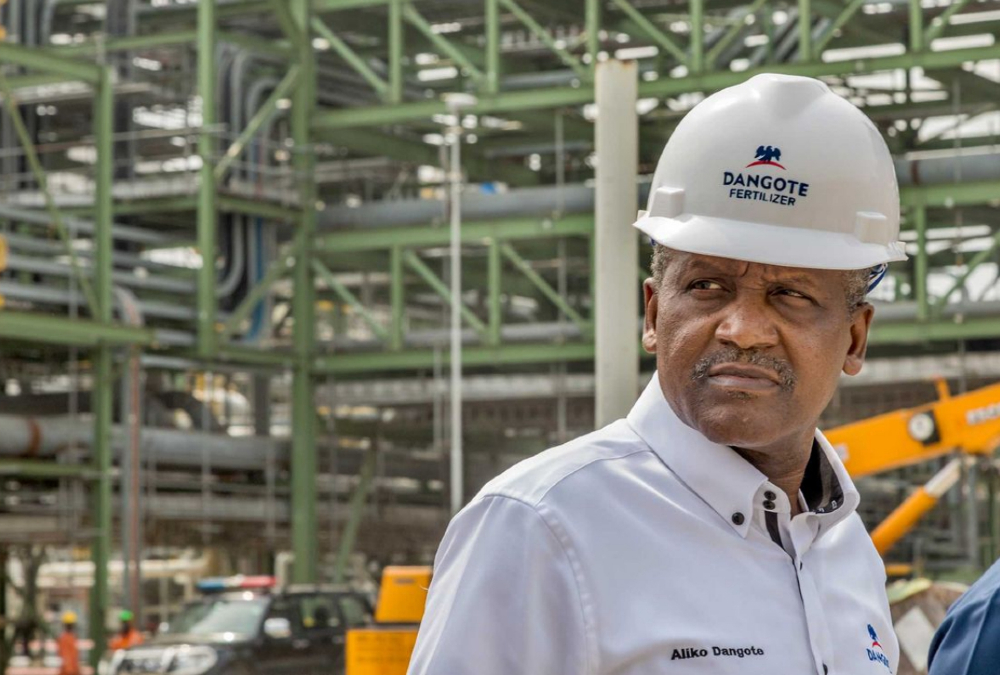
Barring any last-minute changes, the US$20 billion Dangote Oil Refinery is set to be listed on the Nigerian Stock Exchange by December 2024.
Aliko Dangote, the Founder and Chairman of the Dangote Group, expressed his desire for Nigerians, Africans, and other investors to become shareholders in the refinery. He emphasized that he wants to allow them to participate in what he describes as a historic move.
“I wouldn’t be surprised if we list on the Nigerian Stock Exchange by the end of this year. We plan to do that. It’s a new venture, and we want to give Nigerians, Africans, and other investors the opportunity to join in making this historic move,” Dangote said.
Rotimi Fakayejo, an economy and capital market analyst, estimated that the refinery’s listing could bring about ₦8 trillion (US$5.75 billion) in market capitalization to the Nigerian Stock Exchange. According to him, this move would attract foreign portfolio investment, thereby boosting the country’s foreign exchange reserves.
“The purpose of listing a company is to distribute wealth. When individuals and corporate entities invest in a company that is expected to perform well, it increases the economic prosperity of the country,” Fakayejo stated.
He added that the refinery’s listing would enhance the equity market in terms of both quality and quantity and stimulate foreign portfolio investment, which would, in turn, boost the economy. “The Dangote refinery’s listing is long overdue and will add significant value to various sectors,” he added.
Fakayejo further explained that the refinery’s addition could increase the market capitalization by ₦8 trillion (US$5.75 billion) to ₦10 trillion (US$7.2 billion), potentially raising the total market capitalization to between ₦40 trillion (US$28.75 billion) and ₦45 trillion (US$32.34 billion). He noted that the company’s balance sheet at the time of listing would exceed ₦15 trillion (US$10.78 billion), making his estimate of a ₦10 trillion (US$7.2 billion) increase in market capitalization conservative. “It’s going to be a win-win,” he concluded.
Read: Nigeria’s Dangote refinery supplies petroleum products to local market
David Adonri, Vice President of Highcap Securities Limited, noted that stakeholders were eagerly anticipating the refinery’s stock market listing. He highlighted that this development would allow Nigerians to share in the wealth generated by the refinery.
“It will be a significant event for the Nigerian capital market, given the size of the refinery and the depth it will bring to the equity market,” Adonri remarked. He added that the exact value added by the listing would depend on the number of shares and the listing price announced by the company.
Dangote announced that the refinery would reach a production capacity of 500,000 barrels per day by the end of July and its full capacity of 650,000 barrels by year-end. Speaking at the Africa CEO Summit in Rwanda, he stated that the refinery would end Nigeria’s monthly importation of about 1 billion liters of premium motor spirit once it starts selling the product in June.
He affirmed that Nigeria would no longer need to import gasoline from next month. “We have enough gasoline to supply at least West Africa, diesel for West and Central Africa, and aviation fuel for the entire continent, with surplus for export to Brazil and Mexico,” Dangote said.
The refinery, which will be the largest in Africa and Europe at full capacity, has begun selling diesel and aviation fuel, with gasoline sales expected to commence soon.
Reuters reported that the Dangote refinery could disrupt the long-standing gasoline trade from Europe to Africa, valued at US$17 billion annually. Analysts and traders noted that the refinery’s operation is exerting pressure on European refineries, which are already facing the risk of closure due to increased competition. In 2023, about a third of Europe’s 1.33 million barrels per day average petrol exports went to West Africa, primarily Nigeria. However, Dangote assured that this would no longer be necessary by June.
