
Opinion
BRICS+: A Strategic Architecture of Markets, Resources and Global Trade

By Jacqueléne Coetzer
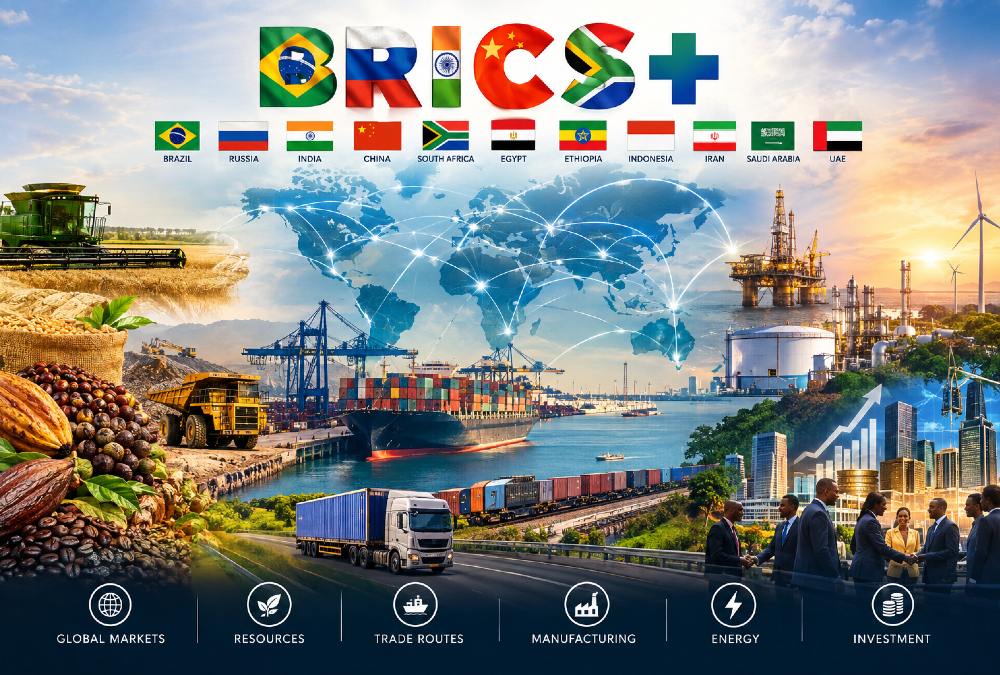
BRICS has evolved considerably from the grouping created by Brazil, Russia, India and China, with South Africa joining in 2010. It now comprises 11 countries: Brazil, Russia, India, China, South Africa, Egypt, Ethiopia, Indonesia, Iran, Saudi Arabia and the United Arab Emirates. Together, they represent substantial shares of the world’s population (3.9 billion people – roughly 49 percent of the global population) economic output (US$30 trillion to US$35 trillion, accounting for roughly 27 percent – 40 percent of global GDP) and trade (24 percent – 26 percent of global trade).
The significance of this expansion lies less in the number of countries than in the strategic capabilities they bring into a single framework. BRICS brings together major agricultural and commodity producers, energy suppliers, manufacturing powers, financial centres, large consumer markets and countries occupying important positions along global trade routes.
The original five already provided much of this foundation. Brazil brings agricultural strength, commodities and access to Latin America. Russia contributes energy, minerals, agriculture and extensive experience in operating under geopolitical and financial constraints. India combines enormous consumer-market scale with strengths in technology, services, pharmaceuticals and manufacturing. China provides manufacturing capacity, infrastructure capability, finance and one of the world’s largest markets. South Africa provides an established financial, commercial and institutional gateway into Africa.
Complementary Strengths Across the Membership
The expanded membership adds further strategic depth. Egypt occupies a critical position between Africa, the Middle East, Europe and Asia, with the Suez Canal forming one of the world’s most important maritime trade routes. Ethiopia adds population scale, industrial development potential and a strategic position in the Horn of Africa. Indonesia brings a major Southeast Asian consumer market, significant nickel and other mineral resources, and an important maritime position. Iran adds substantial oil and gas resources, a strategic position around the Strait of Hormuz and extensive experience developing trade relationships under sanctions.
The Gulf members add yet another dimension. The United Arab Emirates is already a major international centre for logistics, finance, re-export and distribution, connecting markets across East and West. Saudi Arabia brings major energy resources together with considerable financial and investment capacity and a strategic position in the Gulf.
Taken together, the membership creates a network with complementary strengths rather than a collection of similar economies. Agricultural production in Brazil can intersect with consumer markets in China, India, Indonesia and the Gulf. Energy and minerals from Russia, Iran, Saudi Arabia, Indonesia and other members connect with manufacturing demand. Chinese manufacturing and infrastructure capabilities can connect with African markets through South Africa, Egypt and the Gulf. Indian pharmaceuticals, technology and manufacturing can expand through African markets, while UAE and Saudi capital, finance and logistics can support cross-border investment.
This is why BRICS+ should be understood as part of a wider realignment in global trade and economic architecture. Its importance is not simply that more countries have joined a political grouping; it is that the expanded membership brings together resources, production, markets, capital and logistics in ways that can create new commercial routes.
From Declaration to Doing Business
The New Delhi Declaration adopted in September 2026 reinforced cooperation across political and security affairs, economic and financial matters, and cultural and people-to-people exchanges, alongside practical areas including trade, supply chains, energy, agriculture, technology and development.
For businesses, however, BRICS membership does not remove the practical realities of international trade. Customs procedures, regulations, import requirements, payment mechanisms, currency exposure, taxation, logistics, local partners, competition and commercial due diligence remain critical. A BRICS label does not automatically create market access.
It does, however, provide a useful strategic lens. For South African companies in particular, the expanded architecture creates multiple possibilities: minerals supplying Asian and other manufacturing markets; agricultural products reaching large consumer economies; Chinese and Indian technology, manufacturing and pharmaceutical capabilities entering African markets; and Gulf capital, logistics and distribution networks connecting Africa with wider international markets.
The commercial question is therefore not simply which BRICS country offers an opportunity, but it is how the capabilities of these 11 markets can intersect.
And therein lies the real significance of BRICS+: in the architecture connecting markets, resources, production, capital and trade routes — and in understanding how to operate within that architecture rather than merely trading on the BRICS name.
Jacqueléne Coetzer is a strategic trade and market analyst specialising in African and emerging markets. Her work focuses on structuring cross-border commercial relationships, connecting buyers and sellers, and facilitating trade across key sectors including commodities, diagnostics, and premium agricultural products. Her writing explores the realities behind global trade architecture, BRICS, and African economic development – not from a theoretical lens, but from active market engagement and transaction-level insight.
