
Business
Why Coca-Cola’s Relevance in Africa Is No Longer Guaranteed

By Farouk Mark Mukiibi
For much of the 20th century, Coca-Cola was more than a soft drink in Africa – it was a symbol. A crimson emblem of arrival, modernity, and global belonging.
From roadside kiosks in Lagos to wedding tents in Nairobi, the brand didn’t just quench thirst; it conferred identity. To drink Coke was to sip from the same cup as the rest of the world – to signal that you, too, were part of the global story.
But today, that story is being rewritten – and not by Atlanta, but by Addis Ababa, Accra, and Johannesburg.
Africa’s consumer landscape is undergoing a quiet but profound transformation. The continent that once looked outward for validation is now turning inward – not in retreat, but in reclamation.
It no longer seeks to taste like the world. It seeks to taste like itself.
Coca-Cola remains the volume leader in carbonated soft drinks across Nigeria, Kenya, and South Africa. Yet market dominance no longer guarantees cultural relevance.
In Africa’s evolving marketplace, leadership isn’t measured just in liters sold, but in meaning made. Coca-Cola’s model was built on quantitative MVPs – Minimum Viable Products. But African markets don’t reward MVPs, they reward Minimum Viable Relationships (MVR).
The End of the Global Standard
The real threat to Coca-Cola isn’t a nimble local startup or a rival multinational. It’s the waning appeal of “global standardization” itself.
African consumers aren’t rejecting global brands – they are demanding reciprocity. They want modernity that speaks their languages, honors their rhythms, and shares their risks.
Coca-Cola’s historic strength – its unwavering consistency – has become a liability in a market defined by fragmentation. Africa is splintering into a mosaic of micro-palates: health-conscious urbanites, tradition-rooted rural communities, and digitally native Gen Z consumers who prize authenticity over uniformity.
What once united the globe under a “secret formula” now feels like a straitjacket that cannot bend to local soil.
In Africa, comfort never lasts long. Relevance does – but only if it’s earned through conversation, not assumed through legacy.
The company has responded with what might be called “defensive delegation”: appointing more African managing directors, amplifying regional marketing voices, and tailoring flavors like Krest Bitter Lemon or Sparletta. These are welcome steps – but they are adjustments at the periphery, not a reimagining of the core.
Representation without operational reinvention leaves the underlying myth intact: that global consistency is the ultimate virtue.
When Water Becomes a Moral Metric
Meanwhile, a deeper paradox looms. Coca-Cola’s most vital ingredient is water – the very resource at the heart of Africa’s most urgent crises.
In a continent grappling with scarcity, climate volatility, and inequitable access, a product built on mass consumption faces a moral reckoning. Water stewardship programs are commendable, but they read as risk mitigation, not mission.
In today’s moral economy, values are the new value chain.
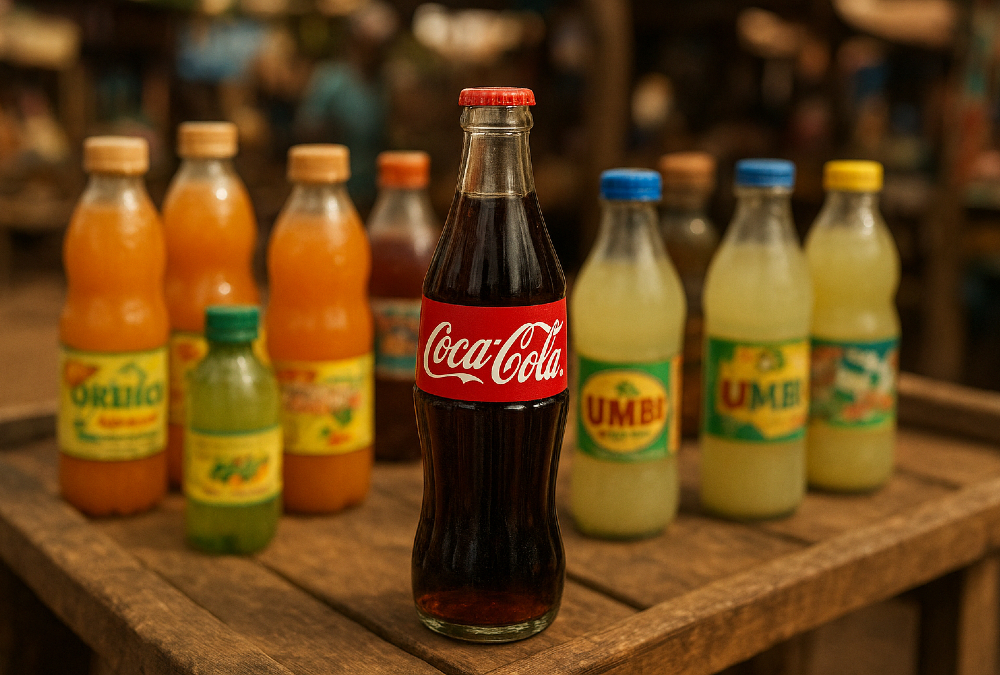
The iconic red logo still glows on shelves – but its symbolism has shifted. Once a beacon of global modernity, it now evokes global memory.
And Africa no longer buys what it remembers. It buys what remembers it.
Legacy, once defined by ubiquity, is now defined by rootedness. To be “everywhere” is no longer enough; to be “of somewhere” is everything.
Coca-Cola isn’t failing – at least not yet. But it is being questioned in ways that transcend sales figures: philosophically, culturally, existentially.
That’s a far harder battle than market share.
The question is no longer “Can Coke sell?” It is “Can Coke belong?”
In Africa, comfort never lasts long. Relevance does – but only if it’s earned through conversation, not assumed through legacy.
Farouk Mark Mukiibi is the author of The African Startups Playbook and creator of the Minimum Viable Relationships (MVR) business framework. He is also a marketing consultant based in Uganda, East Africa, where he helps international brands and ventures navigate the realities of East Africa’s evolving middle class and consumer economies.
