
Business
The Demographic Mismatch: Building for Europe’s Past, Ignoring Africa’s Future

By John Kourkoutas
Building for Europe’s Shrinking Market While Ignoring Africa’s Demographic Explosion Is the Century’s Most Expensive Mistake.
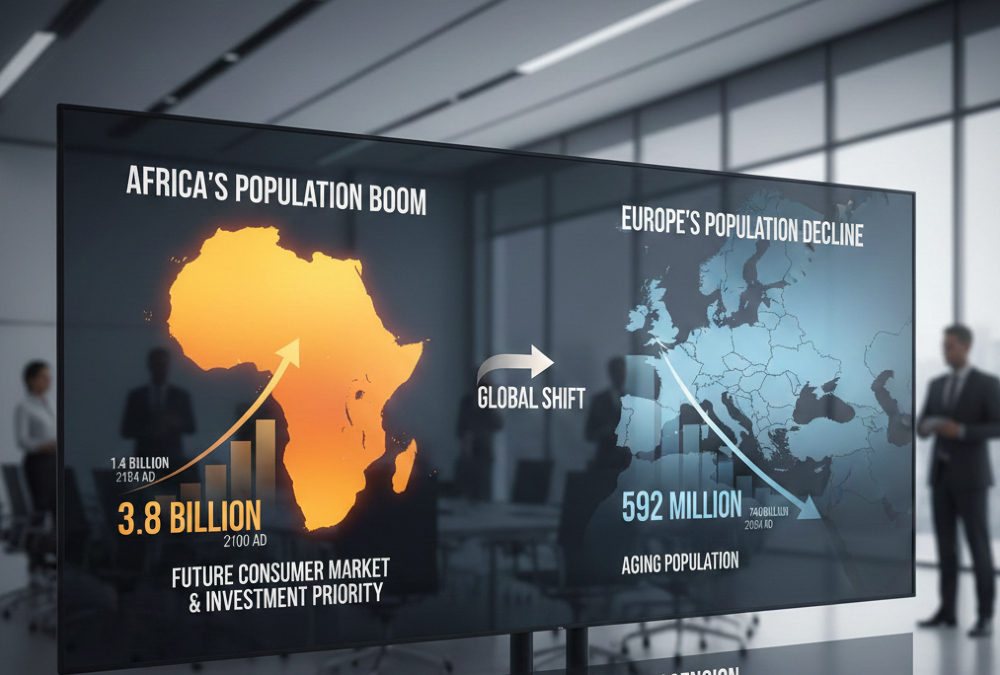
By the time today’s newborns reach their 75th birthdays, Africa will be home to 3.8 billion people. Europe, meanwhile, will have contracted to just 592 million.
Yet if you examine where multinational corporations are concentrating their infrastructure investments, supply chain networks, and market development resources, you will find a puzzling disconnect: they are still optimizing for the continent that will soon represent less than one-sixth of Africa’s consumer base.
This isn’t speculative futurism or ambitious forecasting. This is demography – the most predictable force in economics.
The Mathematics of Inevitable Transformation
The United Nations population projections through 2100 reveal a global realignment so profound it demands we reconsider every assumption about market strategy:
- Africa: 3.8 billion (up from 1.4 billion today)
- Asia: 4.6 billion (peaking, then declining)
- Europe: 592 million (down from 750 million today)
- North America: 710 million (essentially flat)
- South America: 380 million (declining)
- Oceania: 73 million (stable)
Africa will add 2.4 billion new consumers between now and century’s end – a market expansion equivalent to adding another China and India combined. By 2100, the continent will command six times Europe’s population and represent the world’s primary labor force, consumer base, and economic growth engine.
These figures aren’t projections dependent on policy decisions or economic variables. The people who will be 30-year-old consumers in 2050 have already been born.
Population momentum is locked in by the mathematical certainty of demographic structure. Africa’s median age today stands at 19 years, compared to Europe’s 43.
Those teenagers will have families. Those middle-aged Europeans, statistically speaking, will not.
The Strategic Blindness of Legacy Thinking
Despite these mathematical certainties, corporate strategy remains anchored to 20th-century demographic realities. Companies continue building elaborate distribution networks in markets destined to contract while treating Africa as a distant, speculative opportunity – something to consider “when it’s ready.”
Ready for what, precisely?
Africa is already the world’s second-largest continent by population. By 2050, it will be home to 2.5 billion people – more than China and India’s projected combined populations.
By 2100, that figure reaches 3.8 billion. If corporate strategists are waiting for some threshold of “readiness” before committing resources, they are actually waiting for the market to mature while better-positioned competitors establish unassailable positions.
Consider the implications: every product designed for European regulatory standards, every service platform optimized for European consumer behavior, every distribution network built around European population density is being calibrated for a market that will represent 15 percent of Africa’s consumer base within three generations.
The mathematics, quite simply, doesn’t work.
The Compounding Advantage of Early Entry
First-mover advantages in emerging markets aren’t merely beneficial – they compound across generations. Companies establishing distribution infrastructure in African nations today are building relationships with countries of 50, 100, or 200 million people.
By 2100, those same nations will have populations of 300, 500, even 800 million consumers.
These early relationships create network effects that become nearly impossible for late entrants to overcome. Consider the parallel: Europe experienced its population explosion between 1800 and 1950.
The companies that built distribution networks during that demographic surge – Unilever, Nestlé, Coca-Cola – continue to dominate those markets today, more than a century later. Their infrastructure investments made during Europe’s growth phase created advantages that persist across generations.
Africa’s demographic boom is occurring right now, spanning 2025 through 2100. The companies building distribution networks, establishing brand relationships, and developing supply chain infrastructure today will be the century’s dominant players.
Late entrants will face competitors with 75-year head starts, established consumer relationships, and infrastructure networks built across three generations of compounding advantages.
The Cost of Strategic Complacency
The business case for prioritizing African market development isn’t about altruism or speculative opportunity – it’s about mathematical inevitability and competitive positioning.
By 2100, Europe will have fewer people than Africa has today. Every strategic decision to optimize for European demographics while postponing African market development is a decision to build for a shrinking customer base while ceding a growing one to competitors with longer time horizons.
The question facing corporate strategists isn’t whether Africa will become the world’s dominant consumer market – demography has already settled that question. The only remaining question is which companies will own the distribution networks, brand relationships, and market positions when that demographic reality fully materializes.
The clock is already running. The demographic momentum is locked in. And the companies still building primarily for Europe’s 592 million while treating Africa’s 3.8 billion as a distant consideration are making what may prove to be the century’s most expensive strategic error.
John Kourkoutas is business development expert that specializes in helping companies, export teams, and business leaders succeed in Africa’s dynamic and emerging markets.
