
Business
The Africa Opportunity Europe and America Can’t Afford to Miss


By John Kourkoutas
Africa is no longer a frontier market – it’s a battleground for global economic influence. And while European and American businesses continue to deliberate, conduct market studies, and hedge their bets, China has already won the first phase of the race.
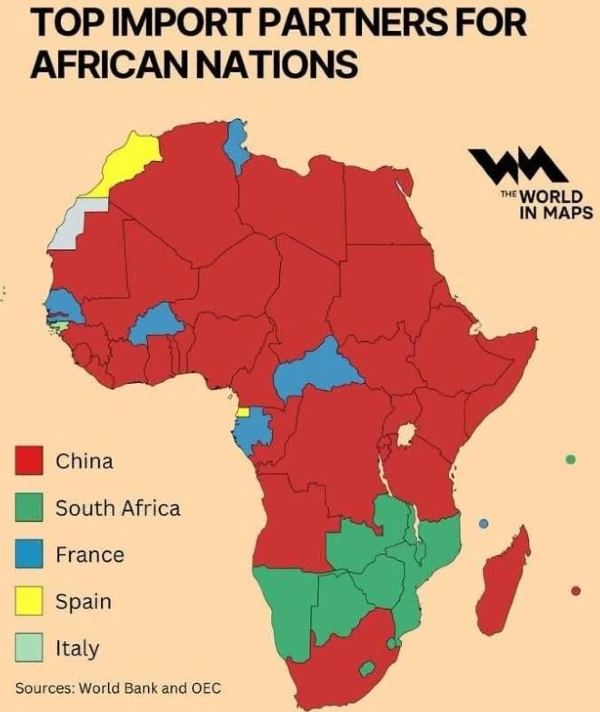
A striking map of African import patterns reveals an uncomfortable truth: China is now the dominant trade partner for over 80 percent of African nations. In contrast, European countries – despite historical ties and geographic proximity – cling to fragmented, legacy-driven influence.
France maintains modest links with its former colonies. Spain and Italy barely register.
Even regional powerhouses like South Africa remain confined to their immediate neighborhoods.
This isn’t just about trade flows. It’s about strategic positioning, long-term vision, and the future of global supply chains.
The Chinese Advantage: A 20-Year Head Start
China didn’t win Africa overnight. Its dominance is the result of a calculated, state-backed strategy built on four pillars:
- Long-Term Commitment: While Western firms focus on quarterly earnings, China has played the decades-long game—building relationships, infrastructure, and trust since the early 2000s.
- Infrastructure-Led Diplomacy: Through the Belt and Road Initiative (BRI), China has financed and constructed ports, railways, highways, and energy projects – embedding itself in Africa’s development DNA.
- Competitive Pricing and Scale: Leveraging its manufacturing might, China offers affordable, “good enough” solutions that meet urgent needs.
- Flexible Financing: From local currency deals to barter arrangements, Chinese firms and state banks offer payment models that Western institutions often deem too risky.
The result? Deep market penetration, political goodwill, and entrenched supply chains that are now incredibly difficult to displace.
Why Europe and the U.S. Are Losing Ground
Western companies aren’t losing because their products are inferior. In fact, European engineering, American innovation, and high-end technology often outperform Chinese equivalents in quality, durability, and efficiency.
They are losing because they are playing by outdated rules.
- Late to the Table: By the time a European firm completes its due diligence, Chinese competitors have already secured contracts, built distribution networks, and cultivated government relationships.
- Short-Term Mindset: Shareholder pressure for immediate returns discourages the patient capital Africa demands.
- Risk Aversion: Overcautious compliance frameworks and aversion to frontier markets leave vast regions underserved – and wide open to Chinese competition.
- Misplaced Competition: Too many Western firms try to beat China at its own game – on price – instead of leveraging their real advantage: quality, innovation, and sustainability.
There’s Still Time – But the Window Is Closing
After leading more than 100 international market entry projects across Africa, I have seen a consistent pattern: European firms with world-class technology lose bids not because of product flaws, but because they underestimated the importance of trust, timing, and tailored value.
But the story isn’t over.
Africa’s middle class is growing. Urbanization is accelerating. Digital transformation is underway.
And demand for high-quality, sustainable, and innovative solutions is rising – especially in sectors like renewable energy, precision agriculture, healthcare technology, and smart infrastructure.
This is where Western companies can differentiate.
How to Compete – and Win – in Africa
To catch up with China’s two-decade lead, European and American firms must act decisively and differently:
- Differentiate on Quality, Not Price
Focus on sectors where excellence matters: advanced manufacturing, medical devices, clean energy tech, and climate-resilient infrastructure. Sell durability, efficiency, and lifecycle value – not just cost. - Build Value-Added Partnerships
Offer more than products. Provide training, technology transfer, and local capacity building. Help African partners grow – this builds loyalty and long-term contracts. - Innovate on Financing
Match Chinese flexibility with creative solutions: vendor financing, pay-per-use models, or partnerships with development banks. Make it easier to buy European than to wait for slow-moving aid projects. - Leverage Speed and Agility
Western firms can move faster than Chinese state-owned enterprises when bureaucracy slows them down. Be first to market in emerging niches – from AI-driven agritech to green hydrogen. - Adopt a Regional Strategy
Use existing trade agreements – like the EU’s Economic Partnership Agreements or U.S.-led AGOA – to scale across regional blocs, not country by country.
The Bottom Line
Every day Western companies delay their African entry, Chinese firms deepen their roots. Every quarter spent “assessing risk” is another quarter China uses to lock in contracts, build relationships, and shape market expectations.
The winners in Africa won’t be those with the cheapest products – but those willing to invest in long-term relationships, local value, and patient growth.
Africa isn’t just a market. It’s the next global growth engine. And the time to act is now.
Is your company ready to compete with China’s 20-year head start? Or will you let another continent define the future of trade?
John Kourkoutas is business development expert that specializes in helping companies, export teams, and business leaders succeed in Africa’s dynamic and emerging markets.
