
Business
Rwanda’s Central Bank Governor Says its Economy has Reached a Turning Point
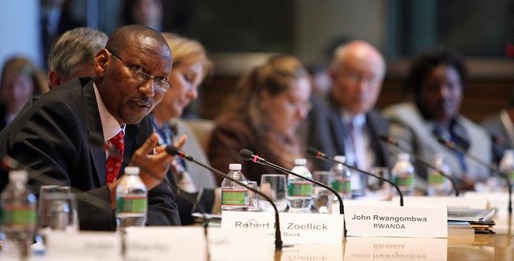
To what extent has the Rwandan economy recovered from the impact of the shortfall in donor funding?
In 2013, we started feeling the challenges of reduced government spending because government is a big player in this economy. Any reduced government spending affects different parts of the economy. Achieving 5.7% and 6% growth in the first two quarters of 2013, I would say, was good compared to the challenges that we had experienced. We are now waiting for the statistics of the third quarter, but I do not expect much difference from that.
However, we do see a turning point in the economy in the fourth quarter in terms of the increase in credit to the private sector. […] We also expect to see trade going up, financial services going up. It shows that we have reached a turning point from the effects of delayed disbursement [of aid] in 2012 and in 2013. We are likely to see growth going back to normal.
The central bank has been easing the interest rate it charges to commercial banks over the past few months as a signal to banks to lower rates. Rates have come down but not as much as the central bank sought. Where do we go from here?
We have started seeing positive signs as we had expected. When we reduce our Key Repo Rate (KRR), normally it is the money markets or short-term interest rates that follow immediately and this is what we saw happening.
In June 2013, when we reduced the policy rate from 7.5% to 7%, we saw the treasury bill interest rates moving from 10.81% in June to 6.06% in November 2013 and the repo rates going down from 6.68% to 4.42% between June and November 2013. We also saw the deposit rate dropping from 10.6% to 8.5% between June and November 2013.
All these factors are playing into influencing the movement of the lending rates, but this happens with a time lag because by the time the deposit starts going down, banks still have expensive deposits that they took before the decline of deposit interest rates. The lending rates also slightly reduced from 17.6% in June to 17.19% in November 2013. This is a good sign.
In addition, banks have been responding to the change in the KRR. We have seen a pick-up in lending to the private sector. New authorised loans are thus likely to hit RWF145.9bn ($221m) in the fourth quarter 2013, compared to RWF116.16bn issued in the fourth quarter of 2012. This might be the highest ever in recent years.
