
News
Obama in final speech to U.N. calls for world ‘course correction’
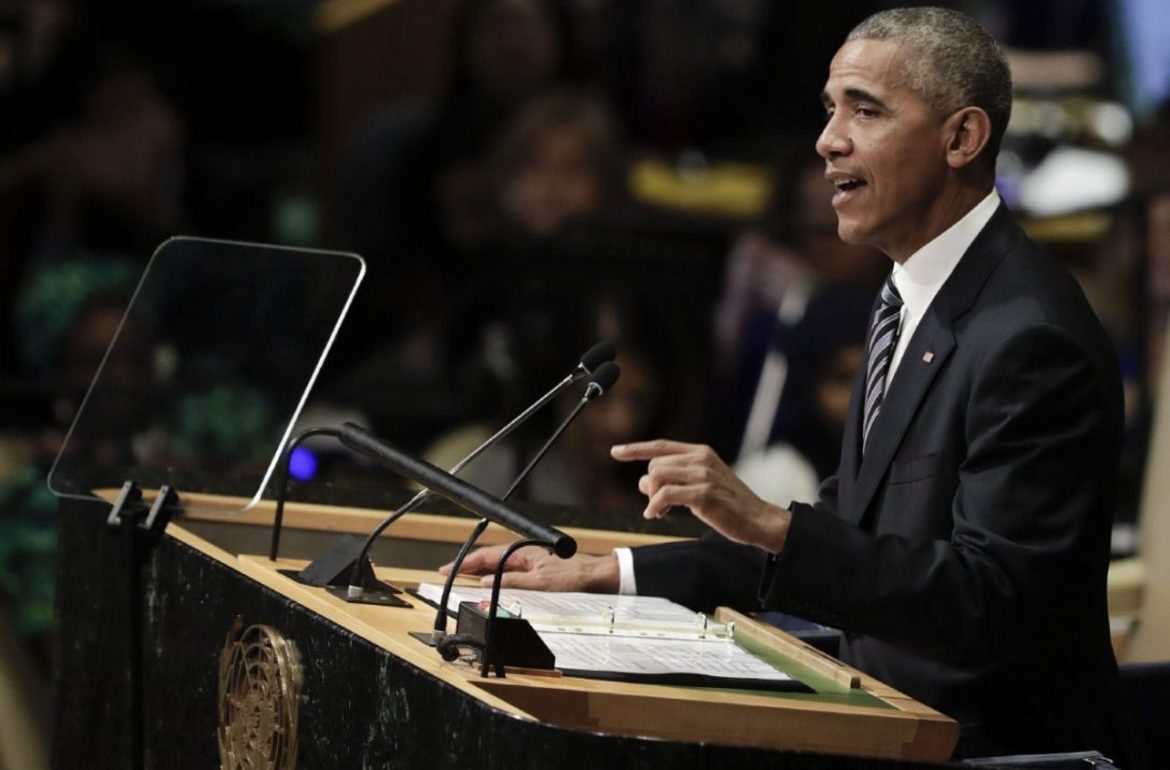
Obama uses his last appearance before the U.N. to define how his leadership has put the world on a better trajectory.
U.S. President Barack Obama conceded Tuesday that the United States and other world powers have limited ability to solve the most profound challenges facing the world, while calling for a “course correction” for globalization to ensure that nations do not retreat into a more sharply divided world.
Obama, in his final speech to the U.N. General Assembly, acknowledged that the extremist and sectarian violence wreaking havoc in the Middle East and elsewhere “will not be quickly reversed.” Still, he stuck faithfully to his insistence that diplomatic efforts and not military solutions are the key to resolving Syria’s civil war and other conflicts.
“If we are honest, we know that no external power is going to be able to force different religious communities or ethnic communities to coexist for long,” Obama said. “Until basic questions are answered about how communities coexist, the embers of extremism will continue to burn. Countless human beings will suffer.”
In a less-than-subtle jab at Donald Trump, the Republican running to replace him, Obama said, “The world is too small for us to simply be able to build a wall and prevent (extremism) from affecting our own societies.”
Tough talk
The president was unabashed in his critique of Russia as he laid out his diagnosis of the world’s ills. Obama’s long-standing differences with Russian President Vladimir Putin over his actions in Ukraine have accompanied intense disagreement over Syria’s future and a series of failed attempts by Russia and the U.S. to resolve the civil war there together.
“In a world that left the age of empire behind, we see Russia attempting to recover lost glory through force,” Obama said.
The tough talk about Russia illustrated how little progress has been made in reconciling the diverging interests among the 2 powers that has allowed the Syria crisis to continue to fester. A year ago, Obama stood at the same podium and declared anew that Syrian President Bashar Assad must leave power, while Putin gave a dueling speech warning it would be a mistake to abandon Assad.
In the year since, Moscow’s leverage in the conflict has strengthened significantly. Russia’s military intervention in Syria has helped bolster Assad’s standing without pulling it into the military “quagmire” that Obama had predicted.
Obama sought to use his last appearance before the global body to define how his leadership had put the world on a better trajectory over the last 8 years. At the heart of that approach, Obama said, is the notion that the biggest conflicts are best solved when nations co-operate rather than tackle them individually.
It is a theme that Democrat Hillary Clinton has put at the forefront of her campaign for president, casting herself as the natural continuation of Obama’s legacy. In another apparent reference to Trump, Obama bemoaned how terrorist networks had spread their ideology on social media, spurring anger toward “innocent immigrants and Muslims.”
Obama lamented that the world has become safer and more prosperous at the same time that nations are struggling with a devastating refugee crisis, terrorism and a breakdown in basic order in the Middle East. He said governing had become more difficult as people lose faith in public institutions and tensions among nations spiral out of control more rapidly.
“This is the paradox that defines the world today,” Obama said. “We must go forward, and not backward.”
The president cited his administration’s outreach to former adversaries Cuba and Myanmar as key examples of progress, along with global co-operation to cut emissions blamed for global warming. At the same time, he said he sought not to “whitewash” challenges across the globe, some of which he attributed to deepening anxieties about the profound shifts inflicted by technology and growing international interdependence.
“In order to move forward though, we do have to acknowledge that the existing path to global integration requires a course correction,” Obama said.
Obama also called on wealthier nations to do more to help millions of refugees find new homes and asked all leaders to imagine what it would be like “if the unspeakable happened to us.”
Obama offered praised for nations “right now that are doing the right thing” to help ease the largest refugee crisis since the 2nd World War. But he said many countries, “particularly those blessed with wealth and the benefits of geography,” can do more to offer assistance to more than 65 million people who have fled their homes because of war or persecution or to seek a better life.
Copyright 2016 The Associated Press
