
Business
Industrial engineer develops indoor mini-farms to beat climate change
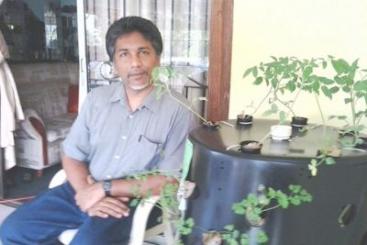
A POC competition is now open that will run until the end of March. “After that date the applications will be evaluated. We are looking for ideas that can be commercialized and the plan is to select the best ideas,” Hanson said. The CCIC, which is jointly managed by the Scientific Research Council in Jamaica and the Caribbean Industrial Research Institute in Trinidad and Tobago, is seeking projects that focus on water management, resource use efficiency, energy efficiency, solar energy, and sustainable agribusiness.
Bhagwandeen entered the POC competition in hopes of securing a grant, because “this POC funding would help in terms of market testing,” he explained. The 48-year-old engineer says he wishes to build dozens of model units and “distribute them in various areas, then monitor the operations and take feedback from users.” He said he would be testing for usability and reliability, as well as looking for feedback on just how much light is needed and the best locations in a house or building for situating his model.
“I would then take the feedback, and any issues that come up I can refine before going into mass marketing,” he said. Bhagwandeen’s model would enable homeowners to grow leafy vegetables, including herbs, lettuce and tomatoes, inside their home or apartment, with minimal expense and time.
The model uses smart electronics, meaning that 100 units can run on the same energy as a 60-watt light bulb, he said. So it differs from typical hydroponics systems that consume a great deal of energy, he added. His model can also run on the energy provided by its own small solar panel and can work both indoors and outdoors.
Bhagawandeen said his model’s design is premised on the fact that “our future as a people is based more and more on city living and in order for that to be sustainable, we need to have city farming at a family level.” A U.N. report says that “the population living in urban areas is projected to gain 2.6 billion, passing from 3.6 billion in 2011 to 6.3 billion in 2050.” Most of that urban growth will be concentrated in the cities and towns of the world’s less developed regions.
To meet the challenges of climate change adaptation, the CCIC “will support Caribbean entrepreneurs involved in developing locally appropriate solutions to climate change.” Bhagwandeen said that support from organisations like the CCIC is critical for climate change entrepreneurs. “From the Caribbean perspective, especially Trinidad and Tobago, we are a heavily consumer-focused society. One of the negatives of Trinidad’s oil wealth is that we are not accustomed to developing technology for ourselves. We buy it.
