
Business
Ghana’s $3.4 Trillion Gambit: Can Mahama Turn Accra Into Africa’s Investment Capital?

By Ziad Hamoui
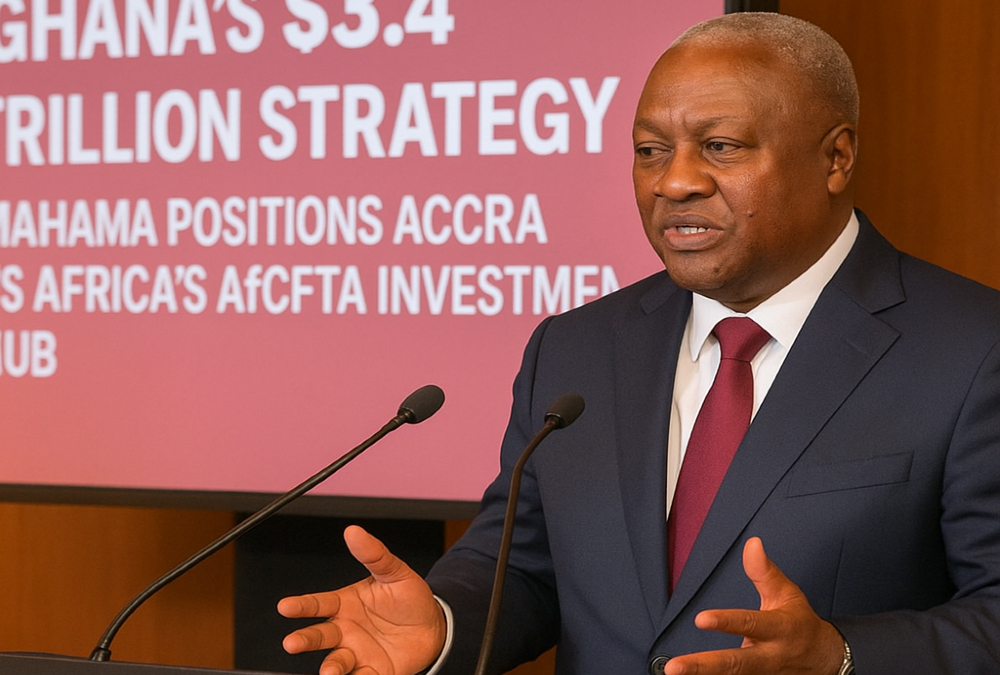
In a bold move that could reshape the economic landscape of West Africa, President John Dramani Mahama’s recent address to investors in Singapore has signaled more than just a diplomatic outreach – it’s a strategic declaration of intent. Ghana is positioning itself not merely as a participant in Africa’s economic transformation, but as its central orchestrator.
At the heart of this ambition is the African Continental Free Trade Area (AfCFTA), a US$3.4 trillion economic opportunity poised to become the world’s largest free trade zone by member count. With the AfCFTA Secretariat headquartered in Accra, Ghana is leveraging its institutional advantage to transform the capital into Africa’s premier investment gateway.
This isn’t aspirational rhetoric. It’s backed by tangible momentum.
Over the past four years, trade between Singapore and Africa has surged by 50 percent, reaching US$14 billion in 2024. Within that figure, Singaporean investment in Ghana has exceeded US$2 billion, channeled through 69 registered companies in sectors ranging from agribusiness to fintech and renewable energy.
This deepening partnership – forged through stability, transparency, and strategic alignment – provides the credibility Ghana needs to scale its ambitions continent-wide.
Accra as Africa’s Trade Nexus: Geography Meets Strategy
President Mahama’s pitch in Singapore centered on a transformative concept: the “24-Hour Economy.” This isn’t just about longer working hours – it’s a comprehensive blueprint to operationalize round-the-clock logistics, manufacturing, and agricultural value chains.
By streamlining port operations, digitizing customs clearance, and incentivizing off-peak industrial activity, Ghana aims to become the continent’s most efficient trade node.
From our vantage point at Borderless Alliance and Tarzan Enterprise Ltd – organizations deeply embedded in cross-border trade and regional integration – this strategy marks a turning point. For years, we’ve emphasized that Africa’s greatest barrier to investment isn’t a lack of resources, but a lack of predictability.
Fragmented regulations, inconsistent customs enforcement, and unreliable infrastructure have long deterred scalable investment.
Ghana’s new approach directly addresses these pain points. As host of the AfCFTA Secretariat, Accra is uniquely positioned to harmonize standards, reduce compliance friction, and serve as a de facto logistics and legal hub for pan-African commerce.
Think of it as Africa’s Singapore – a neutral, well-governed nexus where regional supply chains converge, compliance is simplified, and risk is minimized.
Beyond Infrastructure: The Financial Architecture of Growth
But infrastructure and geography alone won’t win the day. What sets this strategy apart is its emphasis on blended finance and risk mitigation.
President Mahama understands that unlocking private capital requires more than roads and ports – it demands innovative financial instruments, public-private partnerships, and technology transfer. By partnering with global financial institutions and leveraging diaspora investment, Ghana is building a financial ecosystem that can absorb shocks and attract long-term capital.
This financial engineering is critical. For multinational investors, the real hurdle has never been market potential – it’s the complexity of navigating 54 different regulatory regimes.
Ghana’s role as a policy incubator under the AfCFTA framework allows it to pilot harmonized trade protocols, dispute resolution mechanisms, and credit enhancement tools that de-risk investment across borders.
In essence, Accra isn’t just offering access to a market – it’s offering a platform for scaling across Africa with reduced friction and greater confidence.
A Regional Ripple Effect: Will ECOWAS Follow Suit?
The implications extend far beyond national borders. If successful, Ghana’s model could catalyze deeper integration across ECOWAS, turning West Africa into a unified economic bloc capable of competing on the global stage.
Other member states now face a choice: follow Ghana’s lead in regulatory harmonization and infrastructure modernization, or risk being left behind in the new era of African trade.
Already, regional interest is mounting. Discussions around joint customs frameworks and cross-border special economic zones are gaining traction.
But leadership matters – and Accra’s combination of political stability, institutional credibility, and strategic vision gives it a first-mover advantage.
Make no mistake – Ghana is open for business again. But this time, it’s not just selling commodities or tax incentives.
It’s offering a vision: a digitally enabled, investor-friendly, AfCFTA-powered economic hub where the continent’s future is built one scalable enterprise at a time.
The question is no longer whether Africa can integrate its markets. The real question is: who will lead that integration?
Accra is betting it’s time to claim the crown.
Ziad Hamoui is the Co-Founder and Past President of the Borderless Alliance, a leading private-sector advocacy group promoting economic integration and removing trade and transport barriers in West Africa. With extensive experience in Ghana’s road transport, logistics, and shipping sectors, he currently serves as Executive Director of Tarzan Enterprise Ltd., a long-established family business. He is Co-Chair of the Africa Food Trade Coalition, Co-Founder of the Trade Facilitation Coalition for Ghana, and serves on multiple high-level advisory committees on trade, transport, agriculture, and security. A Chartered Fellow of the Chartered Institute of Logistics and Transport (CILT) Ghana, he is also a former member of its Governing Council.
