
Business
East and West Africa Power Africa’s Fastest-Growing Economies


By Des H Rikhotso
As global investors and multilateral institutions turn their gaze toward emerging growth corridors, East and West Africa are no longer just hopeful regions – they are the undisputed engines of Africa’s next economic renaissance.
According to the International Monetary Fund’s (IMF) latest World Economic Outlook projections for 2025–2026, East Africa is on track to become the continent’s fastest-growing region, with West Africa closely trailing. Together, these two dynamic blocs account for seven of the top ten fastest-growing economies in Africa – driven by bold reforms, strategic investments, and an accelerating demographic dividend.
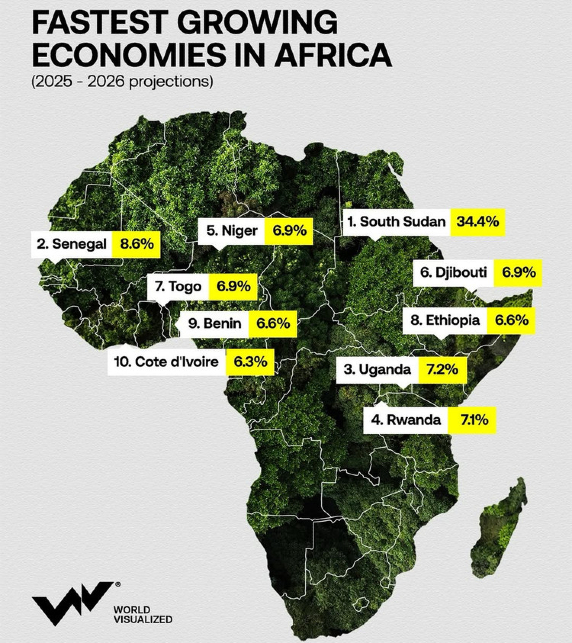
The IMF’s top 10 fastest-growing African economies for 2025–2026 underline this trend:
- South Sudan: +34.4 percent
- Senegal: +8.6 percent
- Uganda: +7.2 percent
- Rwanda: +7.1 percent
- Niger: +6.9 percent
- Djibouti: +6.9 percent
- Togo: +6.9 percent
- Ethiopia: +6.6 percent
- Benin: +6.6 percent
- Ivory Coast: +6.3 percent
While South Sudan’s staggering projected growth – nearly one-third – is largely attributable to post-conflict reconstruction and oil sector recovery, the broader trend reveals something more profound: a continent-wide shift toward institutional resilience, private-sector dynamism, and smart policy design.
The Drivers Behind the Surge
What separates these high-growth nations from stagnant peers isn’t luck – it’s strategy.
- Structural Reforms and Fiscal Discipline
Countries like Rwanda and Ghana have earned global praise for transparent governance, digitized public services, and debt management frameworks that attract foreign capital without compromising sovereignty. Rwanda’s e-government platform, for instance, ranks among the world’s most efficient, slashing bureaucratic delays and boosting investor confidence. - Strategic Infrastructure Investment
From Djibouti’s port-led industrial zones to Ivory Coast’s new highways and power grids, infrastructure is no longer an afterthought – it’s the foundation of growth. These projects are not merely construction feats; they’re economic multipliers, linking rural producers to urban markets and regional trade hubs. - Abundant Natural Resources, Managed Wisely
Niger’s uranium boom, Senegal’s offshore gas discoveries, and Ethiopia’s hydroelectric potential illustrate how resource-rich nations are moving beyond extraction toward value addition. The key? Local content laws, joint ventures with global partners, and sovereign wealth funds designed to cushion volatility. - Human Capital Development
Education and skills training are finally taking center stage. Kenya’s tech-savvy youth population, Benin’s expanding vocational academies, and Uganda’s push for STEM education are creating a workforce ready for Industry 4.0 – not just subsistence agriculture. - The Power of Convergence
Perhaps most critically, these economies are leveraging “technological convergence” – the ability to leapfrog outdated systems by adopting proven innovations from advanced economies. Mobile money (think M-Pesa), AI-driven agritech platforms, and solar microgrids are being deployed at scale, bypassing decades of legacy infrastructure investment.
Beyond the Headlines: A Deeper Narrative
It’s tempting to reduce this growth to commodity cycles or donor aid – but that misses the point. What’s unfolding across East and West Africa is a quiet revolution in state capacity and entrepreneurial spirit.
Take Togo: once dismissed as politically fragile, it now ranks among Africa’s top reformers in ease of doing business. Or Senegal, where democratic stability and green energy investments have made it a beacon for ESG-focused investors.
This isn’t about “Africa rising.” It’s about specific African nations rising – through agency, not aspiration.
The Road Ahead: Challenges Remain
Growth alone doesn’t guarantee shared prosperity. Inflation, currency volatility, youth unemployment, and climate vulnerability still threaten hard-won gains.
But what’s clear is this: the playbook for sustainable development in Africa is no longer theoretical. It’s being written daily – in Kigali’s tech hubs, Abidjan’s fintech startups, and Addis Ababa’s manufacturing parks.
For global policymakers, investors, and multilateral institutions: the opportunity isn’t hypothetical.
It’s here. And the leaders who act decisively will shape the next chapter of global economic growth – not just observe it.
Des H Rikhotso (PgDip-BA, MBL) is a seasoned C-suite Multi-Industry business executive with 25+ years of Business Leadership Experience across the South, East and Western Sub-Sahara Africa Region. Based in Kampala, Uganda he serves as East Africa Region Business Executive, driving Business Strategic Growth and Operational Excellence – contributing his Leadership Voice and Clarity to the Region. Des has held Business Leadership roles at BMW Group Africa, Volkswagen Group Africa, Peugeot Motors South Africa, Toyota/Lexus South Africa, Nissan Group of Africa, G.U.D Holdings (Africa Exports Operations Division) and The HDR Group of Companies. He holds Under-Graduate and Post-Graduate business degrees from the University of the Western Cape, Wits University (Wits Business School) and the University of South Africa.
